
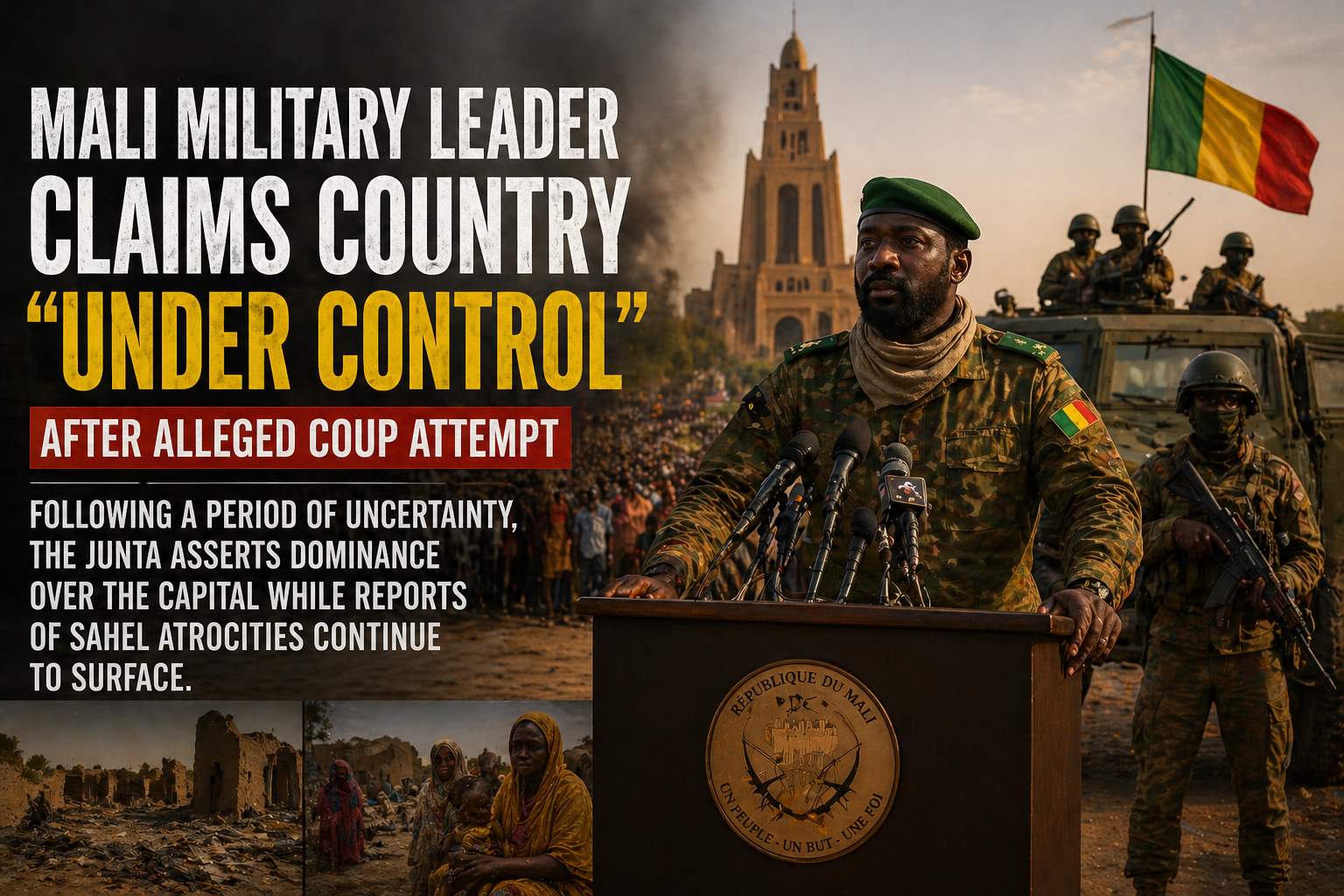
Junta asserts dominance over Bamako as coordinated insurgent strikes and reports of Sahel atrocities underscore regional instability.
April 30, 2026
By Staff Writer, Global War News
Mali’s military transition leader, Colonel Assimi Goïta, made his first public appearance on Tuesday since a wave of coordinated insurgent attacks struck the capital and key military installations over the weekend. In a televised address, Goïta insisted that the security situation in the West African nation is “under control,” despite what Russian state-controlled media and local reports have described as a thwarted coup attempt.
The violence, which began on Saturday, April 25, involved synchronized assaults by Al-Qaeda-affiliated militants (JNIM) and Tuareg-led separatist groups. These forces targeted the main military base in Kati, the airport area in Bamako, and several strategic positions in the north. Reuters reported that Mali’s Defence Minister, Sadio Camara, was killed during the Saturday attacks, a significant blow to the junta’s leadership circle.
The Russian Ministry of Defence stated on Tuesday that its forces, operating under the “Africa Corps” banner, were instrumental in repelling the insurgents and preventing the seizure of the presidential palace. While the government claims victory, independent verification of the full scale of the “coup attempt” remains limited, as state communications have offered few specific details regarding the identities of the alleged conspirators.
Context and Background
Mali has been governed by military leaders since two successive coups in 2020 and 2021. The current administration under Colonel Goïta rose to power promising to restore security in a country that has struggled with extremist insurgencies for over 14 years. After expelling French and UN peacekeeping forces (MINUSMA) in 2023, Bamako turned toward Russia and its paramilitary organizations for security assistance.
This weekend’s attacks represent an unprecedented breach of security in the capital, which had previously remained relatively insulated from the high-intensity combat seen in northern and central Mali. The loss of the northern strategic hub of Kidal to separatist rebels during this same period further highlights the challenges facing the Malian Armed Forces (FAMa) and their Russian partners.
Analysis: What This Could Mean
The reported killing of the Defence Minister and the requirement for Russian intervention to secure the presidential palace suggest a high level of vulnerability within the Malian state apparatus. Analysts note that the “coup attempt” narrative serves a dual purpose: it explains the presence of internal dissent while justifying a more aggressive crackdown on perceived political and military rivals in the coming weeks.
Furthermore, the simultaneous push by JNIM and Tuareg separatists indicates a level of tactical coordination, or at least opportunistic timing—that complicates the military’s “neutralization” strategy. If the government cannot secure the capital without direct foreign paramilitary support, it raises questions about the long-term viability of the junta’s independent security doctrine.
Humanitarian and Economic Impact
Beyond the immediate combat, international human rights monitors continue to flag reports of atrocities across the Sahel. The Sentry, an independent research institution, recently reported an escalation in incidents including summary executions and torture, particularly in northern Mali and along the Mauritanian border. These abuses are reportedly linked to both insurgent groups and counter-terrorism operations involving Africa Corps.
The instability has also triggered severe economic disruptions. The U.S. Embassy in Bamako issued security alerts advising citizens to shelter in place, effectively halting international business travel and diplomatic operations. Trade routes connecting Bamako to regional ports are increasingly under threat, which observers note will likely exacerbate food insecurity and inflation for the civilian population.
Closing
While the streets of Bamako are reportedly quiet under a heavy military presence and a newly imposed curfew, the situation remains fluid. The international community, including UN Secretary-General António Guterres, has expressed “deep concern” over the escalation. The coming days will determine whether Goïta’s “under control” declaration marks a return to stability or merely a pause before further internal and external challenges to his authority.
Source Disclosure Note: Reporting based on official statements from the Malian Presidency, the Russian Ministry of Defence, and the United Nations. Factual details cross-referenced with reporting from Reuters, France 24, Al Jazeera, and investigative briefs from The Sentry.
This article is based on publicly available reporting from named international news agencies and attributed official statements. All claims about ongoing events are attributed to their original sources. Analysis sections represent the editorial interpretation of reported facts and do not constitute advocacy for any party to the described conflict. AI tools may be utilized for image generation to assist in explaining complex concepts, as well as for refining grammar, spelling, and other linguistic enhancements. However, all original content is produced, fact-checked, and revised by the editorial team. This publication does not take political positions on active military conflicts.