
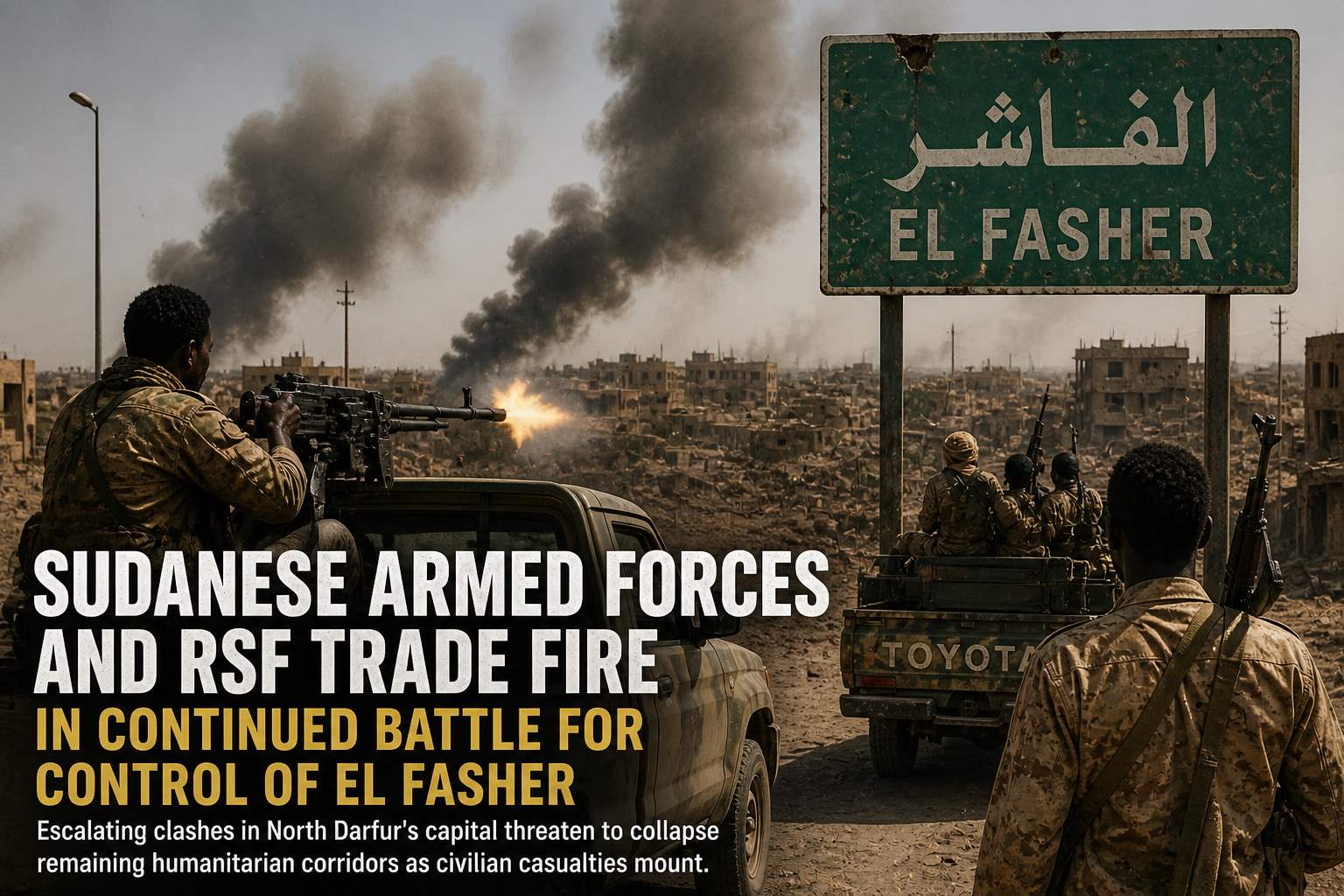
Escalating clashes in North Darfur’s capital threaten to collapse remaining humanitarian corridors as civilian casualties mount.
May 4, 2026
Last Updated: May 4, 2026
By Staff Writer, Global War News
Heavy fighting has reportedly resumed between the Sudanese Armed Forces (SAF) and the Rapid Support Forces (RSF) in and around El Fasher, the capital of North Darfur. According to local reports and satellite imagery analysis, both factions have engaged in sustained artillery exchanges and close-quarters urban combat over the last 72 hours. The city, which remains the last major SAF stronghold in the Darfur region, has become the focal point of a conflict now entering its fourth year.
International monitoring groups, including the United Nations and the International Organization for Migration (IOM), have reported a significant surge in civilian displacement from the city’s outskirts. In a statement released on May 1, the IOM noted that thousands of individuals are attempting to flee toward the eastern states and neighboring Chad, though many remain trapped by active skirmishes on the city’s primary exit routes.
The Sudanese Armed Forces stated via their official social media channels that they had repelled several RSF incursions into the city’s central military district. Conversely, spokesmen for the RSF claimed to have secured new positions in the northern neighborhoods of El Fasher. Neither claim has been independently verified by international observers due to the high risk to journalists and aid workers on the ground.
A City Under Siege
El Fasher has been under a varying state of siege since the conflict began in April 2023. As the administrative heart of North Darfur, its control is essential for managing the flow of aid and trade across western Sudan. According to a February 2026 report by the UN Fact-Finding Mission for Sudan, the protracted siege has led to “conditions of life calculated to bring about destruction,” citing acute starvation and a systematic denial of medical supplies.
The current escalation follows a series of reports from the UN Human Rights Office (OHCHR) detailing widespread atrocities in the region. Verified data from early 2026 confirms that previous RSF offensives in the area resulted in thousands of deaths, with the OHCHR documenting at least 6,000 killings associated with the fall of surrounding districts.
Humanitarian and Economic Paralysis
The impact of the continued fighting extends far beyond the battlefield. Economically, Sudan has seen a catastrophic collapse, with the International Monetary Fund (IMF) and World Bank projecting a GDP contraction of over $15 billion compared to pre-war levels. The agricultural sector, which once supported nearly 40% of the national income, has been decimated by the insecurity in Darfur and the Kordofan regions.
Food security has reached a critical breaking point. The World Food Programme (WFP) estimates that as of May 2026, approximately 33.7 million Sudanese people, more than 60% of the population, require urgent humanitarian assistance. In El Fasher specifically, the cost of basic commodities has reportedly tripled as the RSF maintains a “chokehold” on supply lines, according to reports from Al Jazeera and regional news outlets.
Analysis: The Risk of De Facto Partition
Analysts have suggested that the battle for El Fasher represents more than a tactical military objective; it is a fight for the political future of Sudan. Observers note that if the SAF loses control of North Darfur’s capital, the country faces a heightened risk of de facto partition, with the RSF controlling the majority of the west and the SAF consolidating power in the east and along the Red Sea coast.
The “Joint Forces”, a coalition of armed movements that were signatories to the 2020 Juba Peace Agreement, have increasingly sided with the SAF to defend the city. This alliance, while strengthening the city’s immediate defenses, raises questions about the long-term stability of Darfur’s ethnic and political landscape. Without a mediated ceasefire, observers warn that the conflict could transform into a permanent, low-intensity civil war characterized by regional fragmentation.
Current Standing
As of today, the frontline in El Fasher remains highly volatile. Humanitarian agencies continue to call for an immediate cessation of hostilities to allow for the safe passage of civilians and the delivery of life-saving aid. While international diplomatic efforts remain stalled, the tactical situation on the ground suggests that neither side is currently willing to commit to a truce while the strategic prize of North Darfur remains contested.
Source Disclosure:
Factual claims regarding the military situation are based on official statements from the SAF and RSF, as well as reporting from Reuters and Al Jazeera. Humanitarian data and displacement figures are sourced from the UN Human Rights Office (OHCHR), the International Organization for Migration (IOM), and the World Food Programme (WFP). Economic projections are based on reports from the IMF and World Bank.
This article is based on publicly available reporting from named international news agencies and attributed official statements. All claims about ongoing events are attributed to their original sources. Analysis sections represent the editorial interpretation of reported facts and do not constitute advocacy for any party to the described conflict. AI tools may be utilized for image generation to assist in explaining complex concepts, as well as for refining grammar, spelling, and other linguistic enhancements. However, all original content is produced, fact-checked, and revised by the editorial team. This publication does not take political positions on active military conflicts.