
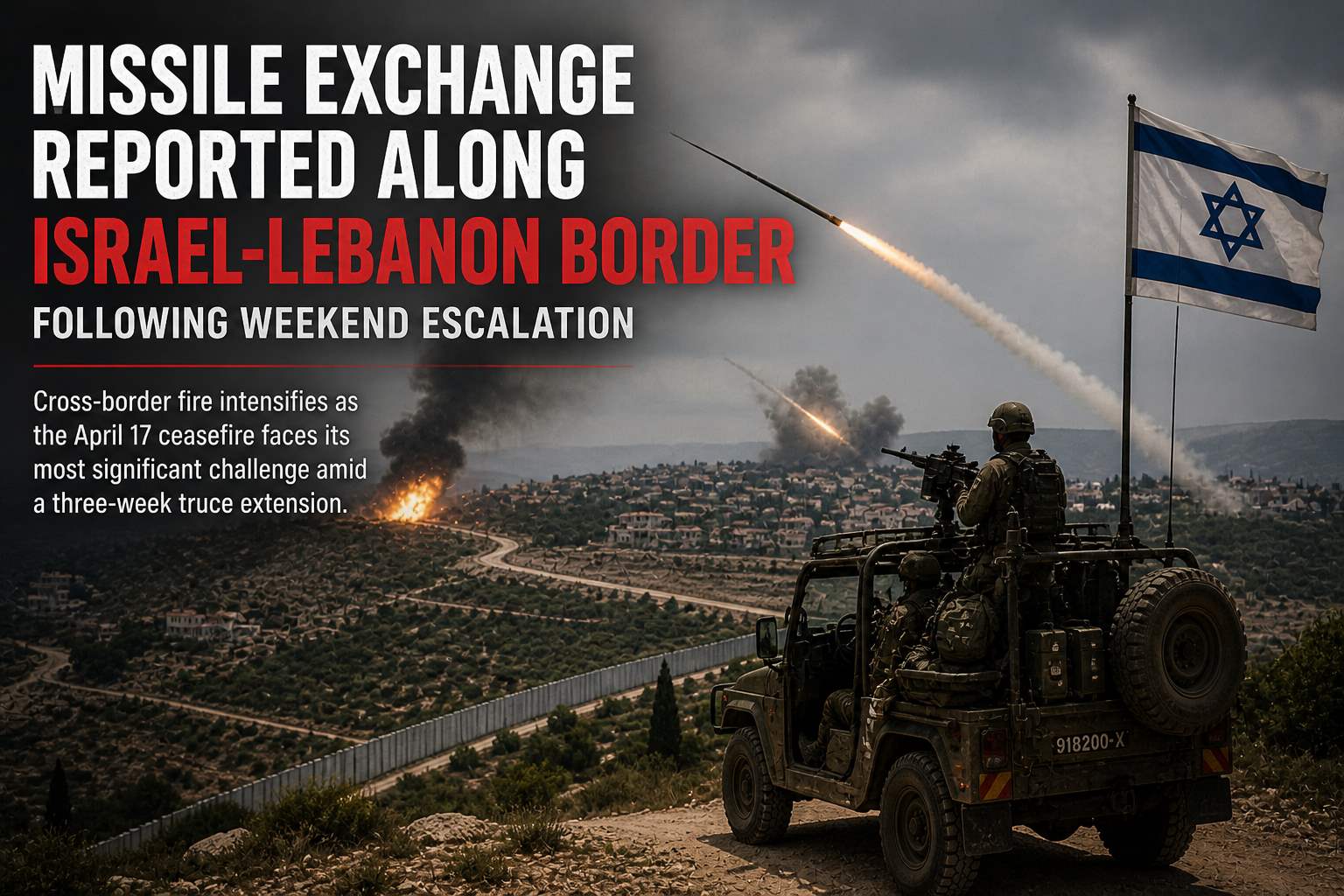
Cross-border fire intensifies as the April 17 ceasefire faces its most significant challenge amid a three-week truce extension.
May 4, 2026
Last Updated: May 4, 2026
By Staff Writer, Global War News
A heavy exchange of missile and drone fire was reported along the Israel-Lebanon border over the last 48 hours, threatening the stability of a U.S.-brokered ceasefire that took effect on April 17. According to official statements from the Israel Defense Forces (IDF), the military conducted a series of strikes targeting approximately 50 sites in southern Lebanon. The IDF characterized these operations as a response to “ceasefire violations” by Hezbollah, specifically citing the launch of explosive drones and rockets toward northern Israeli military positions.
Hezbollah issued several statements through its media wing on Sunday, claiming to have targeted Israeli soldiers and command centers in the border region. The group described its actions as “defensive responses” to Israeli incursions and the use of bulldozers to dismantle civilian and religious infrastructure in border villages such as Yaroun. While both sides have engaged in skirmishes since the truce began, the scale of this weekend’s artillery and missile exchange marks a distinct escalation in kinetic activity.
The Lebanese state-run National News Agency (NNA) reported that Israeli airstrikes on Friday and Saturday resulted in at least four deaths in southern villages, including a Lebanese soldier identified as Ali Jaber. The IDF has also issued fresh evacuation warnings for several southern Lebanese villages, including Qana and Srifa, instructing residents to move at least one kilometer away from what it identified as “terror infrastructure.”
The “Yellow Line” and the Three-Week Extension
The current hostilities come during a critical phase of the 2026 Lebanon War, which began in early March following regional escalations linked to the broader conflict with Iran. On April 23, U.S. President Donald Trump announced that the initial 10-day ceasefire would be extended for an additional three weeks to facilitate direct peace negotiations between the Israeli government and Lebanese authorities.
According to a United Nations Security Council report from early May, the ceasefire terms allow Israel to “preserve its right to take necessary measures in self-defense” while prohibiting offensive military operations. However, the lack of a formal signature from Hezbollah, which maintains a significant military presence south of the Litani River, has left the agreement fragile. Analysts note that the current “tit-for-tat” missile exchanges are testing the limits of these self-defense clauses.
Humanitarian and Economic Consequences
The conflict has brought Lebanon to the brink of institutional and economic collapse. According to data from the Integrated Food Security Phase Classification (IPC) released on April 29, approximately 1.24 million people in Lebanon are now facing high levels of acute food insecurity. The renewed fighting and large-scale displacement have erased modest economic gains made earlier in the year, with inflation returning to double digits as supply lines are severed.
- Displacement: Over one million people remain internally displaced in Lebanon, with OCHA reporting that 87% are living in informal settings or rented accommodations rather than organized shelters.
- Economic Output: Lebanon’s GDP growth for 2026 has been “effectively neutralized” by the war, according to a strategic comparison by economic analysts. The country’s debt-to-GDP ratio has soared to approximately 144%.
- Infrastructure: The destruction of medical clinics and schools in the border regions has severely limited the state’s ability to provide basic services, further increasing dependence on international aid.
Analysis: The Risk of an Uncontrolled Slide
Observers suggest that the current escalation is a strategic “pressure test” by both sides. For Hezbollah, the drone and rocket strikes demonstrate that its operational capacity remains intact despite weeks of Israeli ground operations. For the IDF, the strikes on 50 targets in a 24-hour period signal that it will not tolerate the regrouping of militants near the “buffer zone” established in March.
This cycle of retaliatory fire raises the risk of a “miscalculation” that could lead to a full-scale resumption of the ground war before the current three-week extension expires. Analysts note that without a mechanism to enforce Hezbollah’s compliance with the ceasefire, the diplomatic path toward a permanent peace agreement remains obstructed by the reality of continued tactical engagements.
Current Standing
As of Monday morning, May 4, the IDF continues to maintain a high state of alert in the north, while the Lebanese government has called for international intervention to prevent the collapse of the truce. Operation Freedom, a U.S.-led effort to escort merchant vessels in the region, is also set to begin today, adding another layer of complexity to the regional security landscape. The ability of mediators to de-escalate the border situation this week will likely determine whether the April ceasefire survives its intended duration.
Source Disclosure:
Factual claims regarding military strikes and casualties are based on statements from the IDF, the Lebanese National News Agency (NNA), and reports from the Associated Press (AP) and Xinhua. Humanitarian and economic data were sourced from the UN Office for the Coordination of Humanitarian Affairs (OCHA), the IPC, and the UN Security Council’s May 2026 forecast. Regional context was provided by Al Jazeera and The Times of Israel.
This article is based on publicly available reporting from named international news agencies and attributed official statements. All claims about ongoing events are attributed to their original sources. Analysis sections represent the editorial interpretation of reported facts and do not constitute advocacy for any party to the described conflict. AI tools may be utilized for image generation to assist in explaining complex concepts, as well as for refining grammar, spelling, and other linguistic enhancements. However, all original content is produced, fact-checked, and revised by the editorial team. This publication does not take political positions on active military conflicts.