
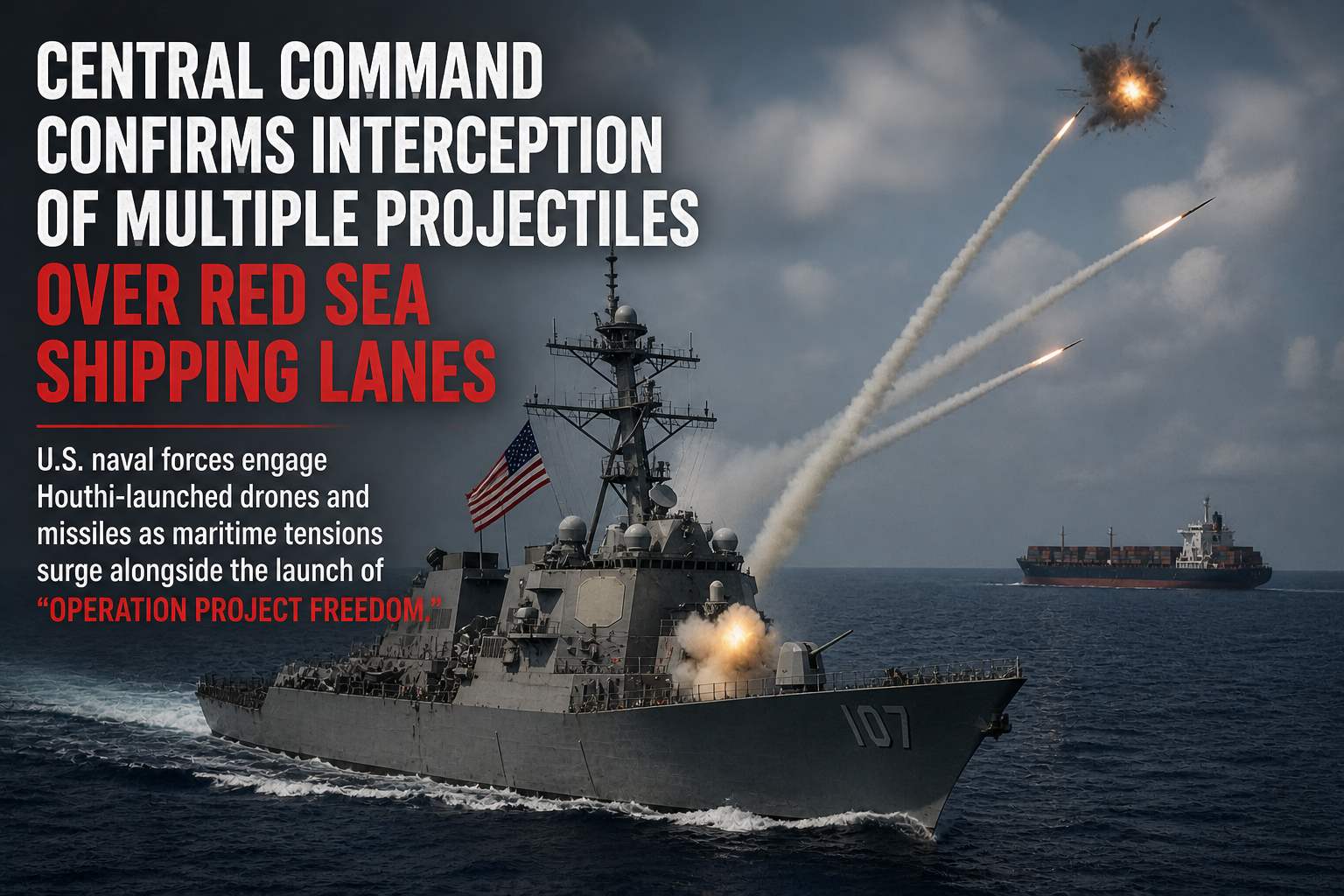
U.S. naval forces engage Houthi-launched drones and missiles as maritime tensions surge alongside the launch of “Operation Project Freedom.”
May 4, 2026
Last Updated: May 4, 2026
By Staff Writer, Global War News
U.S. Central Command (CENTCOM) confirmed today that naval assets stationed in the Red Sea successfully intercepted a series of projectiles launched from Houthi-controlled territories in Yemen. According to an official statement released on Monday morning, the guided-missile destroyer USS Carney and accompanying coalition aircraft engaged three one-way attack drones and two anti-ship ballistic missiles that were assessed to be on a direct path toward commercial shipping lanes in the Bab el-Mandeb strait.
CENTCOM officials stated that no injuries or damage to merchant vessels were reported in the wake of the engagement. The interceptions occurred as regional tensions reach a critical peak, following the official commencement of “Operation Project Freedom”—a U.S.-led initiative aimed at escorting neutral commercial vessels through the increasingly contested waterways of the Middle East. While the Houthi military spokesperson, Yahya Saree, has not yet issued a statement regarding this specific incident, the group has recently vowed to resume high-scale maritime operations in response to what they characterize as “Western interference” in regional waters.
The Red Sea, which typically carries approximately 12% of global trade and 30% of the world’s container traffic, has seen a marked increase in kinetic activity since late April. International maritime monitors have reported a surge in radio warnings and “near-miss” incidents, leading several major shipping conglomerates to reconsider their use of the Suez Canal route.
The Strategic Pressure on Bab el-Mandeb
The Bab el-Mandeb strait serves as the Southern gateway to the Red Sea, a narrow chokepoint that is vital for the transit of energy supplies and consumer goods between Asia and Europe. According to a strategic forecast from the UK Maritime Trade Operations (UKMTO), the frequency of attacks in this sector has transformed it from a commercial corridor into a “militarized flashpoint.”
Analysts note that the Houthi strategy in 2026 has evolved from sporadic harassment to a structured conditional deterrence. By targeting vessels near the strait, the group exerts significant leverage over global supply chains. According to data from the analytics firm Suaid Global, over 800 merchant ships remain effectively stranded in the wider region due to the dual blockades affecting both the Red Sea and the Strait of Hormuz.
Economic Ripple Effects and Freight Surges
The persistent threat of projectile attacks has forced a structural shift in global logistics. Major ocean carriers are once again diverting vessels around the Cape of Good Hope, a detour that adds approximately 3,500 nautical miles and 10 to 14 days to standard transit times. This rerouting is not merely a logistical inconvenience; it carries a profound economic cost.
- Freight Rates: Shipping rates from major Asian hubs have reportedly jumped by nearly 18% in the first week of May.
- Insurance Premiums: “War-risk” insurance premiums for the Red Sea have reached levels that industry experts describe as prohibitive for non-escorted vessels.
- Aid Delivery: The UN Refugee Agency (UNHCR) reported on May 1 that the increased freight costs have doubled the expense of delivering critical relief items from regional stockpiles to operations in Sudan and Chad.
Analysis: Escalation Cycles and Project Freedom
Observers suggest that the timing of these latest interceptions is a direct response to the rollout of “Operation Project Freedom.” The U.S. initiative, which involves over 15,000 service members and a significant carrier strike group presence, is designed to restore confidence in international waterways. However, the Houthi movement and its regional allies have signaled that they view this deployment as a ceasefire violation and a provocation.
This dynamic creates a “tit-for-tat” cycle: Western naval forces deploy to protect trade, while asymmetric forces launch low-cost drones and missiles to demonstrate the vulnerability of that protection. Analysts from the Global Security Review note that as long as the broader regional conflict remains unresolved, the Red Sea is likely to remain in a state of “fragile equilibrium” where a single successful strike could trigger a massive military retaliation.
Current Standing
As of the afternoon of May 4, 2026, U.S. and coalition forces remain on high alert. While the interceptions have successfully prevented damage to commercial hulls today, the presence of nearly 20,000 seafarers on ships “going nowhere” highlights the severity of the maritime paralysis. Diplomatic channels are reportedly open, but the tactical reality on the water suggests that the Red Sea corridor will remain a contested zone for the foreseeable future.
Source Disclosure:
Factual reporting on interceptions is based on official statements from U.S. Central Command (CENTCOM) and the UK Maritime Trade Operations (UKMTO). Economic and logistics data were sourced from the UNHCR, the IMF, and maritime analytics from Suaid Global. Regional political context was provided by The Guardian and the Associated Press (AP).
This article is based on publicly available reporting from named international news agencies and attributed official statements. All claims about ongoing events are attributed to their original sources. Analysis sections represent the editorial interpretation of reported facts and do not constitute advocacy for any party to the described conflict. AI tools may be utilized for image generation to assist in explaining complex concepts, as well as for refining grammar, spelling, and other linguistic enhancements. However, all original content is produced, fact-checked, and revised by the editorial team. This publication does not take political positions on active military conflicts.