
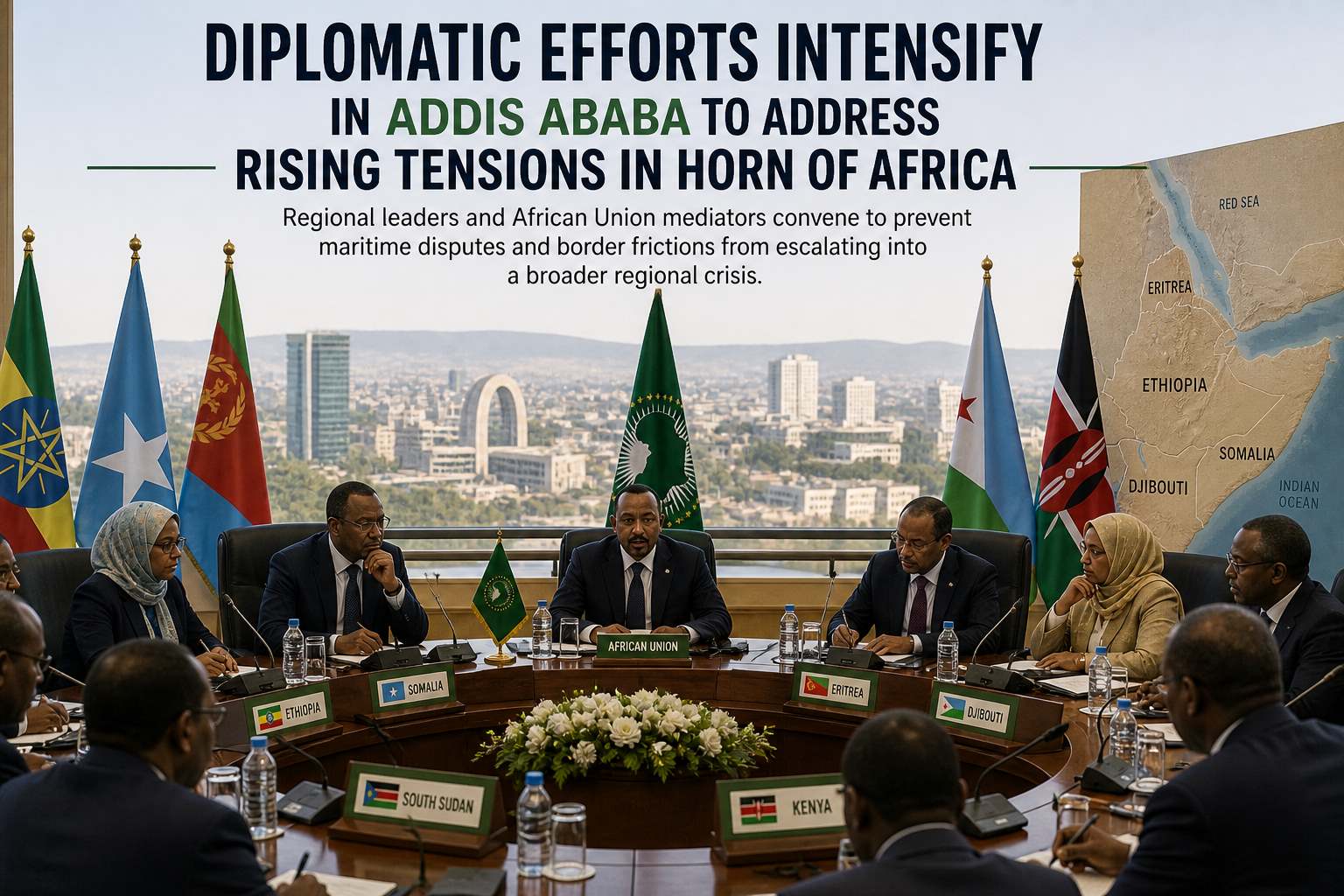
Regional leaders and African Union mediators convene to prevent maritime disputes and border frictions from escalating into a broader regional crisis.
May 4, 2026
Last Updated: May 4, 2026
By Global War News Editorial
High-level diplomatic delegations have gathered in Addis Ababa this week as the African Union (AU) launches an emergency mediation circuit aimed at de-escalating friction between Ethiopia, Somalia, and Egypt. According to official statements from the AU Commission, the talks are focused on resolving the dispute over the Memorandum of Understanding (MoU) between Ethiopia and Somaliland, as well as the ongoing technical disagreements regarding the Grand Ethiopian Renaissance Dam (GERD).
The summit follows several weeks of increased military posturing along various borders in the Horn of Africa. Somalia’s federal government has publicly stated that it views the Ethiopian naval access agreement with the breakaway region of Somaliland as an “act of aggression” and a violation of its territorial integrity. Conversely, Ethiopian officials have maintained that the deal is a purely commercial and strategic necessity for the landlocked nation’s economic survival.
United Nations representatives attending as observers have noted that the security situation is “exceptionally delicate.” Reports from the region indicate that both Somalia and Ethiopia have moved additional security units toward their shared border districts, though no direct kinetic engagements have been confirmed by independent monitors.
The Maritime Access Dispute
The primary driver of the current tension is the agreement signed in early 2024, which reportedly grants Ethiopia a 50-year lease on 20 kilometers of coastline in Somaliland in exchange for potential state recognition. According to reporting from Al Jazeera, the deal has triggered a significant shift in regional alliances, with Somalia seeking closer military ties with Egypt and Turkey to bolster its maritime defense.
The African Union’s Peace and Security Council has urged all parties to “exercise restraint and respect the principles of sovereignty and territorial integrity” as enshrined in the AU Charter. However, mediators face a significant challenge in balancing Ethiopia’s stated economic requirement for sea access with Somalia’s constitutional claim over the Somaliland territory.
Economic Impacts and Trade Vulnerability
The Horn of Africa is one of the most economically vulnerable regions in the world, with its trade heavily reliant on the stability of the Red Sea and the Gulf of Aden. The current diplomatic rift has already begun to affect local markets and international investor confidence.
- Foreign Direct Investment: According to a 2026 regional economic outlook from the African Development Bank, projected investment in Ethiopia’s manufacturing sector has slowed by 12% as companies assess the risk of regional conflict.
- Logistics Costs: Somalia has reportedly considered imposing stricter airspace and maritime transit regulations for Ethiopian-linked entities, a move that analysts say could increase logistical costs for Ethiopian imports by up to 15%.
- Food Security: The UN Food and Agriculture Organization (FAO) warned in a May statement that any military escalation would “catastrophically disrupt” grain supply chains in a region already suffering from the effects of climate-induced droughts.
Analysis: The Risk of Proxy Competition
Analysts suggest that the Horn of Africa is increasingly becoming a theater for broader geopolitical competition. Observers note that the involvement of external powers, specifically Egypt’s military cooperation agreement with Mogadishu and the Gulf States’ various port investments—has complicated the internal African Union mediation process.
This “internationalization” of the dispute means that a local border friction can quickly become a proxy conflict. Analysts from the International Crisis Group have suggested that if a diplomatic breakthrough is not achieved in Addis Ababa this month, the region could see a formal fracturing of the Intergovernmental Authority on Development (IGAD), the regional trade and security bloc.
Current Standing
As of May 4, the closed-door sessions in Addis Ababa continue. While a joint communiqué has not yet been released, the Egyptian and Somali delegations have held several bilateral meetings on the sidelines of the summit. The African Union mediators are reportedly proposing a “regional maritime framework” that would allow Ethiopia commercial port access without the controversial element of diplomatic recognition for Somaliland. Whether this middle-ground approach can satisfy the nationalist sentiments on all sides remains the central question of the week.
Source Disclosure: Factual reporting on the Addis Ababa summit is based on official statements from the African Union Commission and the Somali Ministry of Foreign Affairs. Economic data was sourced from the African Development Bank and the FAO. Regional strategic context was provided by Al Jazeera, Reuters, and reports from the International Crisis Group.
This article is based on publicly available reporting from named international news agencies and attributed official statements. All claims about ongoing events are attributed to their original sources. Analysis sections represent the editorial interpretation of reported facts and do not constitute advocacy for any party to the described conflict. AI tools may be utilized for image generation to assist in explaining complex concepts, as well as for refining grammar, spelling, and other linguistic enhancements. However, all original content is produced, fact-checked, and revised by the editorial team. This publication does not take political positions on active military conflicts.