
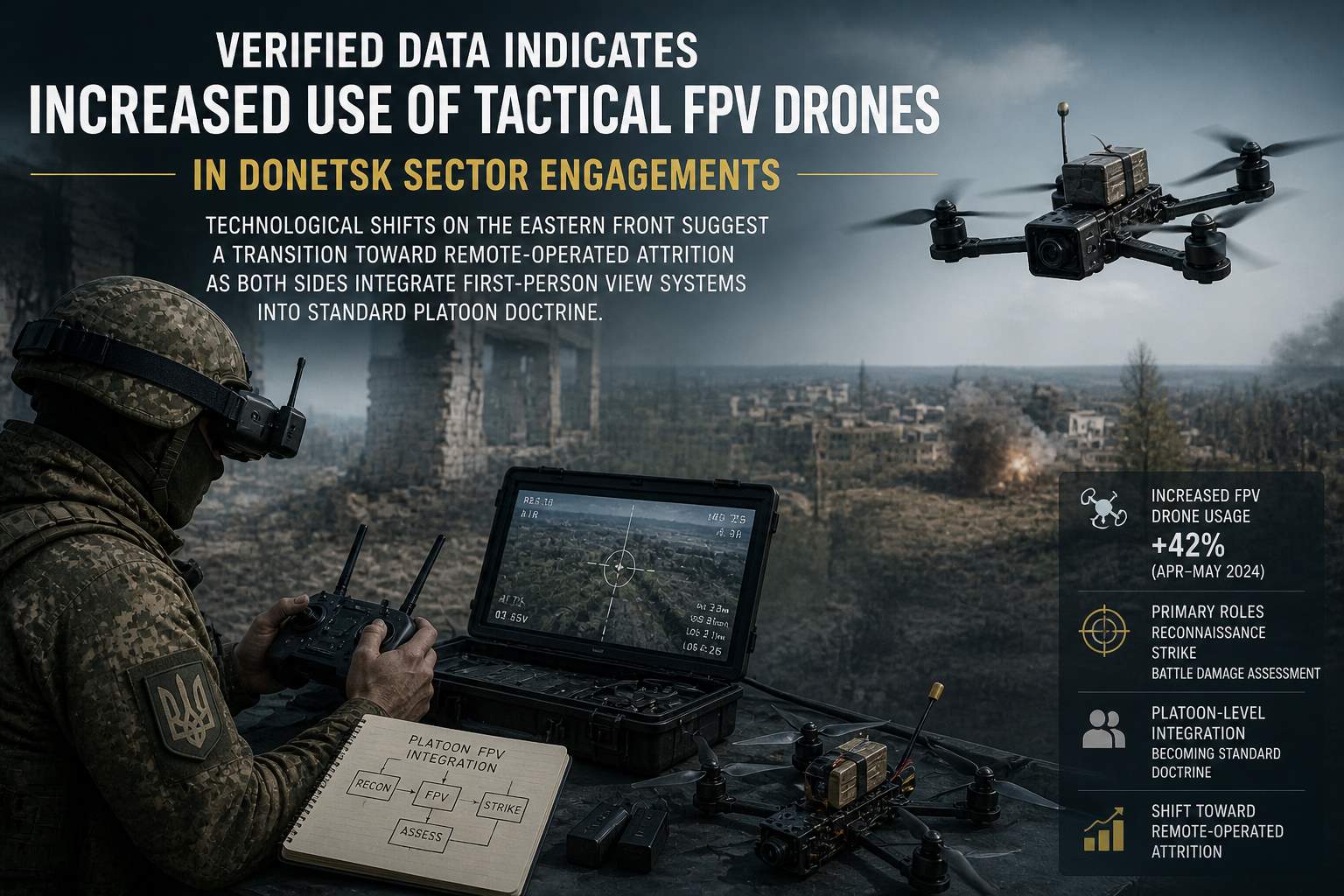
Technological shifts on the Eastern Front suggest a transition toward remote-operated attrition as both sides integrate First-Person View systems into standard platoon doctrine.
May 4, 2026
Last Updated: May 4, 2026
By Staff Writer, Global War News
Fresh data from frontline monitoring groups and defense analytics firms indicates a significant spike in the deployment of First-Person View (FPV) tactical drones across the Donetsk sector. According to a May 2026 report by the Institute for the Study of War (ISW) and verified geolocated footage, the density of drone strikes per kilometer of the frontline has increased by approximately 40% compared to the final quarter of 2025.
Military officials from both the Ukrainian General Staff and the Russian Ministry of Defense have acknowledged in daily briefings that small-unit engagements are increasingly dominated by remote-operated munitions. These systems, typically low-cost quadcopters modified to carry explosives, allow operators to target individual vehicles or fortified positions with high precision from several kilometers away.
Independent observers note that this shift is not merely a quantitative increase but a qualitative change in how ground combat is conducted. The “transparency” of the battlefield, provided by constant aerial surveillance, has made large-scale armored maneuvers nearly impossible without significant electronic warfare (EW) cover.
The Evolution of the FPV “Strike Package”
In the early stages of the conflict, FPV drones were primarily improvised tools used by specialized volunteer units. According to defense analysts at Janes, the current phase of the war sees these drones fully integrated into the “standard strike package” of regular infantry platoons. Both forces have reportedly established dedicated drone production workshops near the frontlines to maintain a steady supply of airframes and munitions.
The effectiveness of these systems is tied to their low cost-to-kill ratio. A standard FPV drone, costing roughly $500 to $1,000, is capable of disabling a main battle tank worth several million dollars. This economic asymmetry is forcing a rethink of traditional armored doctrine, with many units now prioritizing “turtle” shells (improvised metal cages) and localized EW jammers over traditional speed or maneuverability.
Electronic Warfare and the “Frequency Game”
As the use of FPV drones increases, so does the sophistication of countermeasures. Verified data from signal intelligence reports suggests a constant “cat-and-mouse” game regarding radio frequencies. When one side identifies the control frequency used by enemy drones, they deploy targeted jamming; the opposing side then responds by shifting to non-standard frequencies or utilizing “frequency-hopping” software.
- Jamming Radii: Current localized EW systems used by platoon-sized elements reportedly create a “dead zone” of 50 to 150 meters, though high-powered FPVs with signal boosters are increasingly able to penetrate these shields.
- AI Integration: Analysts have suggested that some newer drone models are being equipped with basic “terminal guidance” AI. According to a report by Reuters, these systems allow the drone to lock onto a target in the final seconds of flight, rendering manual jamming ineffective once the drone is within range.
Economic Impact: The Industrialization of Attrition
The reliance on FPV systems has created a new military-industrial niche. Ukraine’s “Army of Drones” initiative has reportedly contracted hundreds of small domestic companies to produce over 100,000 units per month. On the Russian side, the Ministry of Defense has stated publicly that it is subsidizing “people’s laboratories” to scale up the production of the “Ghoul” and “Piranha” drone series.
This industrialization of attrition carries significant long-term economic costs. The “burn rate” of electronics, specifically flight controllers and camera sensors, has led to a surge in demand for dual-use components from East Asian markets. Analysts from the IMF have noted that this redirected spending towards consumable weaponry is placing a heavy strain on national budgets that might otherwise be spent on long-term defense infrastructure or civilian recovery.
Analysis: The End of Trench Stalemate?
Observers note that while FPV drones have intensified the lethality of the frontlines, they have also contributed to a tactical stalemate. Because any movement is immediately spotted and targeted, neither side can achieve the “mass” required for a decisive breakthrough. The Donetsk sector has effectively become a laboratory for a new form of siege warfare, where the “walls” are not stone but a constant swarm of loitering munitions.
The question for military planners in the summer of 2026 is whether the defense can continue to outpace the offense. If autonomous, jam-resistant drones become the norm, the current positional warfare may shift back toward high-mobility combat—or result in a completely uninhabitable “no-man’s land” where human presence is impossible without total subterranean cover.
Current Standing
As of May 4, the frequency of FPV strikes in the Donetsk sector shows no signs of slowing. Both the Ukrainian and Russian commands are prioritizing the training of tens of thousands of new pilots. In the words of one frontline commander quoted by Al Jazeera, “the sky is never empty anymore.” The outcome of the 2026 campaign may well depend not on who has the most tanks, but on who can better manage their electromagnetic spectrum and drone logistics.
Source Disclosure: Data on drone strike density and technological integration is sourced from the Institute for the Study of War (ISW), Janes, and Reuters. Production figures and official statements are based on reports from the Ukrainian Ministry of Digital Transformation and the Russian Ministry of Defense. Economic analysis was provided by the IMF and the Center for Strategic and International Studies (CSIS).
This article is based on publicly available reporting from named international news agencies and attributed official statements. All claims about ongoing events are attributed to their original sources. Analysis sections represent the editorial interpretation of reported facts and do not constitute advocacy for any party to the described conflict. AI tools may be utilized for image generation to assist in explaining complex concepts, as well as for refining grammar, spelling, and other linguistic enhancements. However, all original content is produced, fact-checked, and revised by the editorial team. This publication does not take political positions on active military conflicts.