
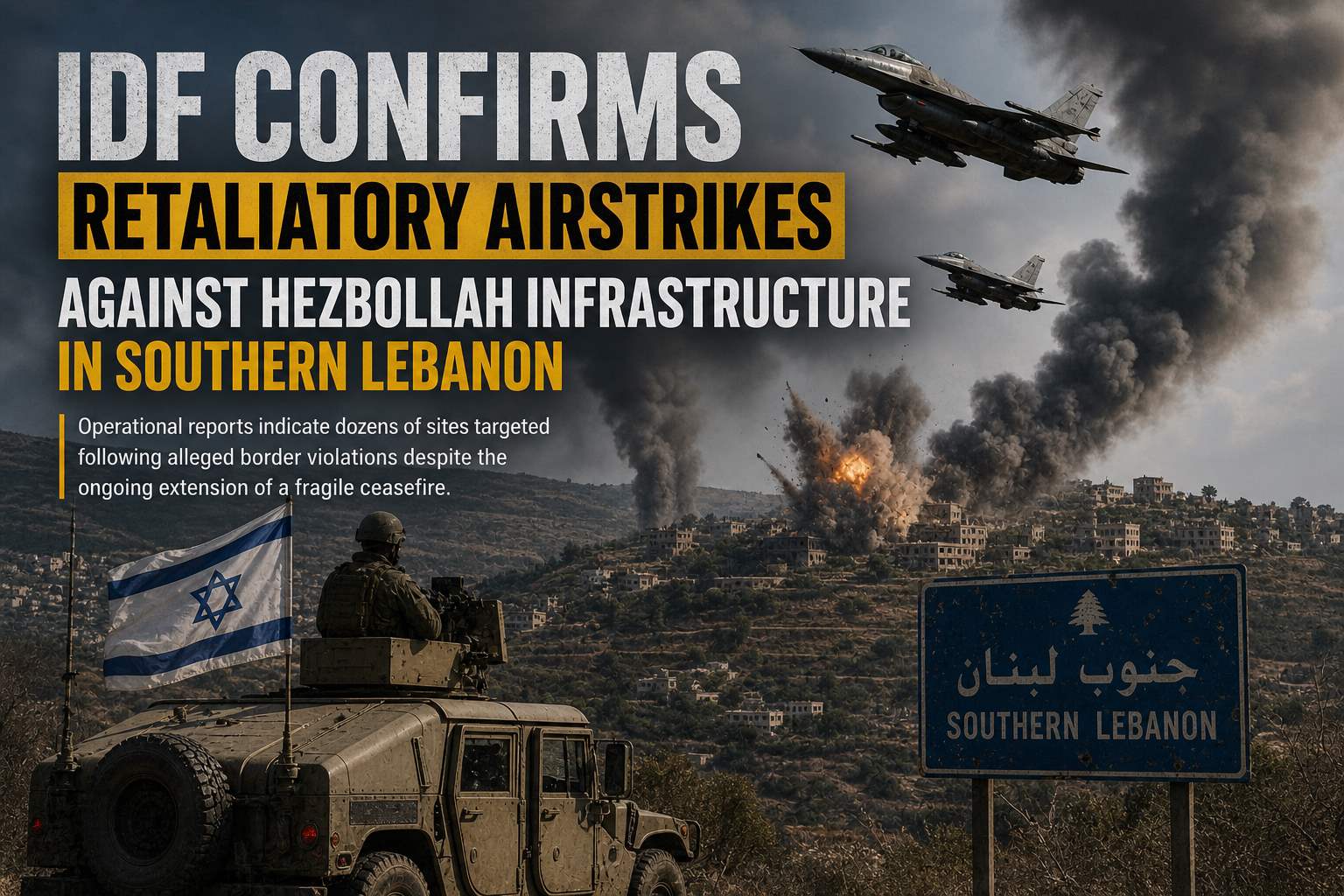
Operational reports indicate dozens of sites targeted following alleged border violations despite the ongoing extension of a fragile ceasefire.
May 5, 2026
By Global War News Editorial
The Israel Defense Forces (IDF) confirmed on Tuesday that they conducted a series of retaliatory airstrikes against Hezbollah infrastructure in southern Lebanon. According to an official military statement, the 146th Division targeted approximately 15 sites over the last 24 hours, including military structures, surveillance equipment, and staging areas. The IDF stated that these operations are part of a continuous effort to neutralize threats to Israeli civilians and soldiers operating near the “yellow line” border zone.
The strikes followed reported clashes on Monday near the town of Deir Seryan. The IDF confirmed that two of its soldiers were moderately wounded during an engagement with Hezbollah fighters who reportedly opened fire as Israeli troops attempted to advance. In response, the Israeli Air Force targeted Buildings used by the group and anti-tank guided missile launch posts. Hezbollah issued a separate statement claiming its fighters engaged the “enemy force” in defense of Lebanese territory, characterizing the Israeli movement as a violation of the existing truce.
Context and Background
A U.S.-mediated ceasefire, which originally took effect on April 17, was recently extended by three weeks following an announcement by U.S. President Donald Trump. While the agreement has successfully halted large-scale strikes on Beirut and its southern suburbs, the border regions south of the Litani River have seen persistent “low-intensity” combat.
Since the escalation began on March 2, Lebanese health authorities report that over 2,500 people have been killed and more than 1.2 million displaced. The Israeli government has maintained a policy of establishing a “buffer zone” along the border to prevent a recurrence of cross-border raids, while the Lebanese government has officially banned military activities by Hezbollah—a mandate the group has firmly rejected.
Analysis: The Fragility of the “Buffer Zone”
The recent exchanges highlight the extreme fragility of the current cessation of hostilities. Analysts note that the “yellow line” established by the IDF—running approximately 10 kilometers deep into Lebanese territory—has become a persistent flashpoint. Because this zone includes numerous Lebanese villages where residents have been told not to return, any movement by either side is frequently interpreted as a tactical breach.
Observers suggest that Hezbollah’s continued use of first-person and fiber-optic UAVs has forced a change in Israeli tactical responses, leading to more frequent preemptive or retaliatory airstrikes on suspected launch sites. It remains unclear whether the Lebanese Armed Forces possess the capacity or political mandate to effectively assert sovereignty in these border areas as requested by international mediators. This “security vacuum” continues to be filled by direct confrontations between the IDF and Hezbollah, undermining the broader diplomatic efforts toward a long-term security pact.
Current Status and Outlook
As of May 5, the situation in southern Lebanon remains highly volatile. Lebanon’s state-run National News Agency (NNA) reported Israeli strikes on more than 20 locations over the past 24 hours, with some focusing on towns previously issued evacuation orders. Lebanese President Joseph Aoun stated on Monday that a security agreement must precede any direct meetings with Israeli leadership, emphasizing that current conditions are “not appropriate” for high-level talks. Residents in the Tyre, Nabatieh, and Bint Jbeil districts are advised to remain away from designated military zones as the potential for further escalation remains high.
Source Disclosure: This article is based on official statements from the Israel Defense Forces (IDF), Lebanon’s National News Agency (NNA), and reporting from Reuters, AFP, and The Times of Israel. Casual figures are cited from the Lebanese Ministry of Public Health.
This article is based on publicly available reporting from named international news agencies and attributed official statements. All claims about ongoing events are attributed to their original sources. Analysis sections represent the editorial interpretation of reported facts and do not constitute advocacy for any party to the described conflict. AI tools may be utilized for image generation to assist in explaining complex concepts, as well as for refining grammar, spelling, and other linguistic enhancements. However, all original content is produced, fact-checked, and revised by the editorial team. This publication does not take political positions on active military conflicts.