
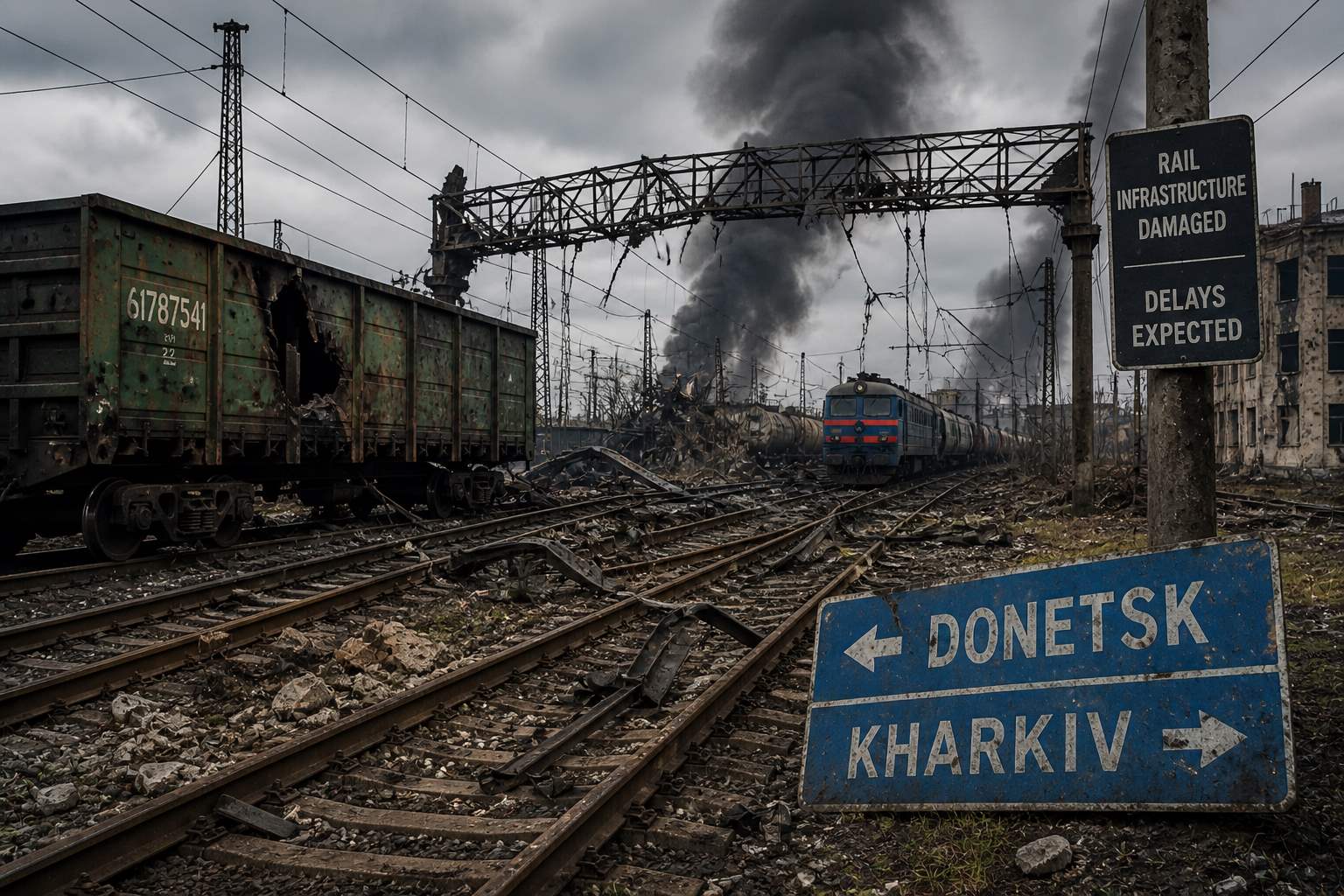
Satellite imagery and local reports indicate structural damage to key junctions as the “war of the rails” complicates both military and industrial transit.
May 5, 2026
By Global War News Editorial
Significant disruptions to rail logistics have been reported across eastern Ukraine following a series of precision strikes targeting critical junctions and switching stations. According to satellite imagery analyzed by private intelligence firms and corroborated by local administrative reports, at least three primary rail arteries in the Donetsk and Kharkiv sectors have sustained damage that has forced the rerouting of both military echelons and commercial freight.
The strikes, which reportedly occurred late Monday, focused on the Lozova and Lyman hubs—stations that serve as essential “bridgeheads” for the movement of heavy equipment and humanitarian aid. Regional authorities in Kharkiv reported that while repair crews were dispatched within hours, the destruction of specialized signaling equipment has slowed transit capacity by an estimated 60% on these lines. The Ukrainian state rail operator, Ukrzaliznytsia, issued a statement noting that several passenger services were diverted, though they emphasized that “alternative logistics remain operational.”
Context and Background
Railways are the literal backbone of the conflict in Ukraine, serving as the primary method for transporting armor, ammunition, and bulk exports like grain and steel. Unlike road networks, which are flexible but limited in tonnage, the rail system is a high-capacity, rigid target. The Soviet-era design of the network in the east means that while it is dense, it relies on a few high-capacity nodes; damaging a single major junction can create a “bottleneck” effect that radiates hundreds of kilometers back into the logistics chain.
Historically, both sides have engaged in “interdiction strikes” to starve frontline units of reinforcements. However, the 2026 campaign has seen an increased focus on transformer substations that power electric locomotives, forcing a reliance on older, less efficient diesel engines which are in shorter supply.
Analysis: The Tactical Bottleneck and Industrial Attrition
The current disruptions represent a calculated effort to degrade the “tempo” of operations. Analysts suggest that the timing of these strikes coincides with reported troop rotations, suggesting an intent to catch units in transit or leave them undersupplied during vulnerable transition periods.
Analysis of recent satellite passes shows significant “crater clusters” around the neck of the Lozova junction. This indicates the use of precision-guided munitions designed to destroy specific track-switching mechanisms rather than simply the rails themselves, as rails are easily replaced while switching systems require specialized electronic components currently under high demand. Furthermore, the economic impact on the remaining industrial base is severe. Observers note that the interruption of the Lyman line has halted the transit of iron ore to western processing plants for the second time this month. This “logistics attrition” serves a dual purpose: it complicates frontline defense while simultaneously draining the national treasury by idling key export industries. It remains unclear how quickly specialized repair parts can be sourced given the ongoing strain on the global supply chain for heavy industrial electronics.
Current Status and Outlook
As of May 5, repair work is ongoing at the Lozova site, though local reports suggest that manual signaling is being used, which significantly limits the speed and frequency of trains. The UK Ministry of Defence, in a brief intelligence update, noted that the strikes likely aimed to preempt a suspected Ukrainian push in the eastern sector by creating a “logistical vacuum.” Looking forward, the reliance on diesel backup is expected to increase fuel consumption requirements for the military by approximately 15% to 20% in the affected sectors. Shippers and aid organizations are advised to anticipate 48-hour delays for any cargo transiting the eastern nodes for the remainder of the week.
Source Disclosure: This report is based on satellite imagery analysis from Maxar and Sentinel-2, official statements from Ukrzaliznytsia, local reporting from the Kharkiv Regional Military Administration, and logistics assessments from the Center for Railway Research.
This article is based on publicly available reporting from named international news agencies and attributed official statements. All claims about ongoing events are attributed to their original sources. Analysis sections represent the editorial interpretation of reported facts and do not constitute advocacy for any party to the described conflict. AI tools may be utilized for image generation to assist in explaining complex concepts, as well as for refining grammar, spelling, and other linguistic enhancements. However, all original content is produced, fact-checked, and revised by the editorial team. This publication does not take political positions on active military conflicts.