
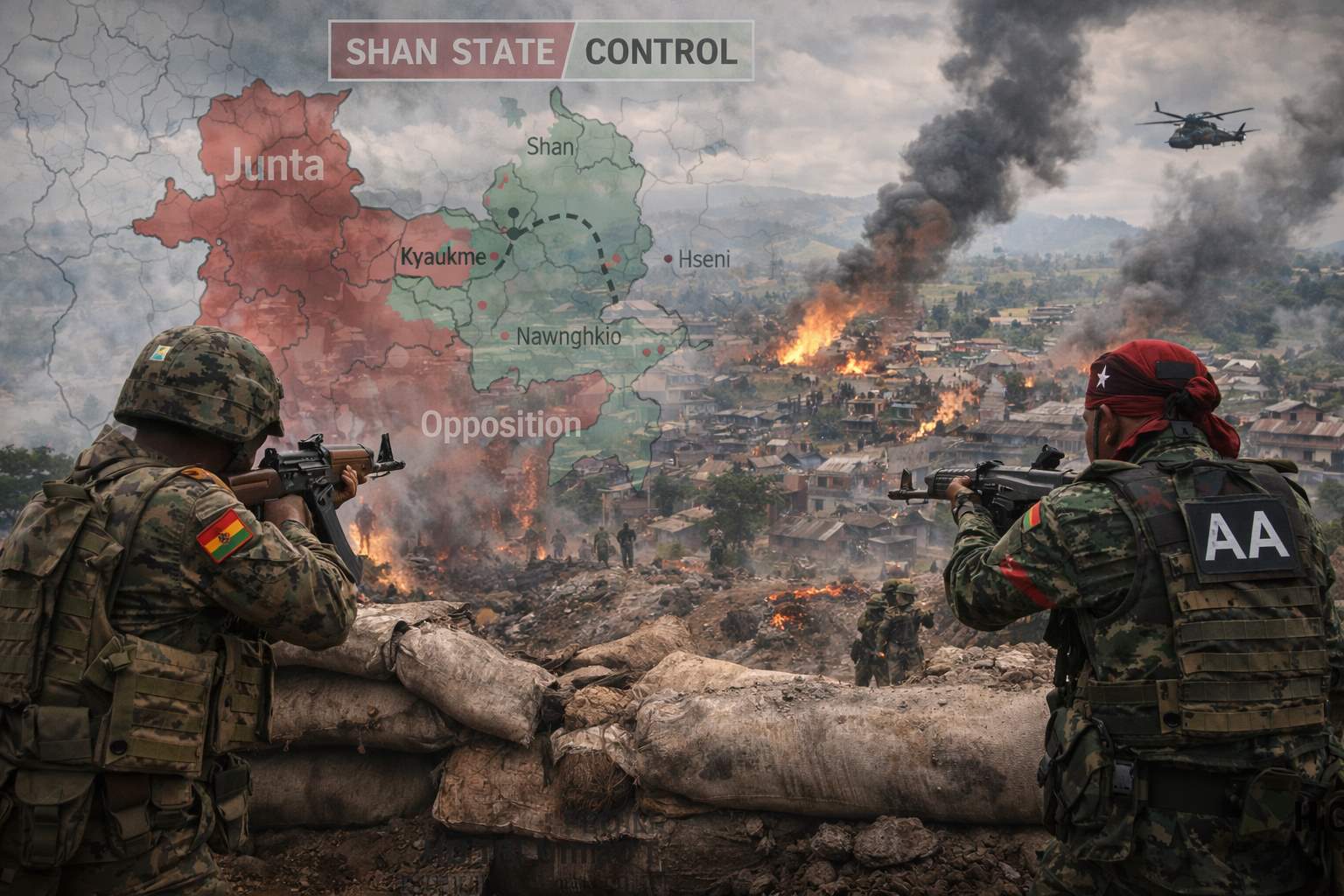
Opposition coalitions and military junta spokespersons provide conflicting reports on township control as the “Operation 1027” successor phase intensifies.
May 5, 2026
By Global War News Editorial
The security landscape in Myanmar’s northern Shan State remains highly volatile as a renewed offensive by the Three Brotherhood Alliance continues to challenge the territorial integrity of the military government. Over the past 72 hours, opposition forces—comprising the Myanmar National Democratic Alliance Army (MNDAA), the Ta’ang National Liberation Army (TNLA), and the Arakan Army (AA)—have claimed the capture of several key outposts surrounding the strategic trade hub of Lashio.
A spokesperson for the TNLA stated via social media that their forces have “effectively neutralized” junta resistance in the Kyaukme and Nawnghkio townships, claiming control over administrative buildings and local police stations. Conversely, Major General Zaw Min Tun, spokesperson for the State Administration Council (SAC), stated in a televised briefing that military units have “successfully repelled” multiple insurgent attempts to infiltrate urban centers. He maintained that the military continues to hold the primary highlands and communication hubs in northern Shan, characterizing opposition claims as “psychological warfare.”
Context and Background
Shan State, which shares borders with China, Thailand, and Laos, has been a central theater of conflict since the February 2021 coup. The current “fluidity” follows the significant success of “Operation 1027” in late 2023, which saw the military government lose control of dozens of towns and hundreds of outposts.
The region is economically vital due to its role in border trade with China. The Muse and Chin Shwe Haw crossings traditionally handle billions of dollars in annual commerce, including agricultural exports and manufactured imports. Since the escalation of fighting in early 2024, these trade arteries have remained largely paralyzed. The Haigeng Agreement, a China-mediated ceasefire signed in January 2024, has faced repeated accusations of violations from both sides, leading to the current resumption of high-intensity combat.
Analysis: Fragmentation and the Border Economy
The inability of either side to establish definitive, uncontested control over Shan State points to a growing fragmentation of Myanmar’s sovereign territory. Analysts note that the current offensive is no longer just about capturing territory but about controlling “economic nodes.”
Observers suggest that the ethnic armed organizations (EAOs) are seeking to create a contiguous “liberated zone” along the Chinese border. This would provide them with both a defensive buffer and a direct revenue stream through the taxation of informal trade. For the SAC, the loss of Shan State represents more than a military defeat; it signifies a decoupling from the Chinese “Belt and Road” infrastructure projects that are essential for the junta’s long-term economic survival. It remains unclear how Beijing will respond to the continued instability, as the disruption of the Muse-Mandalay rail project and the influx of refugees into Yunnan province place increasing strain on the bilateral relationship. The conflict has essentially devolved into a series of localized sieges where the “frontline” shifts daily based on the availability of junta air support versus the ground-level numerical superiority of the allied EAOs.
Current Status and Outlook
As of May 5, independent verification of township-level control remains difficult due to localized internet shutdowns and restricted access for humanitarian workers. Local aid groups in Lashio report that thousands of civilians have begun moving toward the central dry zone to escape intensified aerial bombardments. While the Three Brotherhood Alliance claims to be in the “final stages” of clearing the Mandalay-Lashio road, the military junta has reportedly reinforced its garrison at the North Eastern Command. In the coming weeks, the primary indicator of the conflict’s direction will be whether the opposition can maintain control of the high-speed transit routes during the impending monsoon season, which typically complicates mechanized military movements.
Source Disclosure: This report is based on official statements from the TNLA and MNDAA press offices, briefings from SAC spokesperson Major General Zaw Min Tun, reporting from the Irrawaddy and Myanmar Now, and data from the UN Office for the Coordination of Humanitarian Affairs (OCHA).
This article is based on publicly available reporting from named international news agencies and attributed official statements. All claims about ongoing events are attributed to their original sources. Analysis sections represent the editorial interpretation of reported facts and do not constitute advocacy for any party to the described conflict. AI tools may be utilized for image generation to assist in explaining complex concepts, as well as for refining grammar, spelling, and other linguistic enhancements. However, all original content is produced, fact-checked, and revised by the editorial team. This publication does not take political positions on active military conflicts.