
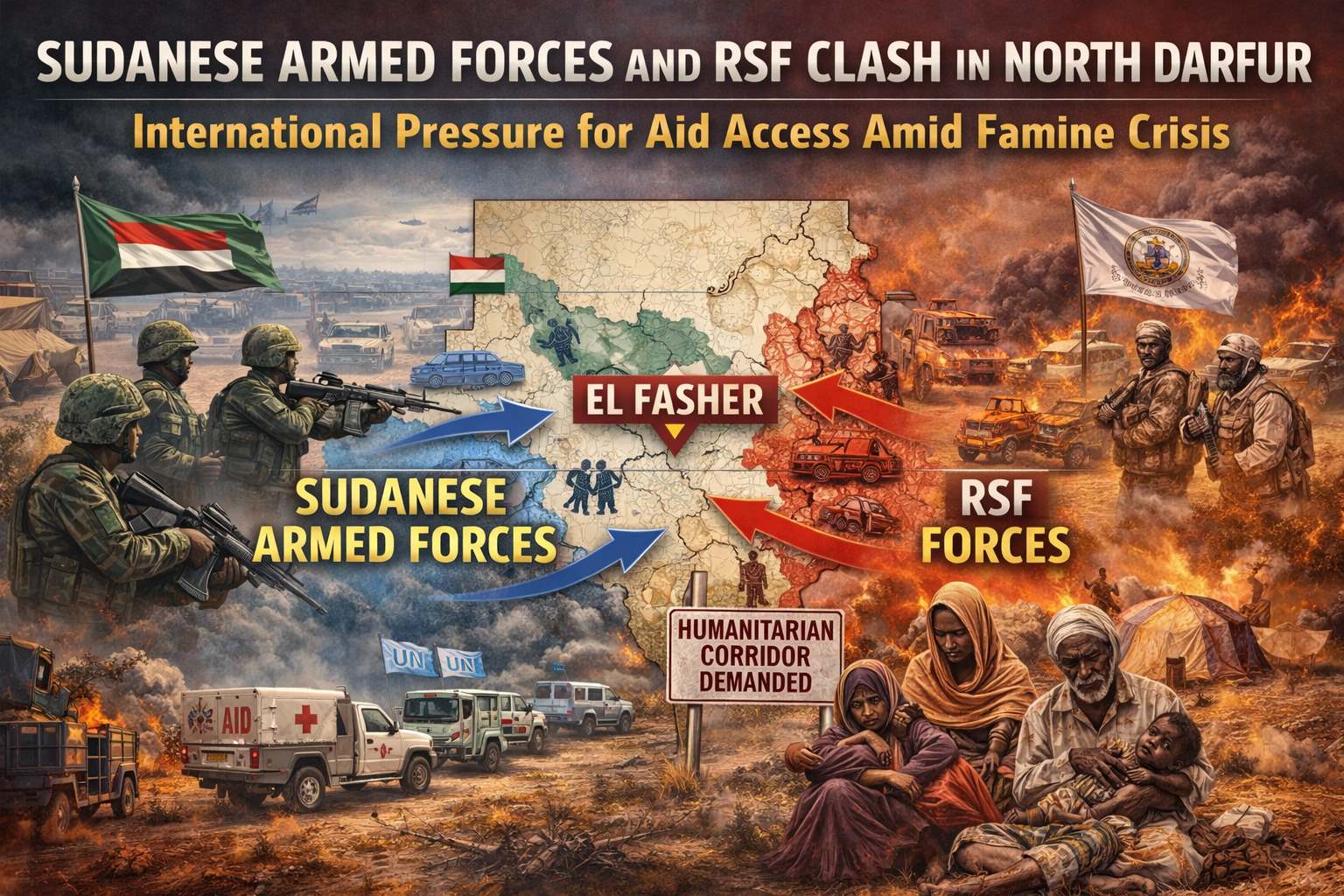
Tactical shifts in El Fasher reported as famine conditions are confirmed and global bodies demand immediate humanitarian corridors.
Publication date: May 6, 2026
Last updated: May 6, 2026
By Staff Writer, Global War News
Renewed fighting has broken out in the outskirts of El Fasher, the last major urban stronghold of the Sudanese Armed Forces (SAF) in the Darfur region. According to regional monitoring groups and United Nations situational reports, the Rapid Support Forces (RSF) have launched a series of coordinated assaults on SAF defensive perimeters, marking a significant escalation in a siege that has paralyzed North Darfur for months.
Reports from local monitoring networks indicate that the clashes have intensified in the northern and eastern districts of the city. The SAF has reportedly utilized aerial bombardment to repel RSF ground advances, while the RSF has employed heavy artillery and drone strikes targeting military installations. While the SAF maintains that its 6th Infantry Division remains in control of key administrative centers, the RSF claimed in a recent statement to have made territorial gains near the city’s main market. These claims could not be independently verified.
The tactical developments come as the international community intensifies its focus on the humanitarian catastrophe unfolding within the city. UN agencies have confirmed that famine conditions have now taken hold in El Fasher, with Global Acute Malnutrition (GAM) rates reportedly reaching as high as 75% in some displacement camps.
Tactical Developments in El Fasher
The siege of El Fasher has evolved into a war of attrition. According to a situation analysis from ReliefWeb, the RSF has successfully consolidated control over much of the surrounding countryside, effectively cutting off the city from primary supply routes. This encirclement has left approximately 1.5 million civilians trapped, many of whom have already been displaced multiple times from other parts of Darfur.
Tactical observers note that the RSF appears to be targeting the city’s remaining infrastructure, including water stations and hospitals, to weaken SAF resistance. Conversely, the SAF’s reliance on air power has led to reports of significant civilian casualties, with local medical sources alleging that several strikes have hit residential neighborhoods.
Analysis: The Logistics of Starvation
The humanitarian impact of the current clashes is not merely a byproduct of the fighting but is increasingly viewed by international observers as a deliberate tactical tool. A recent report by a UN Fact-Finding Mission suggested that the denial of aid access to El Fasher carries “hallmarks of a campaign of destruction” against specific ethnic communities.
International pressure on both General Abdel Fattah al-Burhan of the SAF and Mohamed Hamdan “Hemedti” Dagalo of the RSF has reached a new peak. The UN Security Council has repeatedly called for an immediate cessation of hostilities in North Darfur to allow for the entry of food and medicine. However, aid convoys remain blocked at the Adre border crossing and other transit points, with both warring parties accusing the other of weaponizing humanitarian assistance.
What This Could Mean
The fall of El Fasher would represent a total RSF takeover of the Darfur region, a development that analysts suggest could lead to further ethnic-based violence. For the SAF, losing the city would be a devastating strategic and symbolic blow, potentially shifting the focus of the war entirely toward the Kordofan and Khartoum regions.
Observers suggest that unless a verifiable ceasefire is established specifically for El Fasher, the city faces a total collapse of its remaining social and medical structures. The primary concern for regional actors now is whether international diplomatic pressure can secure a “humanitarian pause” before the famine leads to a mass casualty event that dwarfs the direct combat deaths.
Source Disclosure: This report is based on situational analysis from ReliefWeb, official press releases from the UN Office of the High Commissioner for Human Rights (OHCHR), data from the Famine Review Committee (FRC), and regional monitoring by the Sudan Tribune.
This article is based on publicly available reporting from named international news agencies and attributed official statements. All claims about ongoing events are attributed to their original sources. Analysis sections represent the editorial interpretation of reported facts and do not constitute advocacy for any party to the described conflict. AI tools may be utilized for image generation to assist in explaining complex concepts, as well as for refining grammar, spelling, and other linguistic enhancements. However, all original content is produced, fact-checked, and revised by the editorial team. This publication does not take political positions on active military conflicts.