
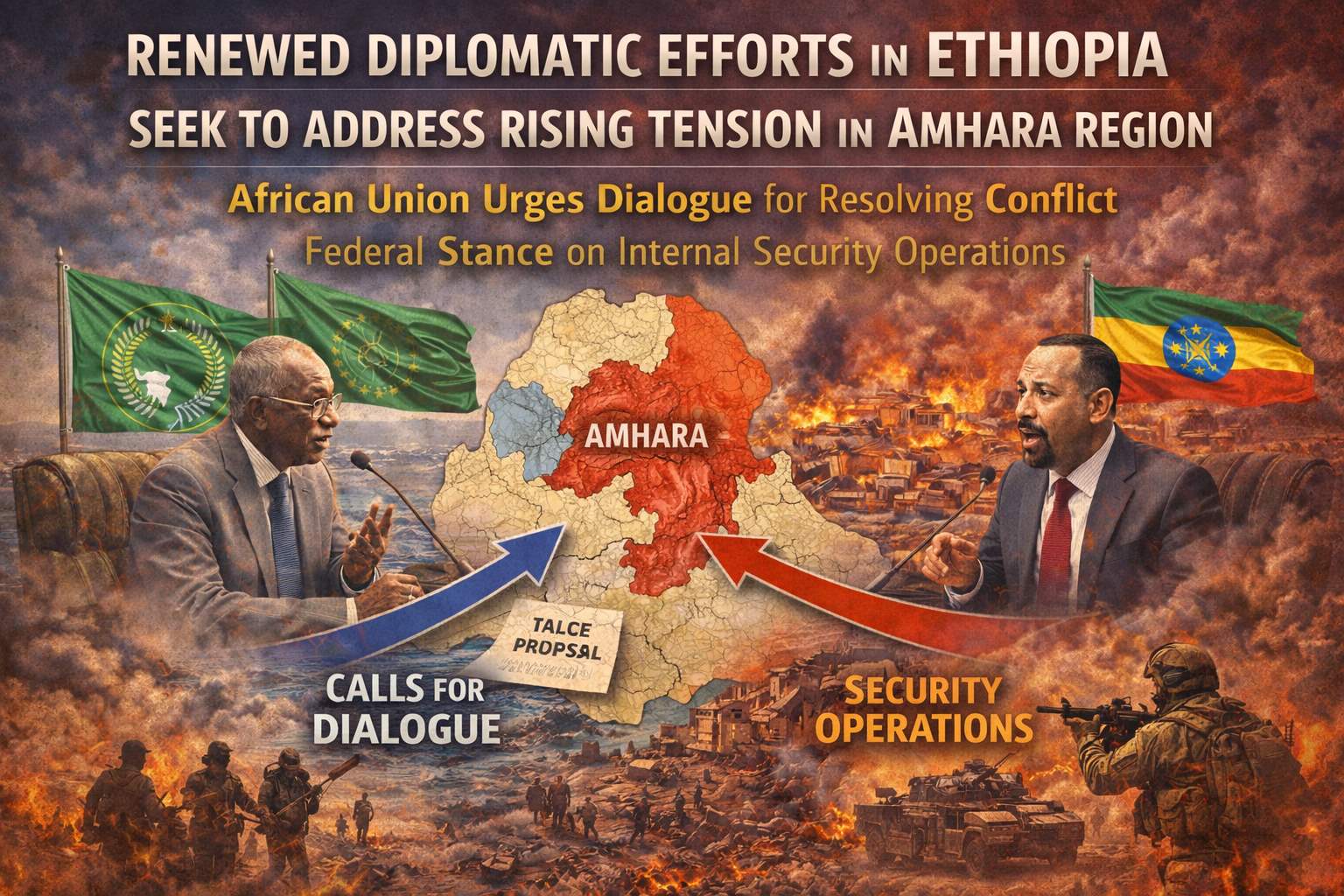
African Union calls for “maximum restraint” as federal security operations intensify against unified Fano militia factions.
Publication date: May 6, 2026
Last updated: May 6, 2026
By Staff Writer, Global War News
Diplomatic pressure is mounting on the Ethiopian federal government to pivot toward a negotiated settlement in the Amhara region, where over two years of insurgency have evolved into a sophisticated guerrilla war. The African Union (AU), headquartered in Addis Ababa, has issued a renewed appeal for “constructive dialogue,” warning that the internal instability threatens the broader security architecture of the Horn of Africa.
The current escalation follows the January 2026 merger of various Fano militia factions into a more unified command structure. This consolidation has shifted the conflict from localized skirmishes to a broader campaign that federal authorities describe as a threat to “national constitutional order.” While the Ethiopian National Defense Force (ENDF) has maintained a heavy presence in major urban centers like Gondar and Bahir Dar, rural corridors remain contested, with monitoring groups reporting a cycle of rebel offensives and federal counter-strikes.
African Union Calls for Mediation
In a statement released from the AU Commission, Chairperson Mahmoud Ali Youssouf urged all parties to “exercise maximum restraint and prioritize the preservation of Ethiopia’s territorial integrity through political means.” The AU’s High-Level Panel on Ethiopia has reportedly offered to facilitate a preliminary roadmap for talks, similar to the 2022 Pretoria Agreement that ended the Tigray war.
However, the path to mediation is complicated by the fragmented nature of the grievances. The AU’s Peace and Security Council has noted that the lack of a formal “cessation of hostilities” in Amhara, unlike the agreement in Tigray, has left a dangerous vacuum where human rights abuses and civilian displacement are reportedly on the rise.
The Federal Government’s Stance
The administration of Prime Minister Abiy Ahmed has maintained a consistent stance that its operations in the Amhara region are “law enforcement measures” aimed at disarming illegal armed groups. According to official government briefings, the federal authorities view the Fano movement as an entity that has strayed from its role as a wartime ally during the Tigray conflict into a disruptive force that undermines regional administration.
In a recent communication to international observers, the Ethiopian Ministry of Foreign Affairs stated that while the government remains open to “peaceful avenues,” it will not compromise on the “monopoly of the state over the use of force.” Federal officials have frequently attributed the persistence of the insurgency to external actors, including alleged logistical support from Eritrea, claims that the government in Asmara has consistently denied.
Analysis: The Cost of the Stalemate
The current “shadow war” in Amhara represents a profound shift in Ethiopia’s internal power balance. Analysts note that the Fano insurgency is fueled by a perception among the Amhara population that the 2022 Pretoria Agreement sidelined their security interests, specifically concerning contested territories in Western and Southern Tigray.
- Logistical Disruptions: The conflict has severely hampered agricultural output in one of Ethiopia’s most fertile regions. Humanitarian agencies report that aid access is deeply restricted, with both federal roadblocks and militia-enforced travel bans creating “pockets of starvation.”
- Security Vacuum: The unification of Fano factions in early 2026 suggests the insurgency is digging in for a long-term campaign. The ENDF’s reliance on drone strikes and heavy artillery in civilian-populated zones has, according to human rights monitors, further alienated local populations, complicating the federal government’s efforts to re-establish administrative control.
Outlook
The success of the AU’s diplomatic push depends on whether the federal government is willing to recognize the Fano leadership as a legitimate negotiating partner, a move Addis Ababa has so far resisted. Without a formal channel for grievance redress, the Amhara region risks a permanent state of low-intensity conflict that could eventually bleed into neighboring Oromia and Tigray, potentially unraveling the fragile peace of the last four years.
Source Disclosure Note: This report is based on situational updates from the African Union Commission, official statements from the Ethiopian Ministry of Foreign Affairs, reporting from Addis Standard, and conflict analysis from the International Crisis Group and Human Rights Watch.
This article is based on publicly available reporting from named international news agencies and attributed official statements. All claims about ongoing events are attributed to their original sources. Analysis sections represent the editorial interpretation of reported facts and do not constitute advocacy for any party to the described conflict. AI tools may be utilized for image generation to assist in explaining complex concepts, as well as for refining grammar, spelling, and other linguistic enhancements. However, all original content is produced, fact-checked, and revised by the editorial team. This publication does not take political positions on active military conflicts.