
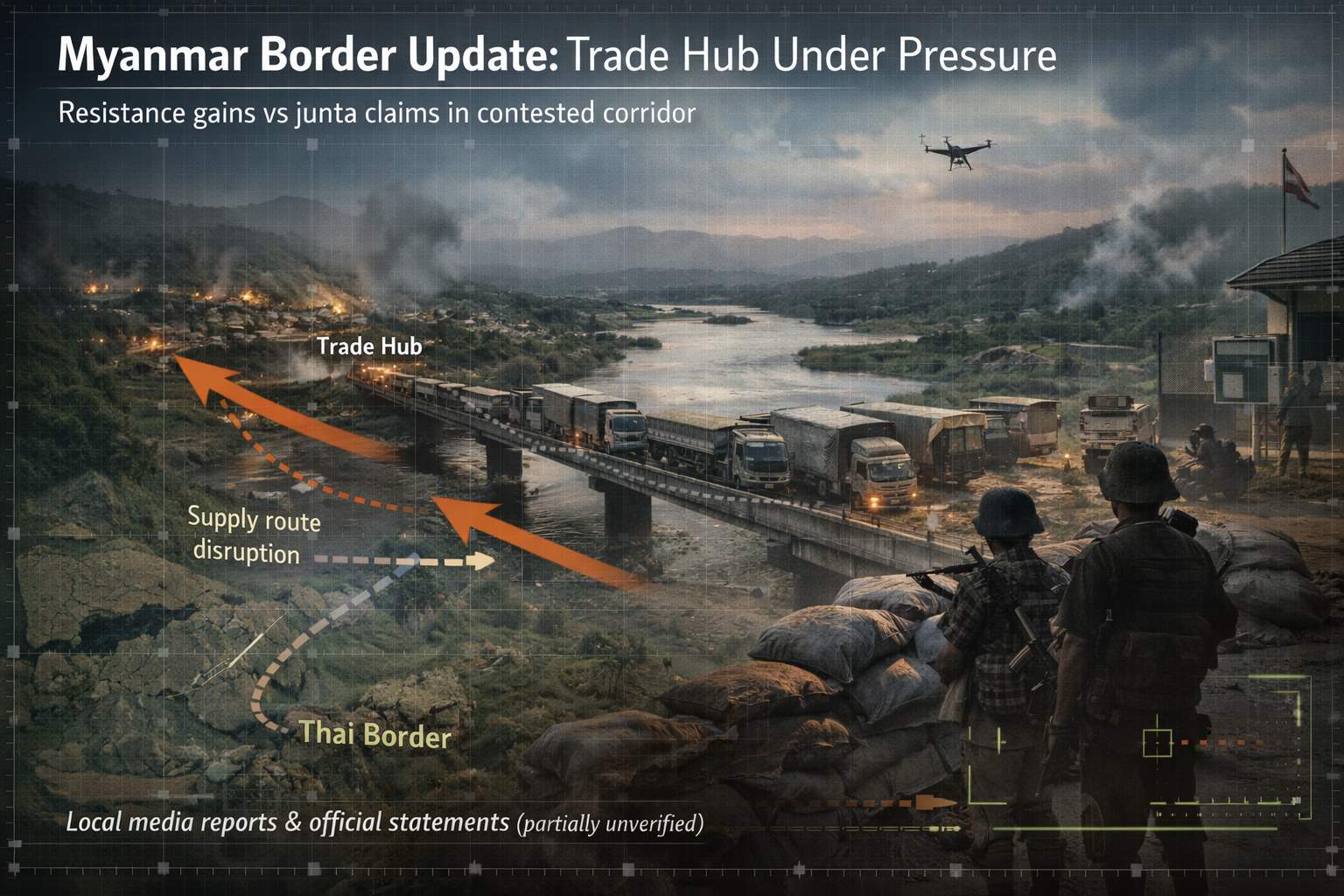
Ongoing contested control of the Asian Highway and mountain routes persists as the military junta attempts to reopen formal trade channels amid resistance pressure.
Publication date: May 6, 2026
Last updated: May 6, 2026
By Staff Writer, Global War News
Resistance forces in Karen State have reportedly consolidated their tactical influence over the critical trade arteries surrounding Myawaddy, a primary land gateway for commerce between Myanmar and Thailand. While the Myanmar military junta has officially declared the Myawaddy-Kawkareik section of the Asian Highway open for non-commercial traffic, regional reports indicate that the surrounding highlands remain under the effective control of the Karen National Union (KNU) and allied People’s Defense Forces (PDF).
The Myawaddy-Mae Sot border crossing, which historically handles over $1 billion in annual trade, has been a central theater of conflict since resistance groups overran several regime bases in April 2024. Although the junta’s forces retook certain urban administrative buildings in late 2025, they have struggled to secure the logistical lifelines required for the full resumption of trade.
According to reports from The Irrawaddy and Karen News, junta forces have intensified security at the Kyondoe-Kawkareik road while simultaneously blocking alternative mountain detours previously used by traders to bypass military checkpoints.
The Duel for the Asian Highway
The Asian Highway No. 1 (AH1) is the most critical logistical link between the two nations. For over two years, the 31-kilometer stretch between Kawkareik and Myawaddy was closed due to the presence of resistance snipers and minefields.
In early April 2026, the Myanmar regime’s Ministry of Commerce announced the “formal reopening” of the road. However, local logistics operators report that the opening remains purely symbolic for the commercial sector.
- Limited Access: Only private vehicles are currently permitted to use the highway, with heavy cargo trucks still diverted to arduous mountain routes.
- Toll Gate Dynamics: Regional monitoring suggests that while the military controls the main road’s checkpoints, resistance forces maintain “tax gates” on the secondary routes. Reports indicate that 12-wheeler trucks are often required to pay up to 4.5 million kyats (approximately $2,100) to pass through territory controlled by various ethnic armed organizations (EAOs).
Official Stance of the Military Junta
The Myanmar military government has framed the reopening of the road as a restoration of stability. In a move to prove its administrative control, the junta has reportedly pressured Thai authorities to reopen the No. 2 Thai-Myanmar Friendship Bridge.
A spokesperson for the junta’s administration in Kayin State stated publicly that “security measures have been finalized to facilitate the safe passage of citizens,” and blamed continued disruptions on “terrorist groups” intent on damaging the national economy. However, the junta has simultaneously warned of “strict action” against unauthorized weapon possession within Myawaddy, signaling an ongoing fear of urban guerrilla infiltration.
Analysis: The Economics of Resistance
The current stalemate highlights a shift in resistance strategy from total territorial capture to “economic interdiction.” By holding the high ground along the Dawna Range, the KNU and its allies are able to levy taxes on the informal trade that sustains the border economy, effectively starving the junta of official customs revenue.
“The military is in a position where they hold the town but cannot hold the road,” one regional analyst noted in a briefing to the Thai-Myanmar Business Council. This has forced the junta to consider shifting its trade focus to the southern port of Kawthaung, a move that would significantly increase transportation costs for Thai exporters.
Outlook
The stability of the Myawaddy trade hub remains tied to a potential, though currently unlikely, agreement between the junta and the KNU regarding tax revenue sharing. Thai authorities are reportedly recalibrating their border strategy to prioritize the establishment of “humanitarian corridors,” while also pushing for a joint working group to restore formal trade channels.
Until the military can secure the AH1 against mobile resistance ambushes, the Myawaddy hub will remain a “checkerboard” of control, where the regime governs the administrative buildings while resistance forces dictate the flow of goods through the hills.
Source Disclosure Note:
This report is based on situational updates from The Irrawaddy, Myanmar Now, and Karen News, cross-referenced with official statements from the Myanmar Ministry of Commerce and the Thai Department of Foreign Trade. Additional data provided by the CNI News and the Karen Peace Support Network.
This article is based on publicly available reporting from named international news agencies and attributed official statements. All claims about ongoing events are attributed to their original sources. Analysis sections represent the editorial interpretation of reported facts and do not constitute advocacy for any party to the described conflict. AI tools may be utilized for image generation to assist in explaining complex concepts, as well as for refining grammar, spelling, and other linguistic enhancements. However, all original content is produced, fact-checked, and revised by the editorial team. This publication does not take political positions on active military conflicts.