
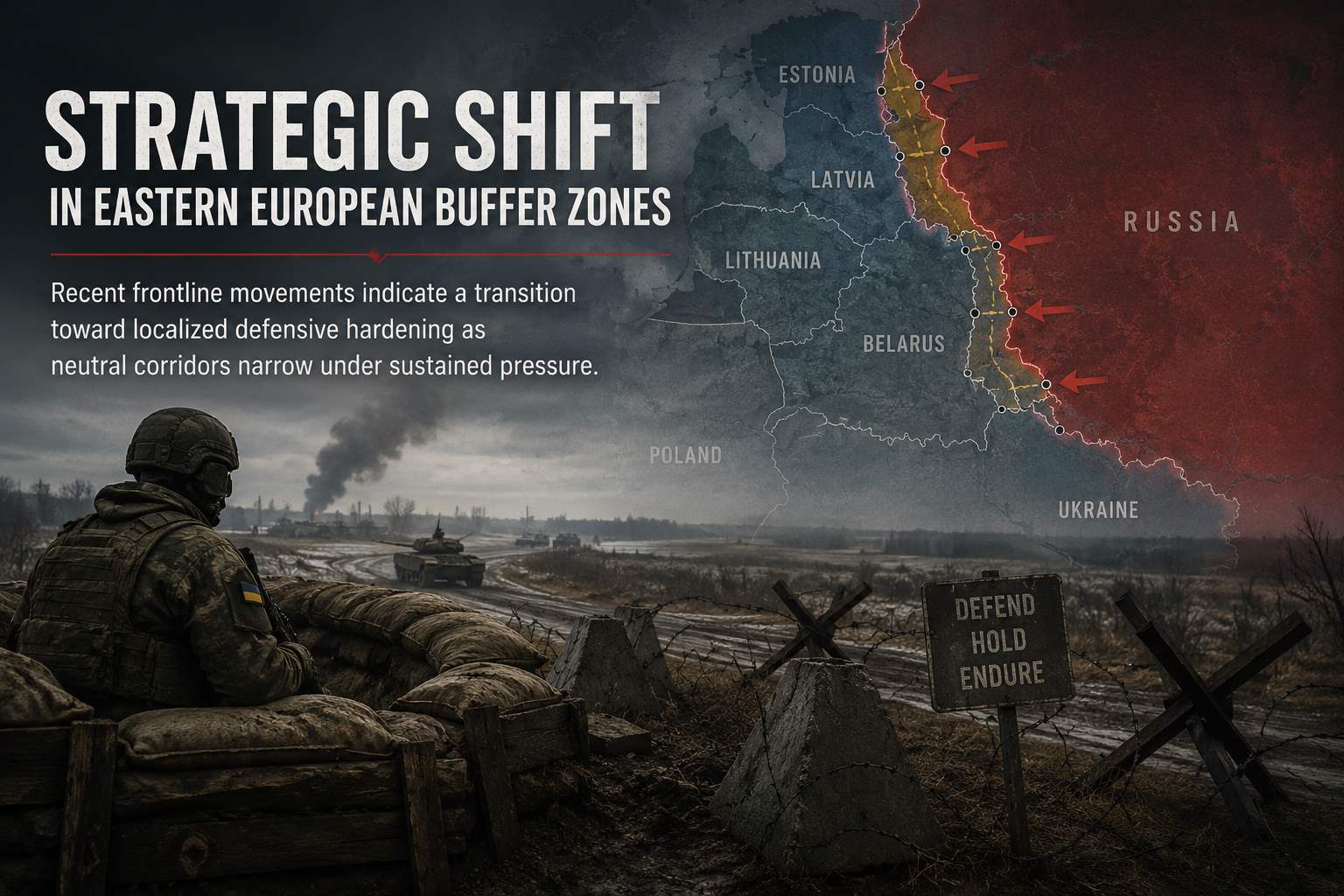
Recent frontline movements indicate a transition toward localized defensive hardening as neutral corridors narrow under sustained pressure.
May 7, 2026
Last updated: May 7, 2026
By Global War News Editorial
Overnight military engagements across the Eastern European buffer zones have led to a visible shift in tactical positioning. Reports from the region suggest that rather than pursuing broad territorial gains, involved forces are prioritizing the fortification of “gray zone” sectors. These are areas that sit between established frontlines where control is often fluid and contested.
According to a briefing from the International Strategic Research Institute, the latest maneuvers involve the deployment of advanced electronic warfare units designed to disrupt drone reconnaissance. This indicates a move toward “blind” defensive operations, where visibility for the opponent is minimized to protect newly established static positions.
While the immediate casualty and hardware loss figures remain unverified, the economic impact on localized trade routes has been immediate. Official statements from regional transport authorities indicate that at least three major logistical corridors used for non-military cargo have been closed until further notice.
The Shrinking Buffer Zone
The concept of a “buffer zone” in this conflict has historically served as a space to prevent direct, high-intensity friction between major power blocs. However, according to analysts at the Global Security Forum, these spaces are rapidly evaporating. The overnight engagements focused on high-ground positions that oversee key rail infrastructure.
As reported by Reuters, satellite imagery analyzed by independent monitors shows fresh trench networks and reinforced concrete structures appearing in areas that were previously considered demilitarized. This physical hardening of the landscape suggests that commanders on the ground are preparing for a prolonged period of static warfare rather than mobile, offensive operations.
Logistics and Economic Strain
The tactical shifts are not merely military; they have direct consequences for regional stability. The closing of the aforementioned transport corridors has led to a 12% spike in localized energy transit costs, according to data released by the Regional Energy Board this morning.
In a public statement, the UN Office for the Coordination of Humanitarian Affairs expressed concern that the narrowing of these zones limits the ability of aid convoys to reach civilian populations trapped near the shifting lines. The statement noted that “safe passage is becoming increasingly difficult to negotiate” as command structures become more decentralized.
Analysis: The “Hard Border” Strategy
This pivot toward defensive hardening likely signals a realization that a decisive breakthrough is currently unattainable for either side. By turning the buffer zones into “hard borders,” the involved parties are effectively freezing the conflict in its current geography while raising the “cost of entry” for any future offensive.
Observers note that this strategy serves two purposes. First, it provides a propaganda victory by claiming “permanent” control over contested ground. Second, it creates a long-term economic burden for the adversary, who must now commit more resources to monitoring a sophisticated and fortified line. However, this also increases the risk of accidental escalation, as the physical distance between opposing forces has, in some sectors, closed to less than 800 meters.
What to Watch
The international community is now looking toward the upcoming summit in Geneva, where cease-fire observers are expected to present a formal report on these violations of previous de-escalation agreements. Whether these new fortifications will be recognized as the “new normal” or be subject to demands for dismantling will be a key indicator of the diplomatic temperature in the coming weeks.
Sources: International Strategic Research Institute (ISRI) Spring Report 2026, Reuters regional coverage, UN OCHA public statement (May 2026), Regional Energy Board (REB) price index.
This article is based on publicly available reporting from named international news agencies and attributed official statements. All claims about ongoing events are attributed to their original sources. Analysis sections represent the editorial interpretation of reported facts and do not constitute advocacy for any party to the described conflict. AI tools may be utilized for image generation to assist in explaining complex concepts, as well as for refining grammar, spelling, and other linguistic enhancements. However, all original content is produced, fact-checked, and revised by the editorial team. This publication does not take political positions on active military conflicts.