
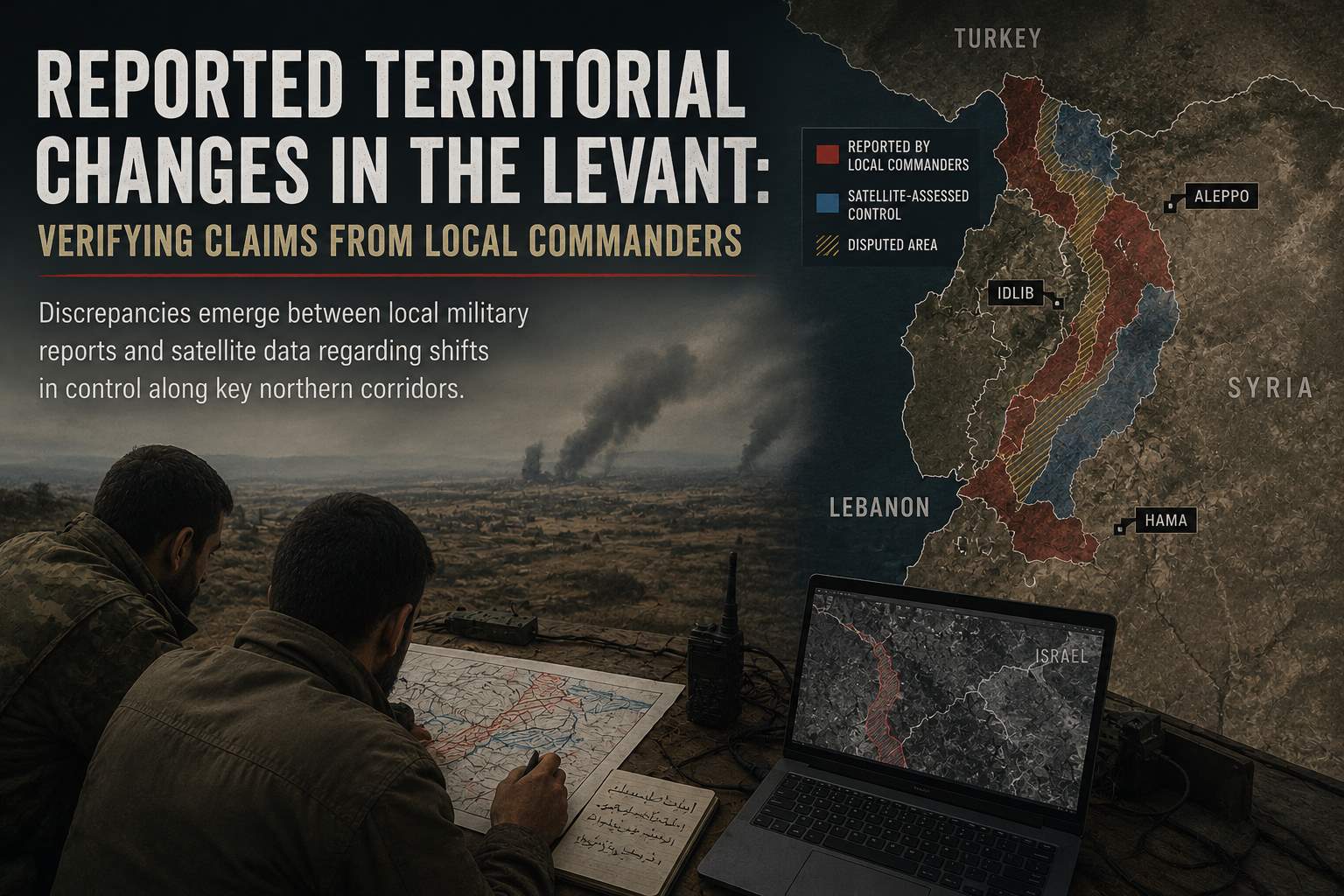
Discrepancies emerge between local military reports and satellite data regarding shifts in control along key northern corridors.
May 7, 2026
Last updated: May 7, 2026
By Staff Writer, Global War News
Conflicting reports have surfaced regarding the control of strategic positions in the Levant following a series of localized skirmishes over the past 48 hours. While local commanders from involved factions have claimed significant territorial gains, international monitors and independent analysts urge caution, noting that physical verification of these shifts remains incomplete.
The claims center on several high-altitude outposts and supply junctions that dictate movement between urban centers. According to a report by the Associated Press, field commanders on the ground asserted they had “fully secured” at least two key transit hubs. However, regional observers note that these claims have not yet been reflected in updated frontline mapping provided by international oversight bodies.
The Challenge of Field Verification
Verifying territorial change in active conflict zones often involves a delay between a physical takeover and international recognition. In the Levant, this process is currently hampered by intermittent communication networks and the frequent use of mobile, non-static defense lines.
As reported by Reuters, satellite imagery captured late yesterday showed no significant change in the structural footprint of the contested hubs. Analysts at the Levant Security Institute stated in a briefing that while personnel may have moved into new buildings, establishing “operational control” over a territory requires a level of logistical consolidation that has not yet been observed.
Conflicting Narratives and Official Responses
The discrepancy in reporting highlights the ongoing “information war” that often accompanies physical engagements. According to official statements from the regional defense ministry, all strategic positions remain under their “nominal control,” a term that suggests the situation is fluid and contested rather than settled.
In contrast, Al Jazeera’s coverage featured interviews with local militia leaders who displayed captured equipment as evidence of their advance. Independent military analysts, such as those from the Center for Strategic and International Studies (CSIS), have suggested that these engagements may be “spoiling attacks” intended to disrupt the opponent’s logistics rather than permanent territorial acquisitions.
Analysis: The Strategic Value of the Contested Zones
The focus on these specific hubs is not accidental. The Levant remains a critical crossroads for regional energy pipelines and aid corridors. Even a temporary shift in control, regardless of whether it is officially recognized, can trigger a 24-to-48-hour halt in transit as insurance companies and logistical firms reassess the safety of their routes.
Observers note that by announcing gains prematurely, local commanders may be attempting to force a diplomatic reaction or influence the terms of potential ceasefire talks. It remains unclear whether these reported shifts represent a genuine change in the balance of power or are merely temporary fluctuations in a highly volatile front.
What to Watch
The United Nations Truce Supervision Organization (UNTSO) is expected to release a status update within the next 24 hours. This report will be a critical benchmark for determining which claims hold weight. Additionally, local markets are closely monitoring the security of the M5 highway corridor, as any confirmed territorial change there would likely impact regional food commodity prices.
Sources: Associated Press (AP) field reporting, Reuters satellite analysis, Al Jazeera regional coverage, Levant Security Institute (LSI) briefing, CSIS military analysis.
This article is based on publicly available reporting from named international news agencies and attributed official statements. All claims about ongoing events are attributed to their original sources. Analysis sections represent the editorial interpretation of reported facts and do not constitute advocacy for any party to the described conflict. AI tools may be utilized for image generation to assist in explaining complex concepts, as well as for refining grammar, spelling, and other linguistic enhancements. However, all original content is produced, fact-checked, and revised by the editorial team. This publication does not take political positions on active military conflicts.