
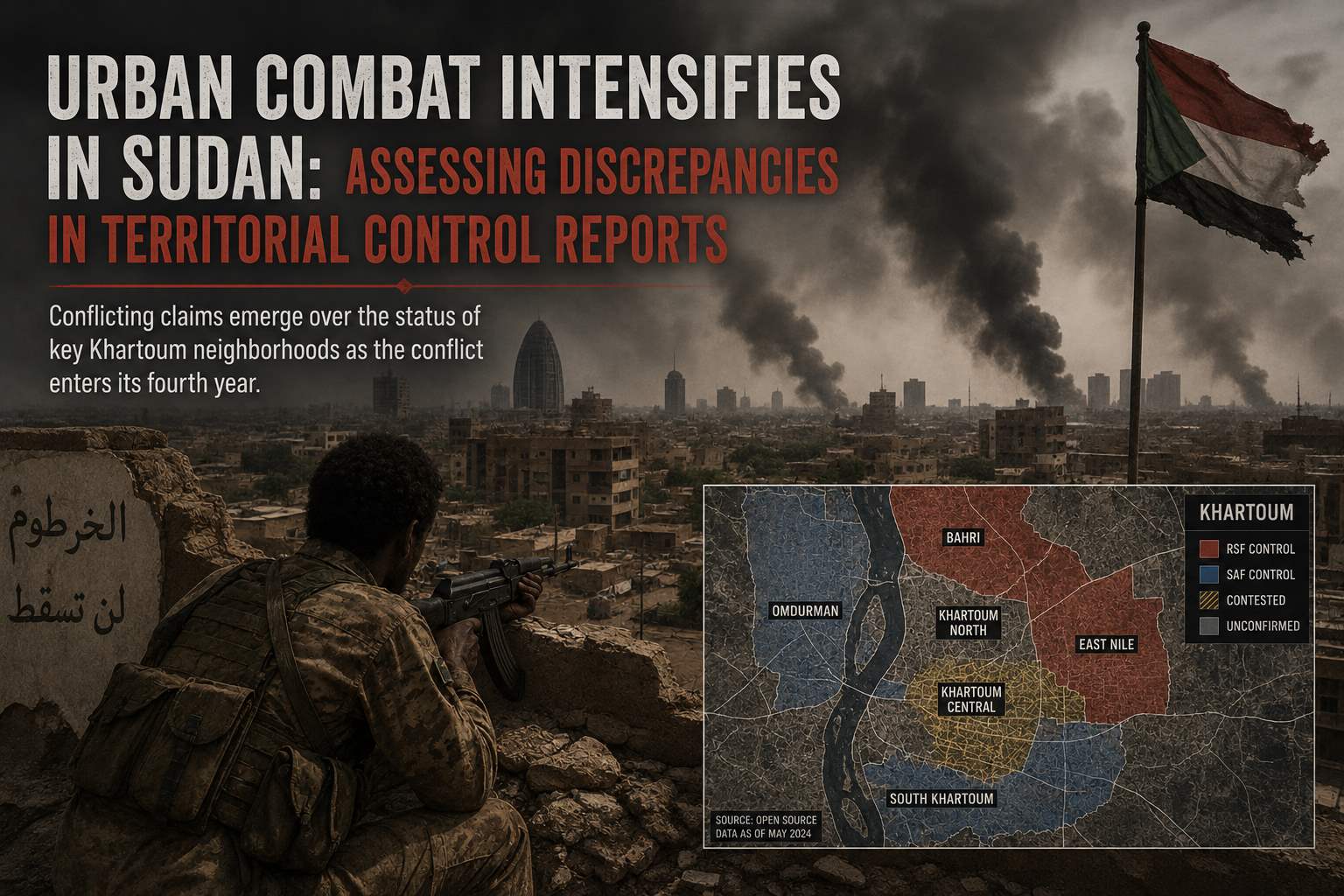
Conflicting claims emerge over the status of key Khartoum neighborhoods as the conflict enters its fourth year.
May 7, 2026
Last updated: May 7, 2026
By Global War News Editorial
Renewed urban combat in Sudan’s capital region has triggered a surge of conflicting reports regarding territorial control. While the Sudanese Armed Forces (SAF) recently announced the “official return” of national institutions to Khartoum, local reports and paramilitary claims suggest that significant portions of the city remain contested or under the control of the Rapid Support Forces (RSF).
The discrepancies center on the “tri-city” area, comprising Khartoum, Omdurman, and Bahri, where the geography of control has become increasingly fragmented. According to a recent Security Council Report, the SAF managed to retake large parts of Khartoum in early 2025, but the RSF remains entrenched in several peripheral neighborhoods and throughout the western Darfur region.
The Fog of Urban Warfare
Verification of frontline shifts in Sudan is notoriously difficult due to the “patchwork” nature of the fighting. In Khartoum, control can change block-by-block, and the use of heavy drone strikes has made static observations more hazardous.
As reported by Al Jazeera, the Sudanese army achieved a major strategic victory in 2025 by breaking the RSF’s siege on Omdurman and securing the Nile corridor. However, Amnesty International noted in an April 2026 briefing that every shift in these frontlines has been characterized by “direct and indiscriminate attacks on civilians,” making it difficult for independent monitors to verify claims without risk to personnel.
Strategic Infrastructure and Institutional Returns
The SAF’s claim of returning government institutions to Khartoum marks a significant symbolic attempt to project stability. Since the outbreak of war in April 2023, the government had been operating primarily from Port Sudan.
According to data from the World Health Organization (WHO), while some “relative stability” is emerging in parts of the east, Khartoum’s infrastructure remains decimated. Over 70% of the city’s health facilities are non-functional, and millions of returning residents face a landscape littered with explosive remnants. Analysts at the Council on Foreign Relations suggest that the return to the capital may be more of a political statement than a reflection of complete military security.
Analysis: The Information Gap
The current conflict in Sudan has evolved into a war of attrition where information is as much a weapon as artillery. By claiming territorial control, both the SAF and RSF seek to bolster their legitimacy before the international community. However, the discrepancy between “official” returns and “on-the-ground” reality suggests a stalemate.
The SAF appears to dominate the east and central Nile regions, while the RSF remains the primary power in Darfur and much of Kordofan. The “urban combat” in Khartoum likely represents a series of tactical raids rather than a full-scale offensive to clear the city. This creates a dangerous “gray zone” for civilians, who may return to neighborhoods under the impression they are safe, only to find themselves in the crossfire of localized skirmishes.
What to Watch
The upcoming UN Security Council session is expected to address the extension of the arms embargo beyond Darfur to cover all of Sudan. Observers will also be watching the Bara, Um Durman road, a key commercial link; control of this route will determine whether the SAF can truly resupply the capital or if the RSF can maintain its economic stranglehold on the city’s western approaches.
Sources: Security Council Report (February 2026), Al Jazeera Interactives, UN News (April 2026), WHO Public Health Situation Analysis (February 2026), Amnesty International Australia briefing, Council on Foreign Relations Conflict Tracker.
This article is based on publicly available reporting from named international news agencies and attributed official statements. All claims about ongoing events are attributed to their original sources. Analysis sections represent the editorial interpretation of reported facts and do not constitute advocacy for any party to the described conflict. AI tools may be utilized for image generation to assist in explaining complex concepts, as well as for refining grammar, spelling, and other linguistic enhancements. However, all original content is produced, fact-checked, and revised by the editorial team. This publication does not take political positions on active military conflicts.