
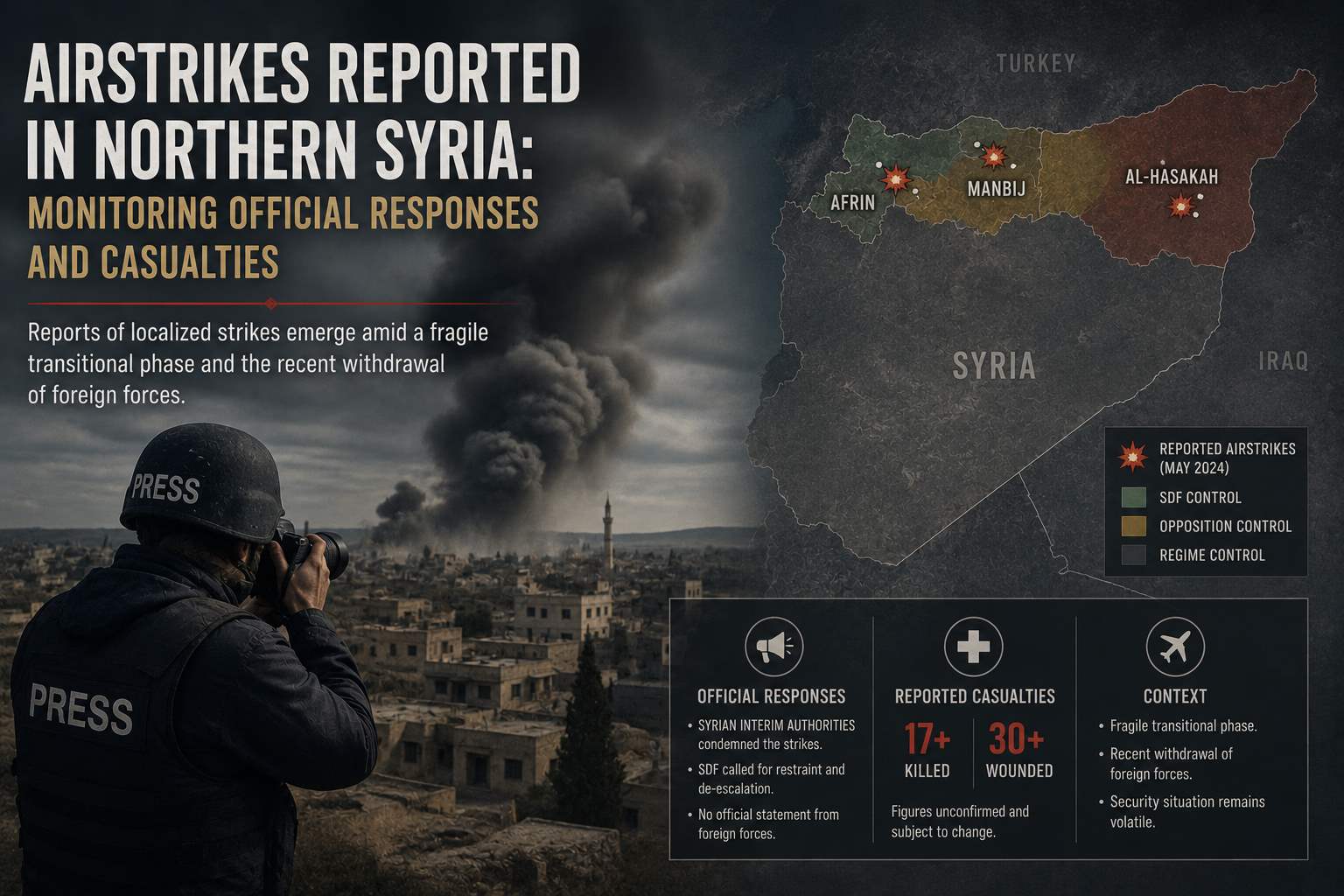
Reports of localized strikes emerge amid a fragile transitional phase and the recent withdrawal of foreign forces.
May 7, 2026
Last updated: May 7, 2026
By Staff Writer, Global War News
Unverified reports of airstrikes in parts of northern Syria have emerged over the last 24 hours, coinciding with a period of high tension as the nation navigates a complex political transition. While local monitoring groups have noted explosions near established security corridors, official confirmation from the interim government in Damascus remains pending.
According to the Syrian Network for Human Rights (SNHR), at least four civilians were reportedly killed by gunfire from unidentified sources in Homs earlier this week, highlighting a broader pattern of persistent instability. However, the specific hardware and origin of the most recent reported aerial activity in the north have not been independently verified by international observers.
A Shifting Security Landscape
The reported activity comes shortly after significant shifts in the regional military footprint. On April 16, 2026, the United States reportedly finalized the redeployment of its forces out of Syria, handing over several key bases to the interim government. This withdrawal, which began in 2025, has left a vacuum that local factions and external actors are currently navigating.
As reported by Al Jazeera, the reopening of Syrian airspace on April 8 was intended to signal a return to normalization. Yet, the Security Council Report for May 2026 indicates that the security context remains “fraught,” compounded by intercommunal tensions and the presence of residual extremist cells.
Casualties and Official Responses
Official figures regarding casualties from the overnight reports are currently unavailable. The United Nations has recently transitioned its humanitarian operations from cross-border models to commercial supply routes, a shift that UN Under-Secretary-General Tom Fletcher described as a “deliberate transition” following the normalization of trade links.
While the Syrian government has condemned recent tangential incidents, such as reported tank fire in the Quneitra municipality, it has not yet issued a formal briefing on the alleged strikes in the north. In past instances, Damascus has attributed such actions to external interference aimed at disrupting the transitional justice process.
Analysis: The Risks of the Transitional Phase
The current situation in Syria is characterized by “A ceasefire in name only,” according to some regional humanitarian reports. The transition from the Bashar al-Assad era to an interim structure has created a delicate period where accountability mechanisms are still being established.
Analysts suggest that localized strikes may be intended to test the air defense capabilities of the new interim administration or to pressure Kurdish and Druze factions during ongoing negotiations regarding representation in the People’s Assembly. The lack of immediate official statements suggests a cautious approach by the transitional authorities as they attempt to maintain “nominal control” without escalating regional friction.
What to Watch
The UN Security Council is scheduled to hold a monthly meeting later in May to discuss these political and humanitarian developments. Observers will be looking for a briefing from Deputy Special Envoy Claudio Cordone, specifically regarding the status of the “Suweida roadmap” and the integration of the Syrian Democratic Forces (SDF). Any confirmed escalation in the north could significantly impact the 2026 Humanitarian Needs and Response Plan, which currently seeks to assist millions of displaced persons.
Sources: Security Council Report (May 2026 Forecast), UN Noon Briefing (May 4, 2026), Syrian Network for Human Rights (SNHR) Daily Report, Al Jazeera regional coverage, Reuters archives.
This article is based on publicly available reporting from named international news agencies and attributed official statements. All claims about ongoing events are attributed to their original sources. Analysis sections represent the editorial interpretation of reported facts and do not constitute advocacy for any party to the described conflict. AI tools may be utilized for image generation to assist in explaining complex concepts, as well as for refining grammar, spelling, and other linguistic enhancements. However, all original content is produced, fact-checked, and revised by the editorial team. This publication does not take political positions on active military conflicts.