
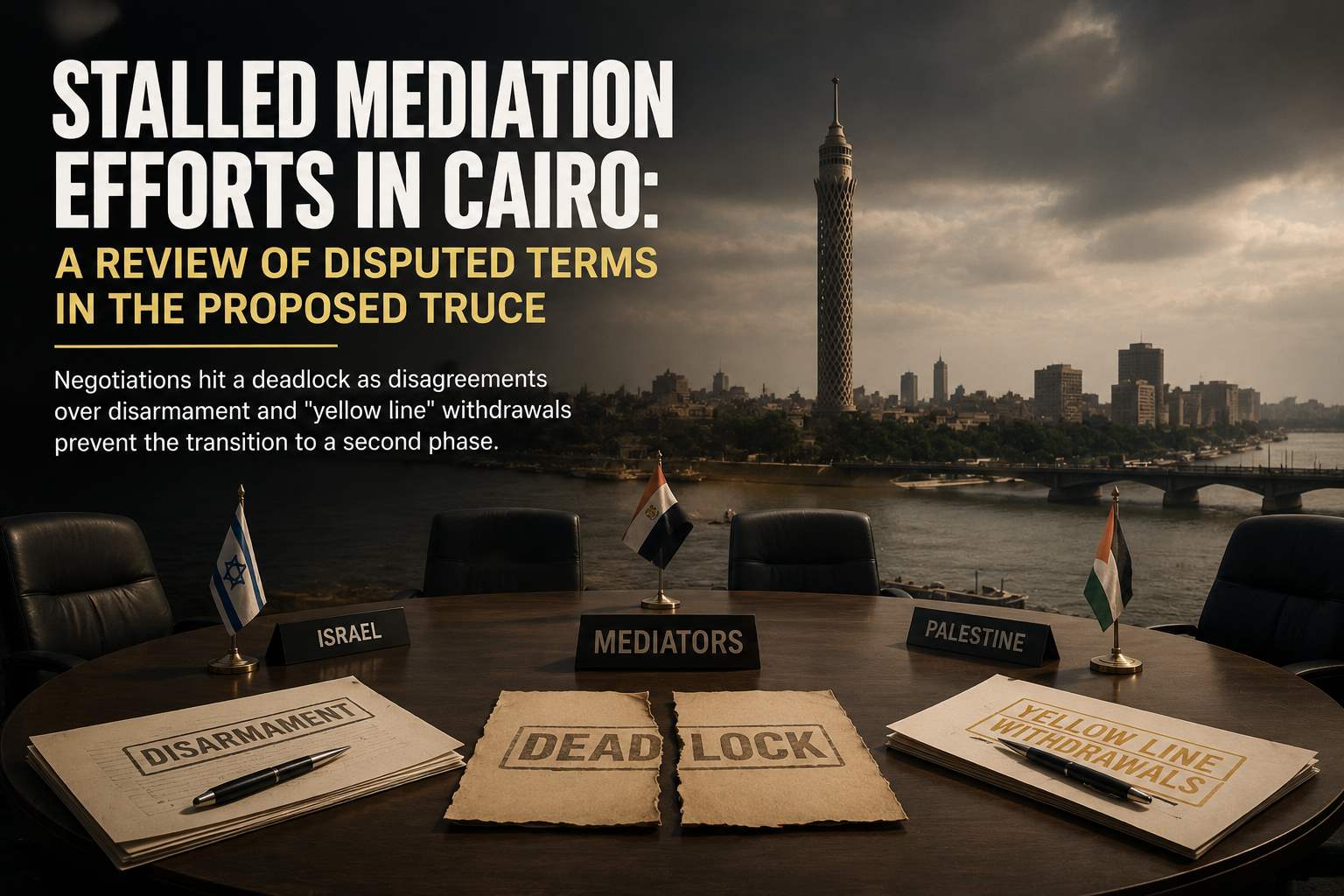
Negotiations hit a deadlock as disagreements over disarmament and “yellow line” withdrawals prevent the transition to a second phase.
May 7, 2026
Last updated: May 7, 2026
By Global War News Editorial
Mediation efforts in Cairo aimed at stabilizing a fragile ceasefire have reached a critical stalemate. High-level delegations from Hamas and Fatah, alongside mediators from Egypt, the United States, and the United Nations, are currently deadlocked over the terms required to transition from the initial truce to a permanent agreement.
According to a report by the Palestine Chronicle, recent discussions centered on a 15-point proposal drafted by the “Board of Peace,” an international mediating body. However, the talks stalled this week after the Palestinian delegation rejected a framework that would link humanitarian reconstruction and military withdrawal directly to a pre-emptive disarmament of Gaza-based factions.
The Disarmament Dispute
The primary point of friction remains the sequencing of the truce phases. In a statement reported by Middle East Monitor, Hamas officials informed mediators that they would not proceed to the second phase of the deal until the terms of the first phase, including the entry of 600 aid trucks daily, are fully implemented.
A central point of contention is the role of Nickolay Mladenov, the U.N. envoy and head of the Board of Peace. Sources close to the talks reported that Mladenov has pushed for a “disarmament timetable” ranging from six months to one year. Hamas has reportedly rejected this, insisting that any discussion regarding weapons must occur within a “comprehensive national framework” and only after the formal establishment of a Palestinian state is guaranteed.
The “Yellow Line” and Withdrawal Lines
Another significant obstacle is the physical location of forces. Under the initial understandings of the U.S.-brokered truce, Israeli forces were expected to withdraw to a predetermined “yellow line” to allow for the return of displaced civilians.
However, as reported by Al Jazeera and confirmed by satellite data cited in regional briefings, Israeli units have reportedly remained in several forward positions, with some advancing into new sectors in late April. The Israeli government has reportedly informed mediators that a full withdrawal to the yellow line is a matter for the second phase of negotiations, rather than a prerequisite for them.
Humanitarian Stakes and Economic Fallout
The stalled talks have immediate humanitarian consequences. While the first phase of the agreement called for the entry of 600 aid trucks per day, UN records indicate that current flows remain significantly lower.
According to data from the Egyptian Cabinet and reported by Anadolu Agency, the ongoing regional instability continues to impact broader logistics. Egyptian President Abdel Fattah el-Sisi stated earlier this week that the war has resulted in approximately $10 billion in losses for the Suez Canal, underscoring the economic pressure on Cairo to secure a resolution.
Analysis: The Risk of a “Fragile Calm”
The current situation in Cairo suggests that while neither side wishes for a return to full-scale war, the “peace” currently in place is exceptionally fragile. By linking disarmament to reconstruction, mediators have introduced a “zero-sum” element into the talks: the Palestinian side views disarmament without a state as a total surrender, while Israel views reconstruction without disarmament as a security risk.
Observers note that this stalemate creates a vacuum often filled by localized escalations. Without a clear path to “Phase Two,” the ceasefire remains a temporary suspension of violence rather than a bridge to a permanent settlement. The insistence on the “yellow line” withdrawal has become the symbolic litmus test for whether the diplomatic track still holds weight.
What to Watch
The next 72 hours are considered a “cooling-off” period. Watch for whether the Board of Peace revises the 15-point proposal to decouple humanitarian aid from the disarmament schedule. Additionally, the arrival of any new mediators from the U.S. “International Board of Peace” could signal a final attempt to salvage the second phase before the current truce terms expire.
Sources: Palestine Chronicle (May 6, 2026), Middle East Monitor (May 4, 2026), Al Jazeera regional reporting, Anadolu Agency (May 7, 2026), Security Council Report (May 2026), Council on Foreign Relations Conflict Tracker.
This article is based on publicly available reporting from named international news agencies and attributed official statements. All claims about ongoing events are attributed to their original sources. Analysis sections represent the editorial interpretation of reported facts and do not constitute advocacy for any party to the described conflict. AI tools may be utilized for image generation to assist in explaining complex concepts, as well as for refining grammar, spelling, and other linguistic enhancements. However, all original content is produced, fact-checked, and revised by the editorial team. This publication does not take political positions on active military conflicts.