
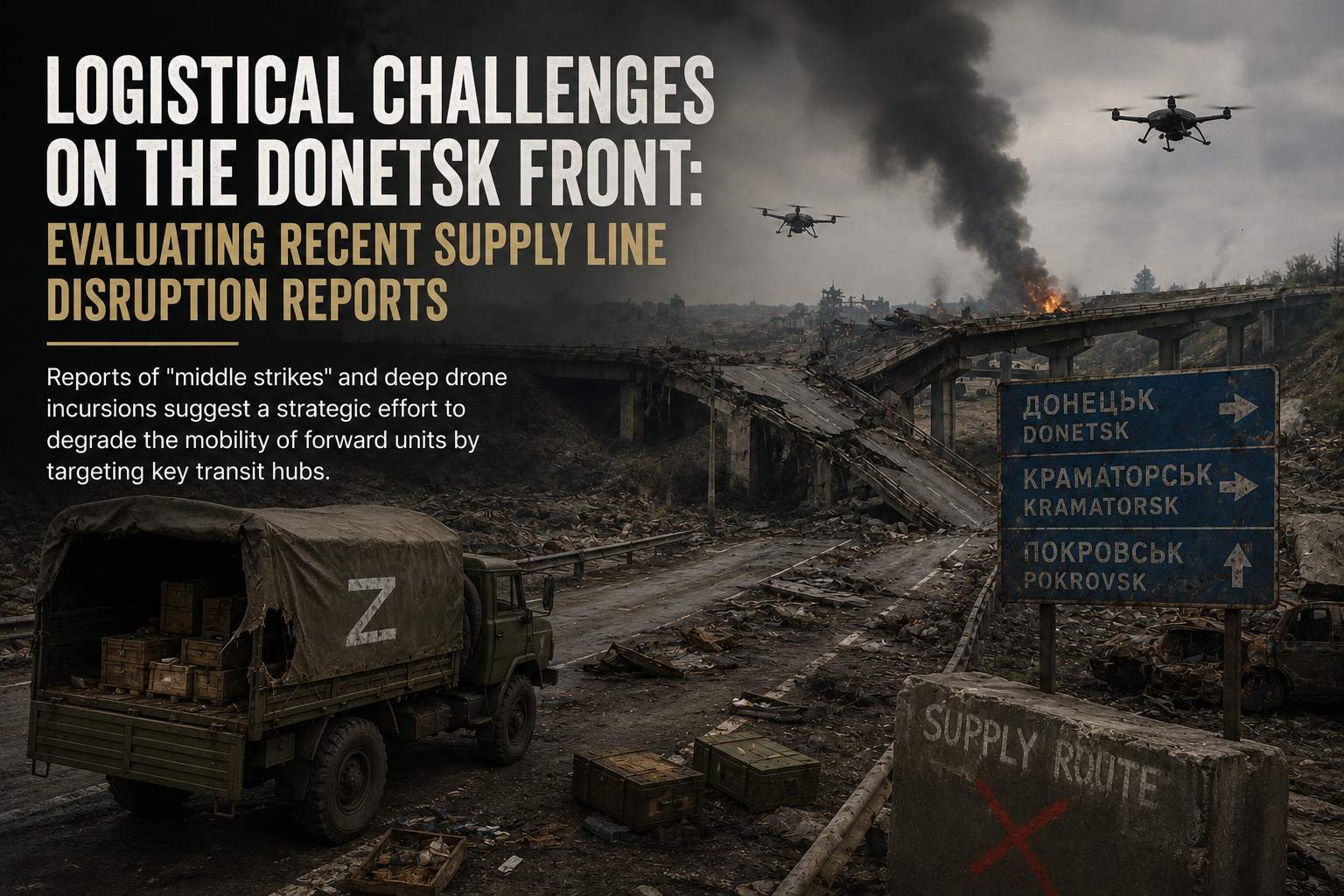
Reports of “middle strikes” and deep drone incursions suggest a strategic effort to degrade the mobility of forward units by targeting key transit hubs.
May 7, 2026
Last updated: May 7, 2026
By Staff Writer, Global War News
Logistical networks supporting military operations in the Donetsk region are reportedly facing sustained pressure as a new wave of long-distance and “middle-range” strikes targets critical supply corridors. According to recent field reports and satellite data, these engagements have focused on rail junctions, fuel depots, and transport ring roads that serve as the backbone for frontline resupply.
Reports from the region, including briefings from the 1st Corps of the National Guard of Ukraine “Azov,” indicate that the reach of these strikes has extended more than 50 kilometers behind established frontlines. These operations reportedly target “deep operational zones” that were previously considered secure rear areas, suggesting a shift in the reach of unmanned aerial systems (UAVs).
The Erosion of the “Secure Rear”
The concept of a secure logistical rear in the Donetsk sector is increasingly contested. According to a report by Reuters on May 5, 2026, the frequency of strikes targeting logistics hubs and troop concentrations dozens of kilometers behind the front line has more than doubled since March. This campaign, often referred to as “middle strikes,” aims to disrupt the flow of ammunition and fuel before it reaches the active combat zone.
As reported by United24 Media, specifically high-value targets such as fuel trains and ammunition warehouses have been hit in sectors including Zuhres, Horlivka, and the Donetsk ring road. Satellite imagery and drone footage released by monitoring groups show smoke plumes rising from several major logistical junctions, though the full extent of the structural damage remains difficult to verify independently.
Impact on Frontline Mobility and Resource Flows
The disruption of these corridors has immediate tactical consequences. Analysts at the International Strategic Research Institute note that when primary rail and road links are compromised, military forces must resort to decentralized, smaller-scale transport. This shift typically reduces the volume of supplies delivered and increases the time required to reposition units.
According to a report by ReliefWeb, these logistical pressures are also compounded by seasonal factors. While spring typically allows for easier movement, the sustained destruction of railway infrastructure, which has affected 14 regions since March, limits the ability to move heavy hardware and bulk humanitarian aid. In the Donetsk oblast specifically, households and military units alike are facing “compounding pressures” from restricted market access and fuel constraints.
Analysis: The Attrition of Infrastructure
The current focus on logistics suggests a “systemic campaign of exhaustion.” By targeting the hardware of movement—trucks, tankers, and trains—the attacking forces are attempting to create a “logistical vacuum” that makes sustained offensive operations nearly impossible.
Observers note that while territorial gains on the map may appear stagnant, the “war of the roads” in the rear is where the most significant shifts are occurring. The ability to strike deep into the Donetsk ring road indicates a potential gap in traditional air defense networks, which were designed for larger, faster targets rather than low-flying, autonomous drones. This raises questions about the long-term sustainability of the current defensive posture if primary supply lines remain under constant surveillance and fire control.
What to Watch
In the coming days, the focus will likely remain on the “tri-city” logistical hub of Donetsk, Omdurman, and Bahri. Observers should watch for any official statements regarding the repair status of the major rail links connecting these hubs to the eastern border. Additionally, a scheduled briefing by the UN Office for the Coordination of Humanitarian Affairs (OCHA) later this week may provide more clarity on whether these military supply disruptions are further impacting the already fragile civilian food and energy supply in the region.
Sources: Reuters (May 5, 2026), United24 Media (April 16, 2026), ReliefWeb/FEWS NET (May 1, 2026), Associated Press regional archives, 1st Corps National Guard of Ukraine “Azov” official statements.
This article is based on publicly available reporting from named international news agencies and attributed official statements. All claims about ongoing events are attributed to their original sources. Analysis sections represent the editorial interpretation of reported facts and do not constitute advocacy for any party to the described conflict. AI tools may be utilized for image generation to assist in explaining complex concepts, as well as for refining grammar, spelling, and other linguistic enhancements. However, all original content is produced, fact-checked, and revised by the editorial team. This publication does not take political positions on active military conflicts.