
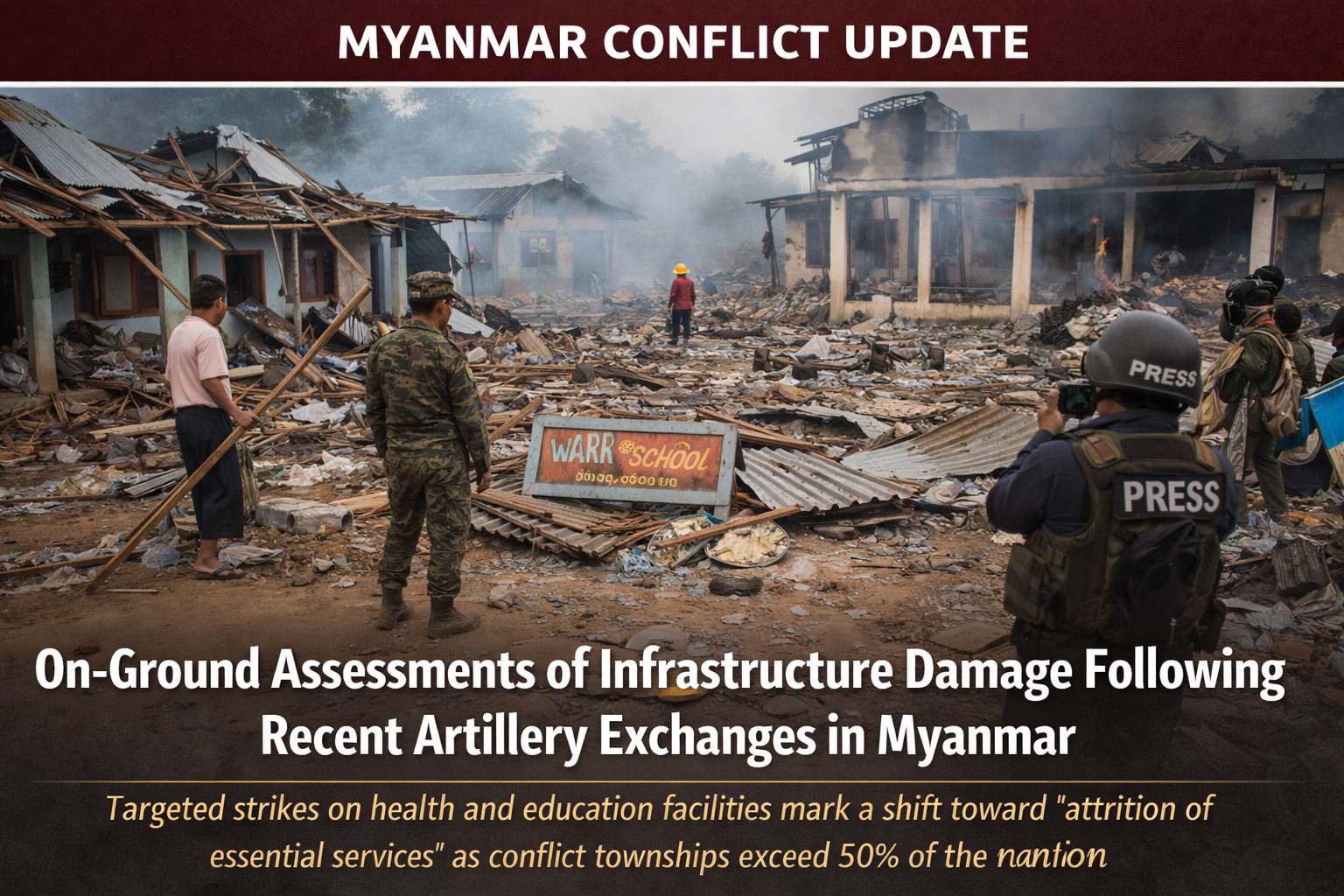
Targeted strikes on health and education facilities mark a shift toward “attrition of essential services” as conflict townships exceed 50% of the nation.
May 7, 2026
Last updated: May 7, 2026
By Staff Writer, Global War News
Recent artillery exchanges and aerial bombardments across Myanmar have resulted in significant damage to civilian infrastructure, particularly in the Sagaing and Mandalay regions. On-ground reports indicate that the conflict has shifted from territorial skirmishes to a deliberate degradation of institutional hubs, with schools and hospitals increasingly caught in the crossfire.
According to a situation report from ReliefWeb released this morning, at least 1,869 incidents of violence against or obstruction of healthcare have been identified since 2021, with a sharp uptick in “collateral” infrastructure damage noted in the first quarter of 2026. Military analysts suggest that the use of heavy artillery in urban townships is creating a “service vacuum” designed to undermine the administrative capacity of local resistance forces.
The Targeting of Institutional Hubs
The scale of the damage is most evident in the Sagaing region, where “makeshift hospitals” and public high schools have been the primary targets of recent airstrikes. As reported by Al Jazeera, the National Unity Government (NUG) has claimed that these strikes are not accidental, but rather a strategic effort to displace communities by destroying their survival infrastructure.
In Mogoke township, local media reported that a township hospital, briefly occupied by military forces, was subjected to rocket fire, causing extensive structural damage to the pediatric and surgical wings. While the military administration (SAC) frequently attributes such damage to “terrorist insurgents,” international monitors from the UN have noted that the majority of documented incidents involving heavy weaponry are consistent with military-grade artillery and fighter jet munitions.
Economic Dislocation and Supply Chain Collapse
The physical destruction of infrastructure is coupled with a “crippling” of the national economy. According to the BTI Project’s Myanmar Country Report for 2026, over half of the country’s townships are now involved in active conflict. This has resulted in the severance of primary border trade routes with Thailand and India.
The economic impact is manifested in several ways:
- Logistics Costs: Transit insurance for domestic cargo has reportedly tripled in the last six months.
- Energy Crisis: Frequent strikes on electrical substations in Shan State have led to a 70% reduction in industrial output in affected areas.
- Agricultural Decline: Artillery fire in the “rice bowl” regions of Sagaing has destroyed irrigation systems, which the UN warns could lead to localized food shortages by late 2026.
Analysis: The “Scorched Service” Strategy
What we are observing is the evolution of a “scorched earth” policy into a “scorched service” strategy. By targeting hospitals and schools, the goal appears to be the demoralization of the civilian population and the forced displacement of anyone supporting resistance governance.
Observers note that this strategy serves as a dual-edged weapon. For the military, it clears “insurgent-friendly” populations from strategic corridors. For the resistance, it creates an immense administrative burden, as they must now govern and provide for millions of displaced people with no functional buildings to house them. This raises critical questions about the long-term feasibility of a “Federal Democratic Union” if the physical foundations of that state, its schools and clinics, are systematically erased.
What to Watch
The upcoming ASEAN summit in Cebu, Philippines, is expected to address these escalations. Sources reported by Reuters suggest that the Philippines and Thailand are pushing for a “Special Envoy” mission to specifically inspect civilian infrastructure damage. Additionally, watch for the NUG’s attempt to form a “unified coalition” with ethnic armed organizations (EAOs), as a consolidated command structure could shift the defensive focus toward protecting remaining urban hubs from further artillery bombardment.
Sources: ReliefWeb/Insecurity Insight (May 2026), BTI Project Myanmar Country Report (May 2026), Al Jazeera regional coverage, Reuters archives (May 6, 2026), UN OCHA Humanitarian Situation Report.
This article is based on publicly available reporting from named international news agencies and attributed official statements. All claims about ongoing events are attributed to their original sources. Analysis sections represent the editorial interpretation of reported facts and do not constitute advocacy for any party to the described conflict. AI tools may be utilized for image generation to assist in explaining complex concepts, as well as for refining grammar, spelling, and other linguistic enhancements. However, all original content is produced, fact-checked, and revised by the editorial team. This publication does not take political positions on active military conflicts.