
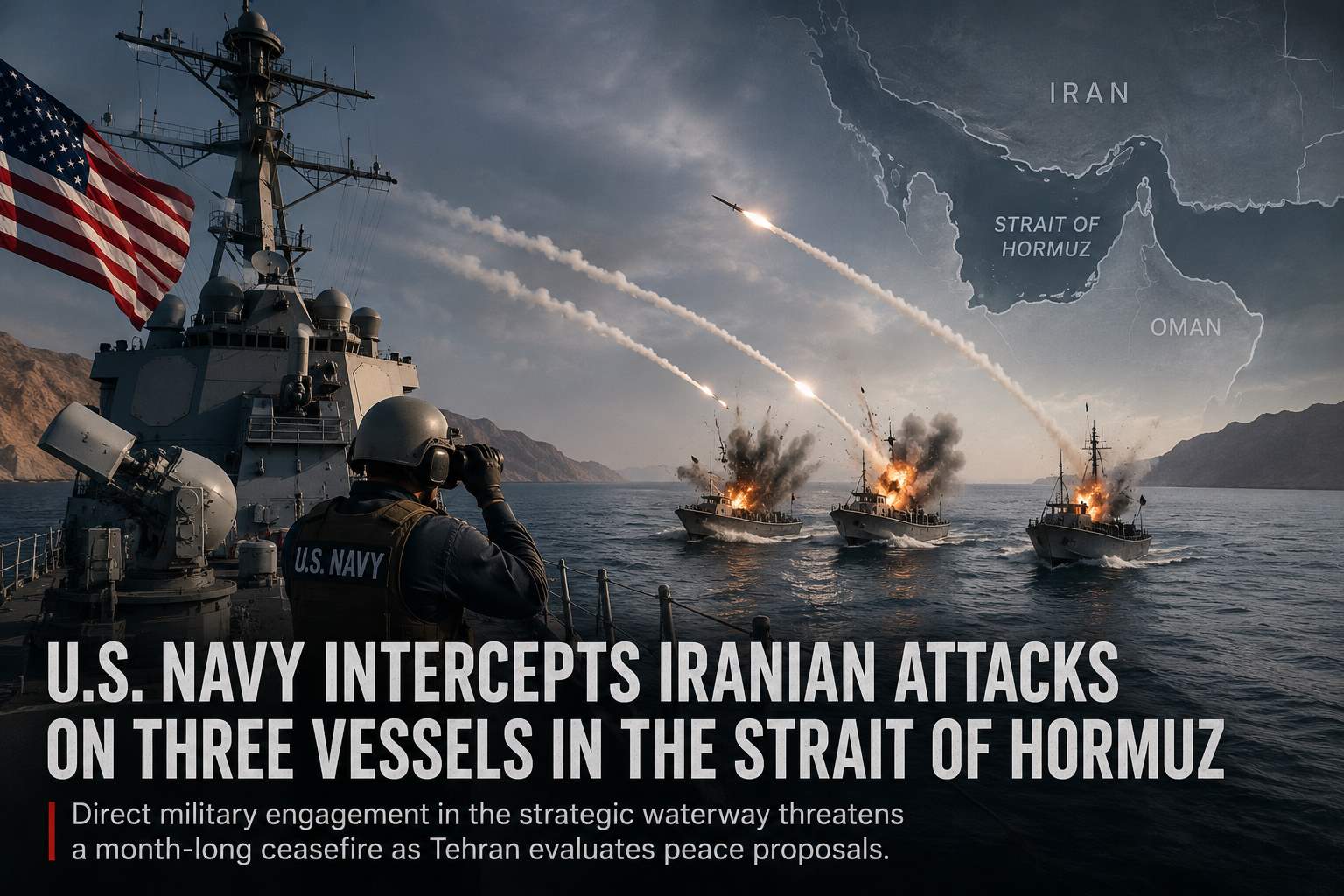
Direct military engagement in the strategic waterway threatens a month-long ceasefire as Tehran evaluates peace proposals.
May 8, 2026
Global War News Editorial
The United States military confirmed on Thursday that it intercepted a series of coordinated Iranian attacks targeting three U.S. Navy destroyers transiting the Strait of Hormuz. The engagement, involving ballistic missiles, drones, and small boats, represents the most significant direct clash between the two powers since a tenuous ceasefire took effect on April 8.
U.S. Central Command (CENTCOM) identified the targeted vessels as the USS Truxtun, USS Rafael Peralta, and USS Mason. According to an official CENTCOM statement, U.S. forces successfully neutralized all inbound threats as the ships were moving through the international sea passage toward the Gulf of Oman. No U.S. assets were struck or damaged in the encounter.
The Exchange in the Strait
The Islamic Revolutionary Guard Corps (IRGC) Navy characterized the operation as a “large-scale and precise combined operation.” According to reports from Iran’s state broadcaster IRIB, the IRGC claimed the strike was a response to what it described as a U.S. ceasefire violation involving an earlier attack on an Iranian oil tanker, the M/T Hasna, near Jask port.
While Iranian state media claimed that the U.S. vessels sustained “significant damage” and were forced to retreat, President Donald Trump disputed this account in a post on Truth Social. The President asserted that the three “World Class American Destroyers” completed their transit successfully and that U.S. retaliatory strikes caused “great damage” to Iranian military facilities responsible for the launch, including drone sites and command centers.
Regional Escalation and UAE Involvement
The naval engagement coincided with a separate escalation involving the United Arab Emirates. On Friday, the UAE Ministry of Defense announced that its air defense systems intercepted two ballistic missiles and three drones launched from Iranian territory. The ministry reported that the incursions resulted in three moderate injuries.
According to data released by Abu Dhabi, the UAE has intercepted over 2,800 projectiles since the broader conflict began on February 28. This latest volley underscores the continued vulnerability of regional partners despite ongoing diplomatic efforts in Pakistan intended to secure a permanent end to the 69-day war.
Analysis: A Fragile Diplomatic Window
The timing of these strikes is particularly notable as Tehran is currently “reviewing” a formal U.S. proposal to end the conflict. Analysts suggest that the IRGC’s actions may reflect internal divisions within the Iranian leadership or a “pressure-cooker” strategy intended to improve Tehran’s leverage at the negotiating table.
Observers note that while both sides are publicly maintaining that the ceasefire remains “active,” the resumption of kinetic activity in the Strait of Hormuz creates a high risk of accidental escalation. President Trump has signaled that the U.S. naval blockade—which he referred to as a “Wall of Steel”, will remain in place until a deal is signed, while Tehran continues to demand the lifting of sanctions as a prerequisite for reopening the waterway.
Economic Implications
The Strait of Hormuz is the world’s most important oil transit chokepoint. Any return to active hostilities in this corridor immediately impacts global energy markets. While international markets initially showed signs of stability on hopes of a deal, the latest exchange of fire has introduced fresh volatility. Market participants are closely watching the Pakistani-mediated talks to see if this latest flare-up will derail the 30-day negotiation window established last month.
Source Disclosure: Reporting from the Associated Press, Reuters, and Anadolu Agency. Official statements from U.S. Central Command, the Iranian Foreign Ministry, and the UAE Ministry of Defense.
This article is based on publicly available reporting from named international news agencies and attributed official statements. All claims about ongoing events are attributed to their original sources. Analysis sections represent the editorial interpretation of reported facts and do not constitute advocacy for any party to the described conflict. AI tools may be utilized for image generation to assist in explaining complex concepts, as well as for refining grammar, spelling, and other linguistic enhancements. However, all original content is produced, fact-checked, and revised by the editorial team. This publication does not take political positions on active military conflicts.