
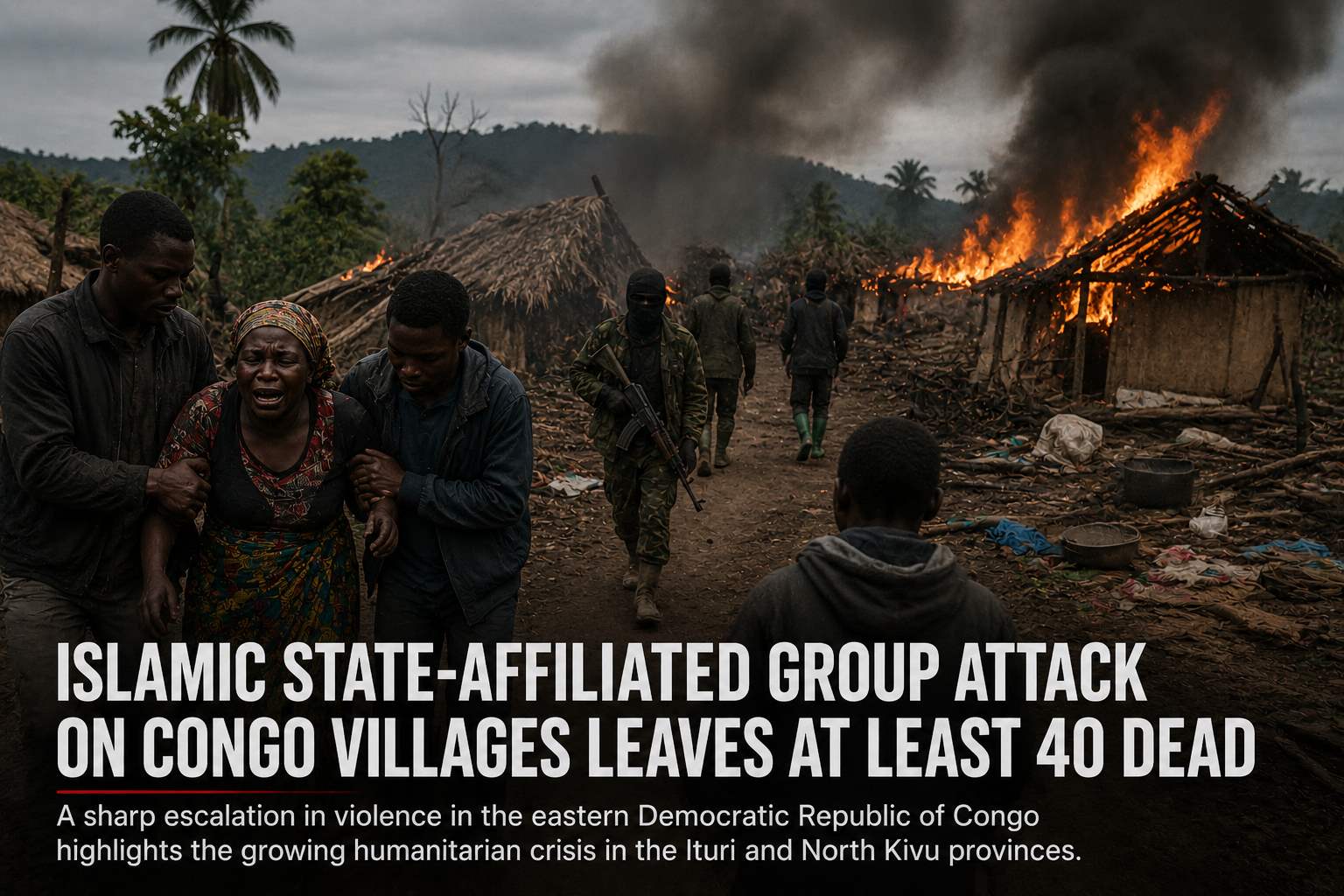
A sharp escalation in violence in the eastern Democratic Republic of Congo highlights the growing humanitarian crisis in the Ituri and North Kivu provinces.
May 8, 2026
Global War News Editorial
At least 40 people were killed in a series of overnight attacks on villages in the eastern Democratic Republic of Congo (DRC), according to local civil society groups and officials on Friday. The assaults, which occurred between Wednesday night and Thursday afternoon, are being attributed to the Allied Democratic Forces (ADF), an armed group that pledged allegiance to the Islamic State in 2019.
The killings took place in border regions near Uganda, targeting communities in the Beni territory of North Kivu and the neighboring Ituri province. Charité Banza, a leader of the Ituri civil society group, told the Associated Press that 25 victims were discovered in North Kivu, while 15 others were found in Ituri. Local residents reported that homes were looted and burned during the raids, leaving several people still missing.
The Persistence of the ADF
The Allied Democratic Forces, originally formed in Uganda, has operated in the dense forests of eastern DRC for decades. Since formalizing its ties with the Islamic State’s Central Africa Province (ISCAP), the group has intensified its campaign against civilian populations. This latest massacre follows a report released earlier this week by Amnesty International, which accused the ADF of “war crimes and crimes against humanity,” including mass murder, abductions, and forced labor.
According to a report by Al Jazeera, the group has increasingly utilized guerrilla tactics to evade joint military operations conducted by the Congolese and Ugandan armies. Despite these offensive efforts, which began in late 2021, the ADF remains capable of launching high-casualty strikes against vulnerable rural villages.
A Fragmented Security Landscape
The DRC is currently grappling with the presence of approximately 100 different rebel groups, creating a complex and volatile security environment. While international attention has frequently focused on the Rwanda-backed M23 rebel group, which has seized significant territory in the eastern region, analysts suggest the ADF has capitalized on this distraction to expand its own operations.
Local officials have expressed frustration with the pace of the military response. Alain Siwako, a member of the North Kivu provincial parliament, stated that the provisional death toll could rise as search efforts continue. In remarks reported by International Christian Concern, Siwako criticized the current security strategy, noting that the enemy continues to earn territory while forcing thousands of families to abandon their homes and livelihoods.
Analysis: Humanitarian and Regional Stability
The recurrence of mass casualty events in eastern Congo underscores the ongoing failure to protect civilians in the nation’s restive east. The United Nations has previously characterized similar ADF attacks as “bloodbaths,” yet the humanitarian response remains strained by the sheer scale of displacement. According to the UN Refugee Agency, millions of Congolese are now internally displaced, many of whom lack access to basic food, water, and healthcare.
Observers note that the ADF’s resilience is bolstered by its ability to melt into the local population or retreat into the cross-border geography of the Lake Edward region. This creates a persistent threat not only to the DRC but also to regional stability in East Africa. Without a more effective strategy to secure the “Adre corridor” and other vital routes, the cycle of violence and displacement appears likely to persist through 2026.
Outlook
Government forces in Kinshasa have pledged to increase patrols in the affected territories, but residents remain skeptical. As the search for the missing continues, the immediate focus remains on preventing further incursions and addressing the urgent needs of those who fled the most recent violence. The international community continues to monitor whether the ICC or other legal bodies will take further action following the recent allegations of war crimes.
Source Disclosure: Reporting from the Associated Press, Reuters, Al Jazeera, and Xinhua. Official statements from the Congolese civil society groups and provincial parliament members.
This article is based on publicly available reporting from named international news agencies and attributed official statements. All claims about ongoing events are attributed to their original sources. Analysis sections represent the editorial interpretation of reported facts and do not constitute advocacy for any party to the described conflict. AI tools may be utilized for image generation to assist in explaining complex concepts, as well as for refining grammar, spelling, and other linguistic enhancements. However, all original content is produced, fact-checked, and revised by the editorial team. This publication does not take political positions on active military conflicts.