
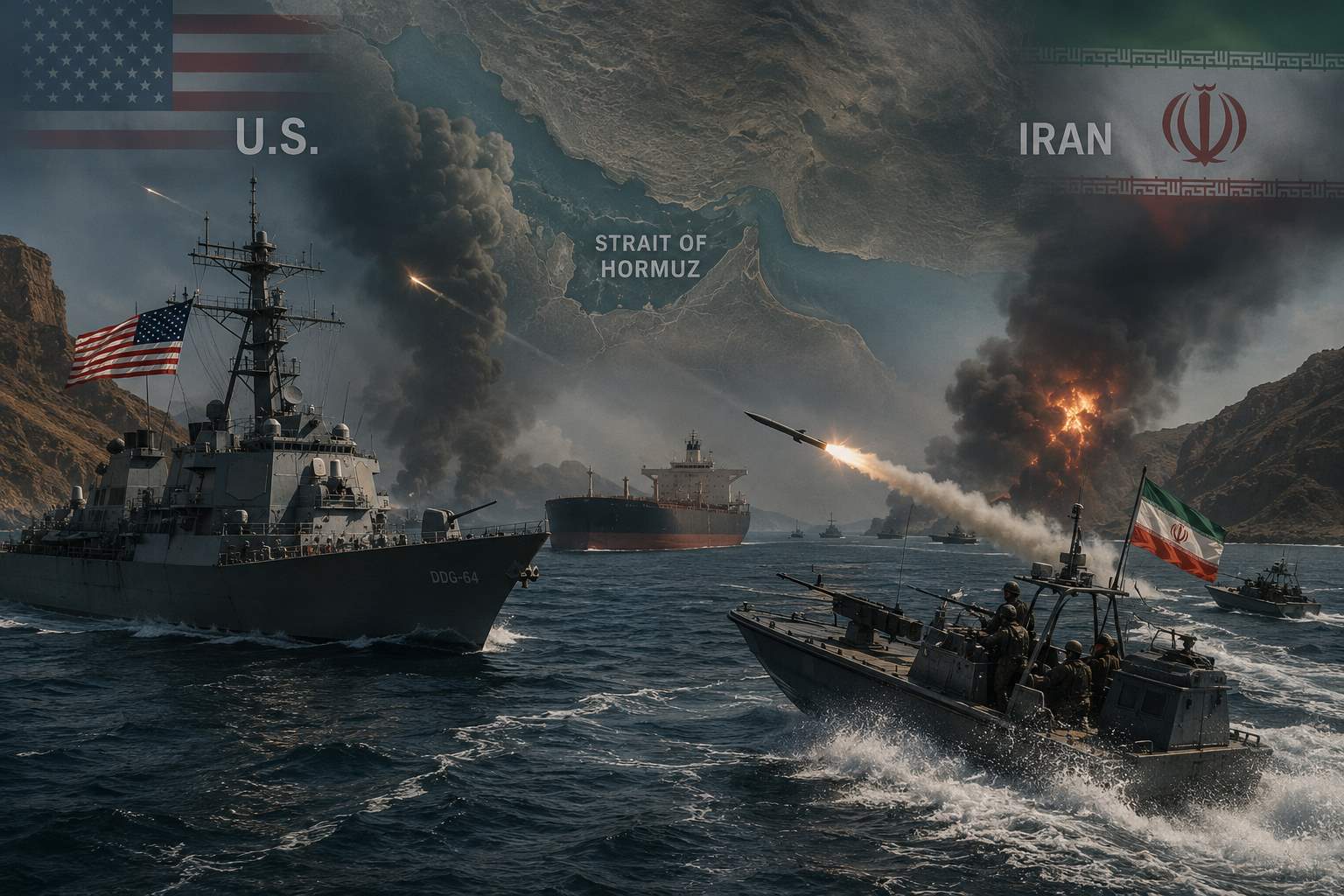
Naval engagement near the world’s most critical energy chokepoint threatens to unravel a month-old ceasefire and restart full-scale regional conflict.
Monday, May 11, 2026
Last updated: 09:04 AM GMT
Global War News Editorial
United States naval forces and Iranian military units have exchanged direct fire in the Strait of Hormuz, according to official statements from both Washington and Tehran. The engagement, which occurred overnight between Thursday and Friday, involved U.S. destroyers and Iranian naval facilities. On Friday afternoon, U.S. forces reportedly disabled two Iranian oil tankers that the Pentagon claims were attempting to breach a naval blockade.
The violence represents the most serious challenge to a tenuous ceasefire mediated by Pakistan that has been in place since April 8. While U.S. President Donald Trump stated on Friday that the truce remains “in effect,” the exchange of fire has immediately impacted global markets. Brent crude futures jumped as much as 7.5% following reports of the clash, reflecting fears of a return to the total closure of the waterway.
Iran has largely controlled or blocked the Strait of Hormuz since the current conflict began on February 28. The waterway is essential for the movement of approximately 20% of the world’s oil and liquefied natural gas (LNG). The recent engagement follows a U.S. decision on April 13 to impose its own naval blockade targeting vessels traveling to and from Iranian ports.
The Nature of the Engagement
According to the Associated Press, U.S. fighter jets disabled two Iranian tankers on Friday after those vessels allegedly attempted to bypass American blockade lines. This followed a nighttime exchange where U.S. destroyers targeted Iranian military facilities within the strait. The U.S. military reported that it thwarted attacks on three of its Navy ships and stated that no American vessels were hit during the encounter.
Tehran has provided a different account of the initiation of hostilities. While confirming the exchange of fire, Iranian officials alleged that Washington initiated the strikes. The Iranian Revolutionary Guard Corps (IRGC) has maintained that it holds “complete control” of the strait and has warned that any entry by foreign military vessels near the waterway is viewed as a breach of the ceasefire.
Economic Impact and Energy Security
The Strait of Hormuz is the world’s most sensitive maritime chokepoint. Analysts note that even brief escalations in this area cause immediate spikes in energy costs. Prior to the 2026 conflict, the strait handled nearly 20 million barrels of oil per day. Since the outbreak of hostilities in February, this volume has been severely restricted, pushing crude prices repeatedly above $100 per barrel.
The United Arab Emirates (UAE) reported additional drone and missile attacks following the naval engagement, further heightening concerns for regional infrastructure. Logistics experts suggest that hundreds of commercial vessels remain “bottled up” in the Persian Gulf, unable to reach the open sea due to the combined impact of the Iranian closure and the U.S. counter-blockade.
Analysis: A Fragile Path to Peace
This escalation occurs at a critical juncture for international diplomacy. Pakistan has been mediating talks in Islamabad aimed at a permanent settlement. The U.S. proposal requires Iran to reopen the strait and roll back its nuclear program in exchange for conditional sanctions relief. Iran has countered with a 10-point plan that includes a full lifting of sanctions and reconstruction aid.
Observers note that the ceasefire has been “violated by both sides” since its inception. The central friction remains the U.S. naval blockade; Iran argues the truce is invalid if its ports remain restricted, while the U.S. maintains the blockade is necessary until a final nuclear agreement is signed. Secretary of State Marco Rubio stated on Friday that it is “unacceptable” for Iran to vet or tax ships seeking passage through the international waterway.
Source Disclosure: This report relies on data and verified statements from the Associated Press (AP), Reuters, Al Jazeera, and official briefings from the United States Central Command (CENTCOM) and the Iranian Foreign Ministry. Economic data was sourced from Bloomberg and the IMF.
This article is based on publicly available reporting from named international news agencies and attributed official statements. All claims about ongoing events are attributed to their original sources. Analysis sections represent the editorial interpretation of reported facts and do not constitute advocacy for any party to the described conflict. AI tools may be utilized for image generation to assist in explaining complex concepts, as well as for refining grammar, spelling, and other linguistic enhancements. However, all original content is produced, fact-checked, and revised by the editorial team. This publication does not take political positions on active military conflicts.