
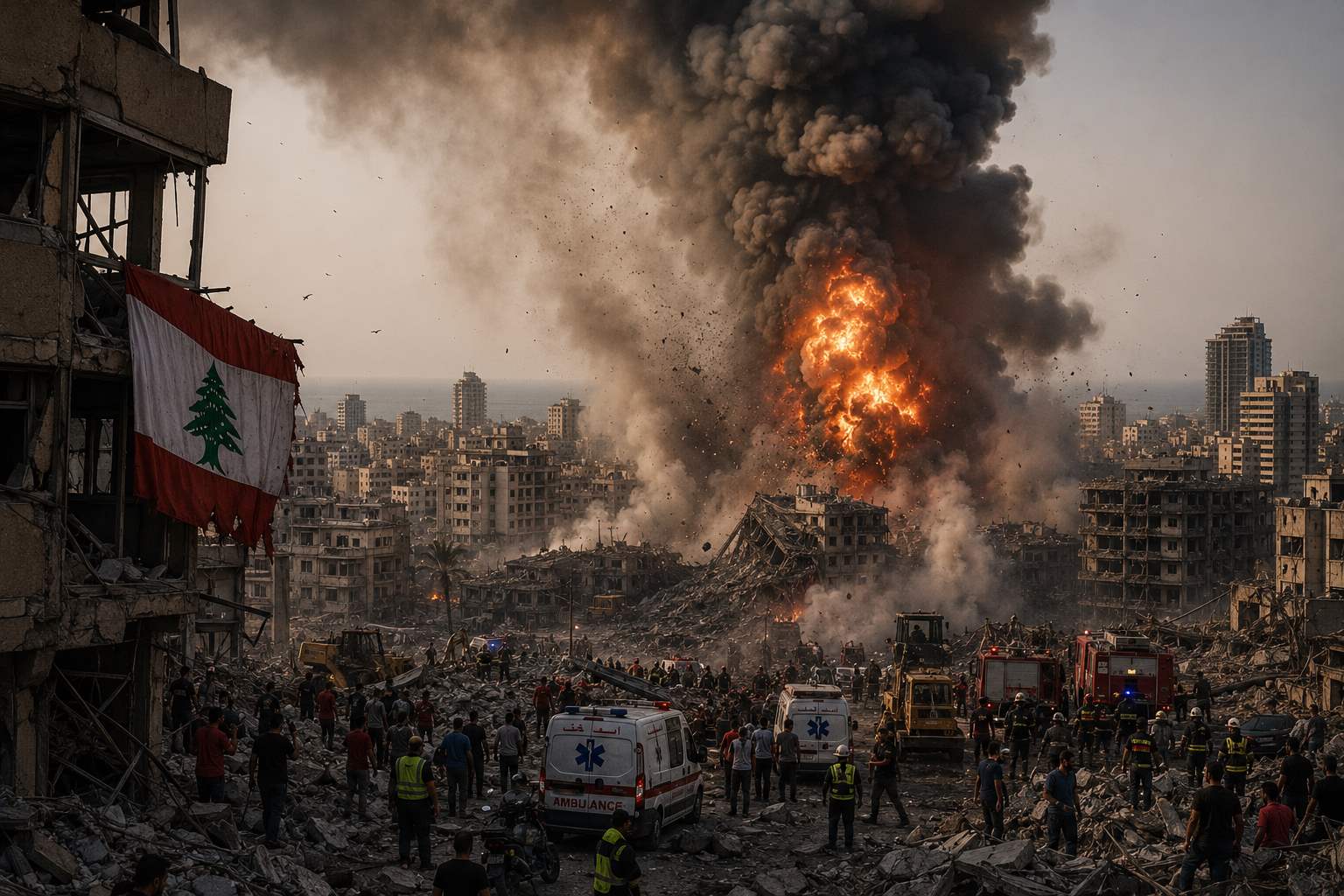
Targeted strike on Lebanese capital marks the most significant breach of a month-old ceasefire as regional tensions over the US-Iran war continue to spill over.
Monday, May 11, 2026
Last updated: 10:15 AM GMT
Global War News Editorial
Israeli forces conducted a targeted airstrike on Beirut’s southern suburbs late last week, marking the first time the Lebanese capital has been hit since a U.S.-brokered ceasefire took effect on April 17. According to reports from the Lebanese National News Agency (NNA) and verified by the Israel Defense Forces (IDF), the strike targeted a high-level military commander. While the IDF claimed the operation was a successful “surgical strike” against Hezbollah’s elite Radwan Force, Lebanese health officials reported that the bombardment resulted in at least three deaths and several injuries among nearby residents.
The return of kinetic activity to Beirut has placed immense strain on a truce that was intended to halt a conflict that began on March 2, following a massive regional escalation between the United States and Iran. According to data provided by the Lebanese Health Ministry, the cumulative death toll in Lebanon has now reached approximately 2,846, with over 1.2 million people displaced from their homes.
Hezbollah responded to the Beirut strike by launching a series of 24 retaliatory attacks against Israeli military positions along the border. The IDF reported that most of these projectiles were intercepted or fell in open areas, though at least one soldier was reportedly wounded in a drone strike near the border region.
Details of the Beirut Strike
The strike on Beirut’s southern suburbs, traditionally a stronghold of Hezbollah, was reportedly aimed at Malek Ballout, identified by Israeli officials as a senior operations commander for the Radwan Force. Prime Minister Benjamin Netanyahu and Defense Minister Israel Katz stated that Ballout was responsible for coordinating rocket fire into northern Israel during the height of the March hostilities.
While the IDF stated that the strike was necessary to prevent “imminent threats,” the Lebanese government condemned the action as a “flagrant violation” of the sovereignty understandings reached in April. President Joseph Aoun called on international mediators to pressure Israel to maintain the ceasefire, noting that the destruction of residential infrastructure in the capital risks a return to total war.
Conflict Background: The “Iran Connection”
The current violence in Lebanon is a direct byproduct of the broader conflict between the U.S. and Iran that ignited on February 28, 2026. Hezbollah, acting as a regional ally of Tehran, entered the fray on March 2 by launching barrages of missiles into northern Israel. In response, Israel launched a campaign aimed at disarming the group and establishing a “security buffer zone” extending roughly 10 kilometers into southern Lebanon.
Despite the April 17 ceasefire, which was recently extended through mid-May, the underlying issues remain unresolved. Israel has maintained that it retains the right to act in self-defense against “high-value targets,” while Hezbollah asserts that any Israeli military presence on Lebanese soil justifies continued “resistance.”
Analysis: The Tipping Point for Diplomacy
Observers note that the Beirut strike represents a tactical shift. For the past three weeks, exchanges of fire had been largely confined to the border districts of Tyre and Nabatieh. By striking the capital, Israel has signaled that it will not observe geographical limits if it perceives a high-value military opportunity.
Analysts suggest this puts the Pakistani-mediated peace talks in a precarious position. While Washington and Tehran are reportedly edging toward a broader regional agreement, the Lebanon front remains volatile. The UN Office for the Coordination of Humanitarian Affairs (OCHA) warned that the renewed uncertainty is preventing hundreds of thousands of displaced Lebanese civilians from returning to their homes, even as food security reaches crisis levels in the south.
Source Disclosure: This report is based on verified data and statements from the Lebanese Health Ministry, the National News Agency (NNA), the Associated Press (AP), Reuters, and Al Jazeera. Military details were sourced from official briefings by the Israel Defense Forces (IDF) and public statements from the Lebanese President’s office.
This article is based on publicly available reporting from named international news agencies and attributed official statements. All claims about ongoing events are attributed to their original sources. Analysis sections represent the editorial interpretation of reported facts and do not constitute advocacy for any party to the described conflict. AI tools may be utilized for image generation to assist in explaining complex concepts, as well as for refining grammar, spelling, and other linguistic enhancements. However, all original content is produced, fact-checked, and revised by the editorial team. This publication does not take political positions on active military conflicts.