
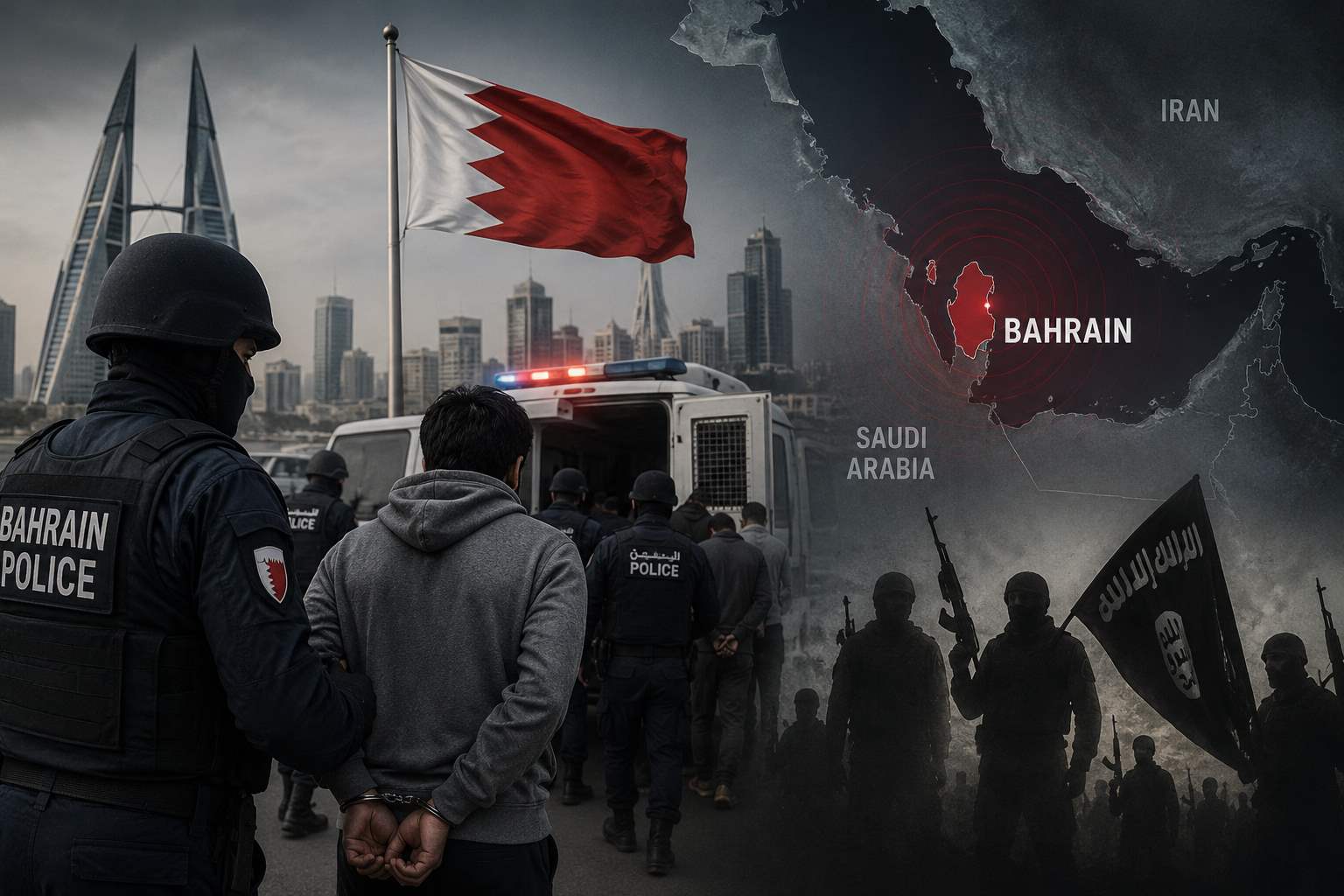
Security sweep in the Gulf kingdom targets individuals accused of collaborating with external entities as regional tensions from the US-Iran conflict continue to ripple.
Monday, May 11, 2026
Last updated: 10:45 AM GMT
Global War News Editorial
The Bahraini Ministry of Interior has announced the detention of several dozen individuals suspected of maintaining links to foreign armed groups and plotting activities aimed at undermining national security. In a statement released through the state-run Bahrain News Agency (BNA) on Sunday, officials reported that the arrests followed a coordinated intelligence operation targeting “terrorist cells” allegedly receiving logistical and financial support from outside the country.
While the official statement did not explicitly name the foreign entities involved, the timing of the arrests coincides with heightened regional instability. Analysts have pointed to the ongoing maritime and diplomatic friction between the United States and Iran as a likely catalyst for intensified domestic security measures across Gulf Cooperation Council (GCC) states. According to reports from the Associated Press, Bahraini authorities have historically used similar language to describe groups they claim are backed by Tehran, though the Iranian government has consistently denied such allegations in the past.
The detentions come as human rights monitors express concern over the scope of the security sweep. According to a preliminary assessment by the Bahrain Institute for Rights and Democracy (BIRD), at least 32 individuals were taken into custody during raids in the villages of Diraz and Sitra. The organization has called for transparency in the legal proceedings and noted that the identities of many of those detained remain undisclosed.
Details of the Security Operation
The Ministry of Interior stated that the operation was the result of a “proactive security effort” to dismantle networks planning to disrupt public order. According to the BNA report, security forces seized communications equipment and documents during the raids. Officials stated that the detainees have been referred to the Public Prosecution to face charges including “membership in an illegal organization” and “receiving funds from a foreign state for the purpose of carrying out hostile acts.”
Local media outlets in Manama reported that security presence has been increased around sensitive infrastructure and government buildings following the arrests. While no specific targets or plots were detailed in the government’s announcement, the statement emphasized that the group’s activities were “directly linked to the current regional security environment.”
Context: Bahrain’s Position in the Regional Crisis
Bahrain occupies a strategic position in the Persian Gulf and serves as the headquarters for the U.S. Navy’s 5th Fleet. This makes the kingdom a critical node in the broader geopolitical struggle involving the U.S., Israel, and Iran. Since the outbreak of the regional conflict on February 28, 2026, Bahrain has tightened its security protocols to prevent spillover from the naval skirmishes occurring in the nearby Strait of Hormuz.
The kingdom has a history of domestic unrest, particularly following the 2011 uprisings. Since then, the government has frequently conducted security sweeps against groups it identifies as proxies for foreign powers. Human rights organizations, including Amnesty International, have frequently reported on these crackdowns, noting that the line between genuine security threats and the suppression of political dissent is often contested by local activists.
Economic and Strategic Implications
For the global economy, stability in Bahrain is closely linked to the security of the regional banking sector and maritime trade routes. As a major financial hub in the Middle East, any perception of internal instability can affect investor confidence.
According to data from the International Monetary Fund (IMF), Bahrain’s economy is sensitive to regional risk premiums. Following the news of the detentions, local market analysts observed a slight tightening in credit default swaps, reflecting a cautious stance from international lenders. Observers note that GCC states are currently coordinating more closely on internal security to ensure that the U.S.-Iran war does not trigger domestic insurgencies that could further disrupt oil production and financial services.
Analysis: Balancing Security and Stability
The arrests highlight the delicate balancing act faced by Manama. On one hand, the government maintains a “zero-tolerance” policy regarding foreign-backed militancy, citing the need to protect its alliance with the United States and its own internal sovereignty. On the other hand, extensive security sweeps risk inflaming long-standing domestic tensions.
Analysts suggest that these detentions may be intended as a deterrent to any local groups considering capitalizing on the regional chaos to challenge the state. It remains unclear whether the evidence against the detainees will be made public. As regional mediators in Islamabad and Muscat work toward a broader ceasefire between the U.S. and Iran, the internal security policies of Gulf states like Bahrain will likely remain a significant variable in the overall stability of the Middle East.
Source Disclosure: This report is based on official statements from the Bahraini Ministry of Interior via the Bahrain News Agency (BNA), as well as reporting from the Associated Press (AP) and Reuters. Data regarding detentions was sourced from the Bahrain Institute for Rights and Democracy (BIRD). Economic context was provided using data from the IMF and Bloomberg.
This article is based on publicly available reporting from named international news agencies and attributed official statements. All claims about ongoing events are attributed to their original sources. Analysis sections represent the editorial interpretation of reported facts and do not constitute advocacy for any party to the described conflict. AI tools may be utilized for image generation to assist in explaining complex concepts, as well as for refining grammar, spelling, and other linguistic enhancements. However, all original content is produced, fact-checked, and revised by the editorial team. This publication does not take political positions on active military conflicts.