
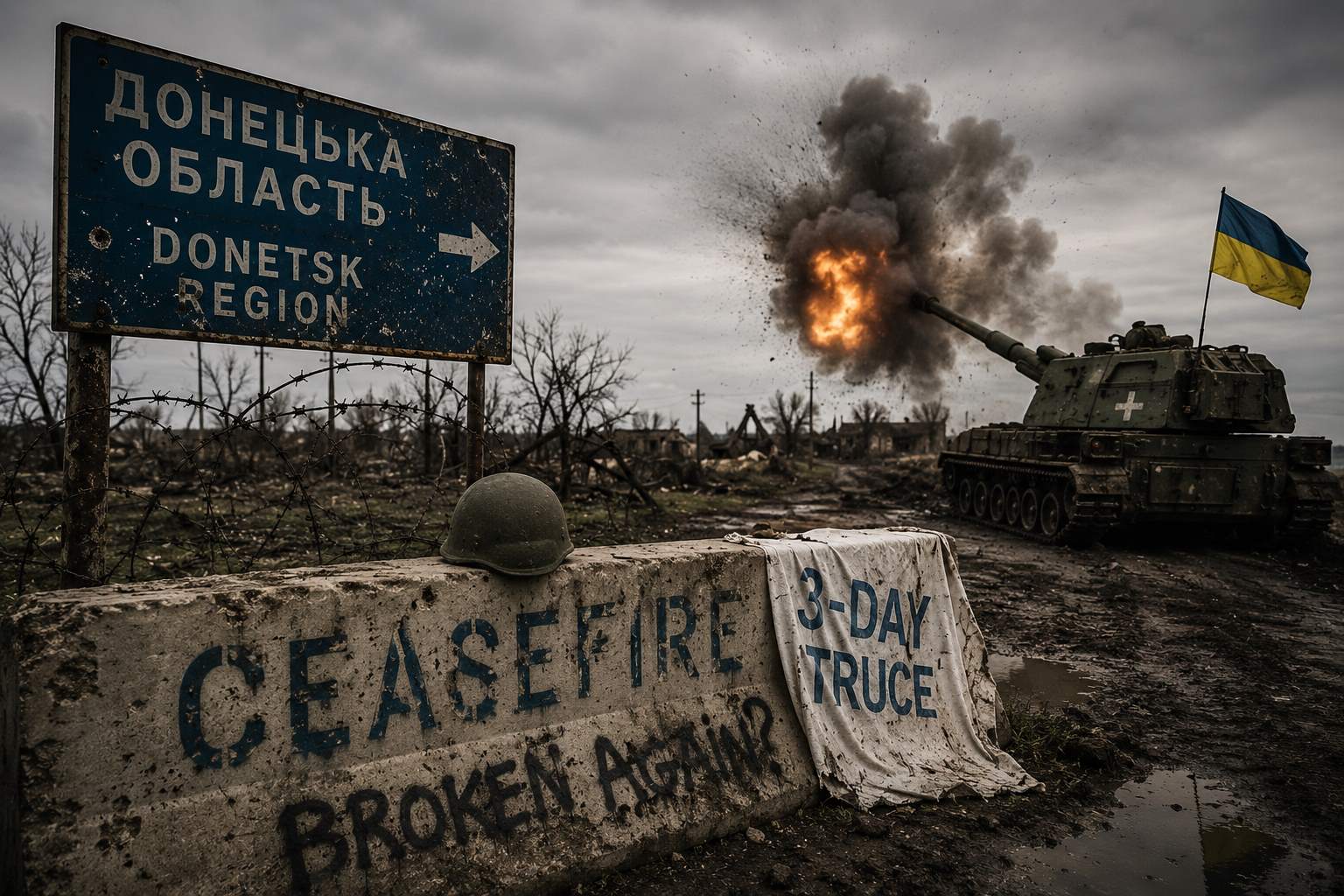
A symbolic ceasefire intended to facilitate a massive prisoner exchange faces imminent collapse as frontline skirmishes and mutual accusations of bad faith intensify.
Monday, May 11, 2026
Last updated: 11:35 AM GMT
Global War News Editorial
A three-day humanitarian ceasefire between Russian and Ukrainian forces is under critical strain following a renewed wave of artillery exchanges across the eastern frontline. The truce, which began on Saturday to mark the May 9 Victory Day period, was designed to provide a “window of silence” for the exchange of 2,000 prisoners of war. However, by late Sunday, both the Ukrainian General Staff and the Russian Ministry of Defense reported multiple breaches that threaten to scuttle the diplomatic progress.
According to reports from the Associated Press and Reuters, the most intense fire was concentrated in the Donetsk and Luhansk sectors, where local residents reported the sound of heavy outgoing and incoming shells despite the official pause. Ukrainian officials alleged that Russian units utilized the lull to reposition armored assets, while Moscow claimed that Ukrainian “sabotage groups” attempted to probe defensive lines under the cover of the truce.
Despite the spike in kinetic activity, the prisoner exchange, facilitated by U.S. and Turkish mediators—reportedly remains on track for late Monday. Both nations have confirmed that the lists of detainees have been finalized, though the logistics of the physical transfer are now being hampered by the continued insecurity of the transport corridors.
Context and Background
The current ceasefire is the first significant pause in fighting since the 2026 spring offensives began. The timing was highly symbolic, overlapping with Russia’s annual Victory Day celebrations. Historically, ceasefires in this conflict have been plagued by “tactical violations” where local commanders engage in small-scale skirmishes that do not necessarily reflect the intent of central leadership but nonetheless degrade the overall stability of the agreement.
The primary objective of this specific three-day window was not a permanent peace, but a humanitarian “clearing” to allow the largest prisoner swap since the conflict’s inception. Approximately 1,000 soldiers from each side are currently held at designated collection points, awaiting the final signal for the transfer.
Reported Violations and Casualties
The Ukrainian Ministry of Defense stated on Monday morning that its positions were targeted by at least 42 instances of indirect fire over the last 24 hours. Regional governors in eastern Ukraine reported that two civilians were injured in the shelling of residential outskirts near Bakhmut.
Conversely, the Russian state news agency TASS, citing the Ministry of Defense, alleged that Ukrainian forces fired 155mm shells into occupied territories in the Donbas region, claiming these strikes were an attempt to disrupt Victory Day commemorations. Neither side has provided independent verification of their claims, and there are currently no international observers on the ground to monitor the frontline for specific truce violations.
Analysis: The “Repositioning” Risk
Analysts note that short-term humanitarian truces often carry an inherent military risk known as “tactical opportunism.” When a pause in major aerial bombardments occurs, both armies naturally seek to move supplies, rotate exhausted troops, and strengthen fortifications. This movement is frequently interpreted by the opposing side as a breach of the truce, leading to “pre-emptive” artillery strikes.
This cycle of suspicion is currently the greatest threat to the Monday afternoon prisoner swap. If one side perceives that the other is using the humanitarian corridor for military logistics, they may target those corridors, making the safe passage of Red Cross buses impossible. Observers from the Institute for the Study of War (ISW) suggest that while neither Moscow nor Kyiv appears ready for a full return to high-intensity combat today, the “trust deficit” on the ground remains at an all-time high.
What to Watch For
The next eight hours are critical. The international community is watching for two specific indicators:
- The Silence of the Corridors: Whether artillery fire subsides specifically in the sectors designated for the POW transfer.
- Confirmation of the Swap: Official statements from the ICRC (International Committee of the Red Cross) confirming that the first buses have crossed the “zero line.”
If the swap is completed, it may provide a template for future localized truces. If it fails due to continued fire, it is likely to harden the positions of both leaderships, making future humanitarian negotiations significantly more difficult.
Source Disclosure: This report is based on official statements from the Ukrainian General Staff, the Russian Ministry of Defense (via TASS), the Associated Press (AP), and Reuters. Local casualty reports were sourced from Ukrainian regional administrations and the NNA.
This article is based on publicly available reporting from named international news agencies and attributed official statements. All claims about ongoing events are attributed to their original sources. Analysis sections represent the editorial interpretation of reported facts and do not constitute advocacy for any party to the described conflict. AI tools may be utilized for image generation to assist in explaining complex concepts, as well as for refining grammar, spelling, and other linguistic enhancements. However, all original content is produced, fact-checked, and revised by the editorial team. This publication does not take political positions on active military conflicts.