
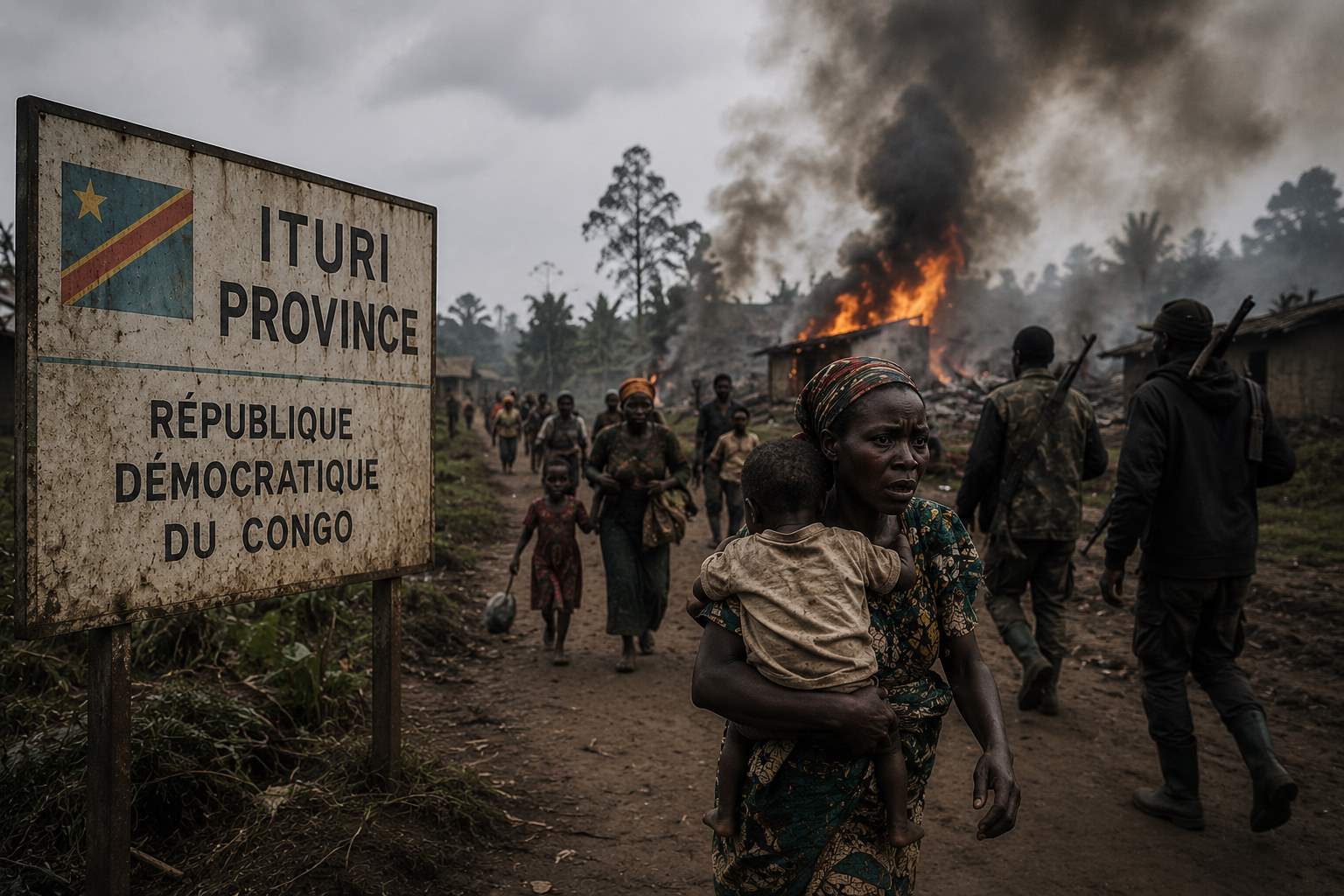
Mass casualty event in Ituri province highlights the persistent failure of regional security frameworks as local militias intensify campaigns against civilian populations.
Monday, May 11, 2026
Last updated: 11:45 AM GMT
Global War News Editorial
At least 69 people were killed during a coordinated assault by an armed group in the Ituri province of the Democratic Republic of Congo (DRC) over the weekend. According to reports from the Associated Press and local civil society leaders, the attack targeted several villages in the Djugu territory, a region that has long been a flashpoint for ethnic and resource-based violence.
The Congolese military (FARDC) confirmed the engagement, stating that government troops were deployed to the area late Saturday to repel the attackers. While the military has not officially finalized a casualty count, local human rights organizations and witnesses have provided the figure of 69 deceased, noting that many victims were targeted in their homes.
As reported by Reuters, the Cooperative for the Development of the Congo (CODECO) is suspected of carrying out the massacre. CODECO is a loose association of ethnic Lendu militias that has been accused of numerous atrocities in the northeastern DRC since the resurgence of conflict in 2017. The group has not yet issued a public statement regarding the weekend’s events.
Background: A Protracted Crisis in Ituri
Ituri province, located in the northeastern corner of the DRC near the borders of Uganda and South Sudan, has faced cycles of intense violence for decades. The conflict is primarily driven by competition over land and the region’s vast gold deposits, exacerbated by long-standing tensions between the Hema and Lendu ethnic communities.
Since 2021, the provinces of Ituri and North Kivu have been under a “state of siege,” a form of martial law intended to give the military broader powers to neutralize armed groups. However, analysts from the Kivu Security Tracker have noted that civilian deaths have continued to rise despite the increased military presence. The United Nations Organization Stabilization Mission in the DR Congo (MONUSCO) remains in the process of a phased withdrawal, raising concerns about a security vacuum in isolated territories like Djugu.
Details of the Weekend Assault
According to accounts provided to Al Jazeera by local survivors, the attackers entered the villages of Galay and Mbidjo late Friday night. Witnesses described the use of both firearms and machetes, stating that the assault appeared aimed at displacing the local population rather than capturing specific military objectives.
A spokesperson for the FARDC in Ituri, Lieutenant Jules Ngongo, stated that “operations are ongoing to secure the area and track down the perpetrators of this ignoble act.” The Congolese government has frequently characterized these attacks as “acts of terrorism” designed to destabilize the central government’s authority in the east.
Economic and Humanitarian Impact
The persistent insecurity in northeastern DRC has severely hampered the region’s agricultural and mining sectors. Ituri is home to significant artisanal gold mining, much of which is currently controlled or taxed by non-state armed groups. According to the World Bank, the “conflict economy” in the east prevents the DRC from realizing the full benefit of its mineral wealth, with illicit trade routes often bypassing official state channels.
The humanitarian situation is equally dire. The UN Refugee Agency (UNHCR) reports that over 1.6 million people are currently displaced within Ituri province alone. The weekend’s attack is expected to trigger a new wave of displacement toward the provincial capital of Bunia, placing further strain on already overextended aid agencies.
Analysis: The Limits of Military Solutions
Observers note that the “state of siege” has largely failed to address the root causes of the violence, which are often local and communal rather than purely national. Analysts suggest that the focus on military operations, without a corresponding emphasis on community-level reconciliation and economic formalization, allows groups like CODECO to continue recruiting from marginalized youth populations.
Furthermore, the regional dimension cannot be ignored. The DRC government has frequently accused neighboring states of providing logistical support to various rebel factions in exchange for access to minerals, though these claims are regularly denied. Until a comprehensive regional security agreement is reached, localized massacres like the one in Djugu are likely to continue, irrespective of the number of government troops deployed to the front lines.
Source Disclosure: This report is based on reporting from the Associated Press (AP), Reuters, Al Jazeera, and the Kivu Security Tracker. Official statements were sourced from the Congolese military (FARDC) and the United Nations (MONUSCO). Economic context was provided via data from the World Bank and UNHCR.
This article is based on publicly available reporting from named international news agencies and attributed official statements. All claims about ongoing events are attributed to their original sources. Analysis sections represent the editorial interpretation of reported facts and do not constitute advocacy for any party to the described conflict. AI tools may be utilized for image generation to assist in explaining complex concepts, as well as for refining grammar, spelling, and other linguistic enhancements. However, all original content is produced, fact-checked, and revised by the editorial team. This publication does not take political positions on active military conflicts.