
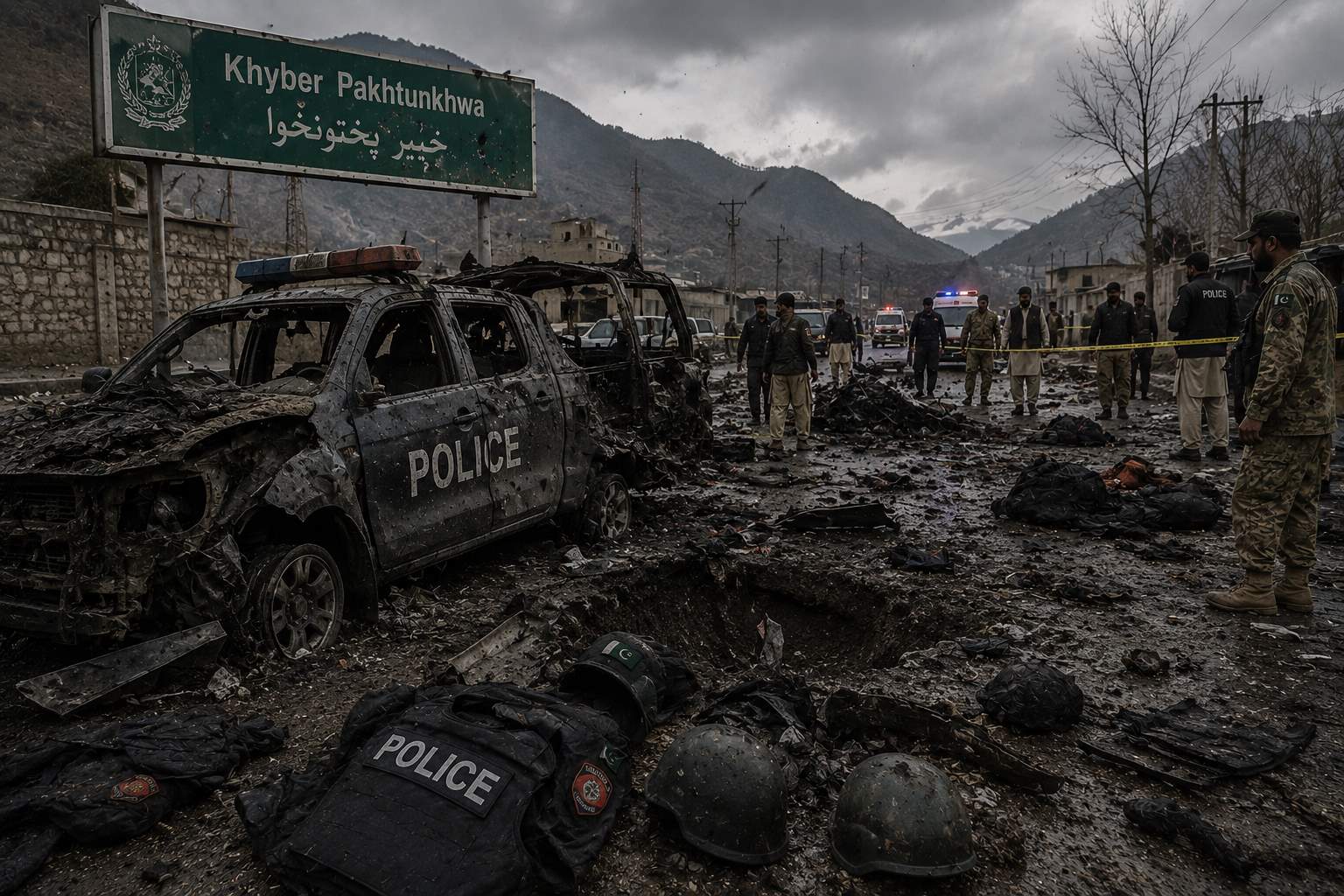
Major security breach in Khyber Pakhtunkhwa province threatens to destabilize regional security as armed groups intensify pressure on state institutions.
Monday, May 11, 2026
Last updated: 12:45 PM GMT
Global War News Editorial
At least 21 police officers were killed on Sunday during a coordinated suicide ambush in the Khyber Pakhtunkhwa province of northwest Pakistan, according to official statements from provincial police and local government authorities. The attack targeted a police convoy in the Lakki Marwat district, an area that has seen a significant surge in militancy over the past year.
The deputy inspector general of police for the region stated that a vehicle laden with explosives was driven into the convoy, followed by heavy gunfire from several directions. In a statement released through official channels, the Pakistani Taliban (Tehreek-e-Taliban Pakistan or TTP) reportedly claimed responsibility for the assault, asserting it was part of a broader campaign against state security forces.
This incident marks the deadliest single attack on Pakistani security personnel in 2026 and comes at a time when the country is navigating extreme economic pressure and political sensitivity. Federal Interior Minister Mohsin Naqvi condemned the “cowardly act” and vowed that the state would respond with full force to neutralize the threat in the border regions.
Details of the Ambush
According to reports from the Associated Press and Reuters, the convoy was transporting officers to a remote outpost when it was intercepted. Witnesses described a massive explosion that destroyed at least two police vehicles, followed by a sustained firefight that lasted for nearly an hour.
Local hospital officials in Lakki Marwat confirmed the receipt of 21 bodies and reported that another 12 officers are currently being treated for critical injuries. Security forces have since cordoned off the area and launched a massive search operation in the surrounding mountains, though no immediate arrests have been reported.
Context: The Surge of Militancy in the Northwest
The Khyber Pakhtunkhwa province, which borders Afghanistan, has historically been a flashpoint for conflict between the Pakistani state and various armed groups. Since the collapse of a ceasefire between the government and the TTP in late 2022, there has been a documented increase in targeted killings and large-scale bombings.
Analysts note that the TTP has increasingly utilized sophisticated weaponry and tactical coordination, often mirroring the strategies used during the height of the regional insurgency a decade ago. The United Nations and several international research institutions have recently warned that the presence of non-state actors in the border regions remains a primary threat to South Asian stability, particularly as regional powers focus their attention on the ongoing US-Iran naval conflict.
Economic and Strategic Implications
The security crisis in the northwest carries direct consequences for Pakistan’s fragile economy. Persistent instability in Khyber Pakhtunkhwa affects the progress of regional infrastructure projects, including those linked to the China-Pakistan Economic Corridor (CPEC).
According to data from the World Bank and the International Monetary Fund (IMF), internal security risks are a significant factor in determining Pakistan’s sovereign credit rating and its ability to attract foreign direct investment. Observers note that the government is currently forced to divert substantial budgetary resources toward counter-terrorism operations at a time when the national economy is struggling with high inflation and debt restructuring.
Analysis: The Challenge of Border Security
The success of the Sunday ambush suggests a significant intelligence failure and highlights the difficulty of securing the rugged, porous border with Afghanistan. While Islamabad has repeatedly called on the interim Afghan government to prevent militants from using Afghan soil to launch attacks, the TTP remains a potent and mobile threat.
It remains unclear whether this specific escalation will lead to a broader military operation in the tribal districts. However, analysts suggest that without a more robust regional diplomatic agreement regarding border management, the police and paramilitary forces in Khyber Pakhtunkhwa will remain highly vulnerable to high-impact “soft target” strikes.
Source Disclosure: This report is based on official statements from the Khyber Pakhtunkhwa Police and the Pakistani Interior Ministry. Factual details regarding the ambush were sourced from the Associated Press (AP), Reuters, and Al Jazeera. Economic context was provided via data from the IMF and World Bank.
This article is based on publicly available reporting from named international news agencies and attributed official statements. All claims about ongoing events are attributed to their original sources. Analysis sections represent the editorial interpretation of reported facts and do not constitute advocacy for any party to the described conflict. AI tools may be utilized for image generation to assist in explaining complex concepts, as well as for refining grammar, spelling, and other linguistic enhancements. However, all original content is produced, fact-checked, and revised by the editorial team. This publication does not take political positions on active military conflicts.