
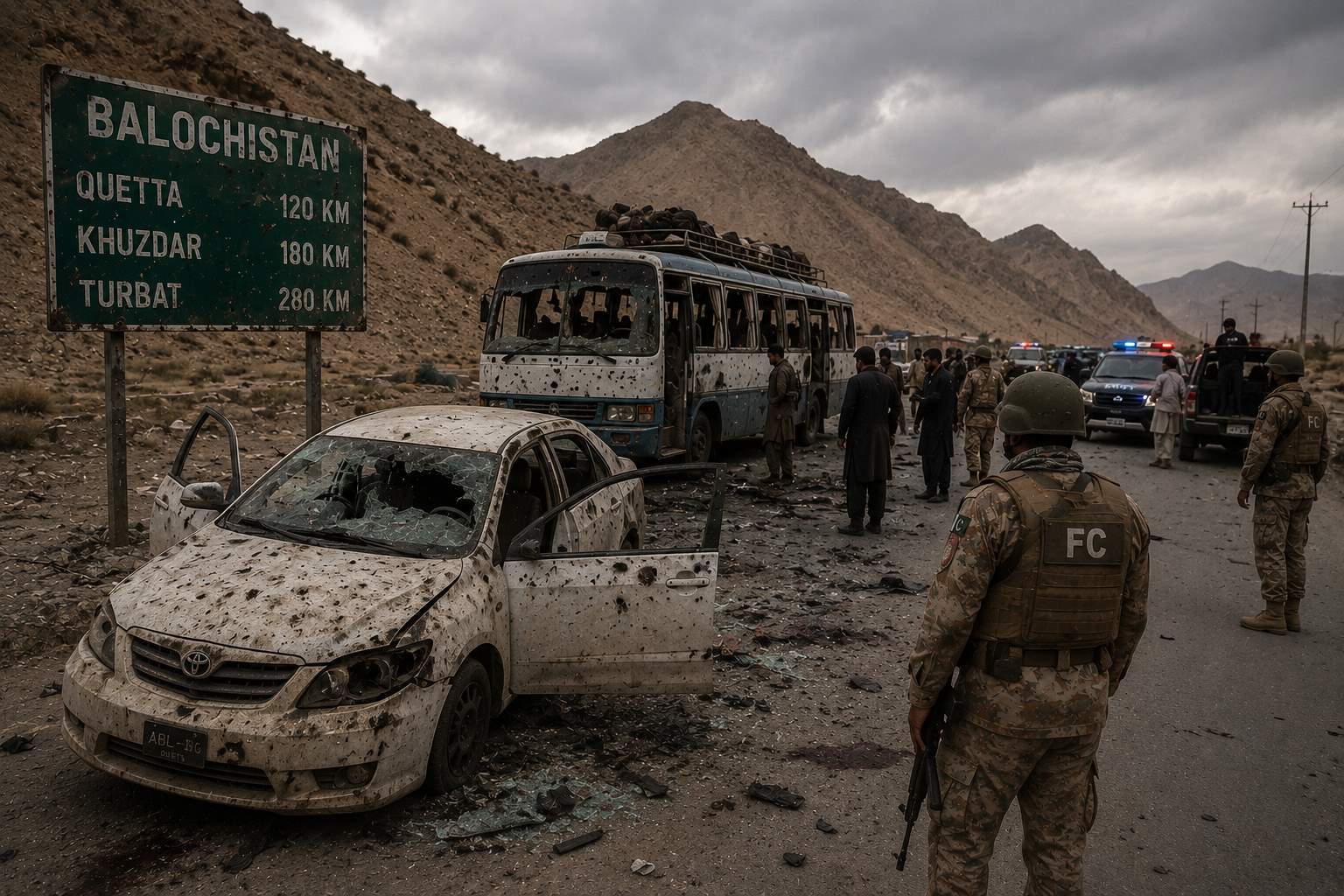
Security forces intensify operations in southwest Pakistan after gunmen target civilians in the latest wave of regional insurgent violence.
Monday, May 11, 2026
Last updated: 12:10 PM GMT
Global War News Editorial
The death toll from a targeted attack in Pakistan’s southwestern Balochistan province has risen to 14, according to local administrative officials and hospital sources. The assault, which took place late Sunday, involved unidentified gunmen who intercepted vehicles and targeted passengers based on their ethnic background, a tactic frequently employed by insurgent groups operating in the region.
According to reports from the Associated Press and Reuters, the attackers established a makeshift checkpoint on a highway in the Musakhel district. After offloading passengers and checking identification documents, the gunmen opened fire. Provincial officials stated that the deceased were primarily laborers from the Punjab province, highlighting the ethnic dimensions of the ongoing insurgency.
While no group has officially claimed responsibility for this specific incident as of Monday morning, the Baloch Liberation Army (BLA) and other separatist factions have carried out similar “identity-based” attacks in the past. Prime Minister Shehbaz Sharif condemned the killings in a public statement, describing the act as an attempt to “weaken the national unity” and ordering an immediate retaliatory security operation.
Context of the Balochistan Insurgency
Balochistan is Pakistan’s largest but least populated province, bordering Iran and Afghanistan. It has been the site of a low-level insurgency for decades, led by ethnic Baloch groups seeking greater autonomy or independence. These groups allege that the central government in Islamabad and foreign entities exploit the province’s vast natural resources, including gas, copper, and gold, without providing adequate benefits to the local population.
The region is also a central hub for the China-Pakistan Economic Corridor (CPEC), a multi-billion-dollar infrastructure project. Separatist groups have increasingly targeted CPEC-related projects and non-local workers, viewing them as symbols of external exploitation. According to data from the South Asia Terrorism Portal (SATP), Balochistan has seen a marked increase in violence since the beginning of 2026, coinciding with broader regional instability across the Pakistani-Afghan border.
Details of the Incident and Security Response
Local police reported that at least ten vehicles were set on fire during the ambush. In addition to the 14 confirmed fatalities, several others remain missing, prompting fears that the death toll could increase as search operations continue in the rugged terrain.
In response, the Pakistan Army and Frontier Corps have launched a “clearing operation” across the district. A spokesperson for the provincial government stated that security has been tightened along all major highways in the province to prevent further ambushes. The Interior Ministry has reportedly authorized the use of aerial surveillance to track the perpetrators, who are believed to have fled into the nearby mountain ranges.
Economic and Strategic Implications
The persistent violence in Balochistan carries significant weight for Pakistan’s economic stability. The province is home to the deep-water port of Gwadar, which is intended to serve as a gateway for trade between China, Central Asia, and the Middle East. Continued attacks on transport infrastructure and laborers threaten the timeline and viability of these strategic investments.
Analysts note that the targeting of workers from other provinces creates a “chilled effect” on the internal labor market. According to reports from the Pakistan Institute for Peace Studies (PIPS), the inability of the state to secure transit routes has led to increased costs for logistics and security, further straining a national economy already grappling with high inflation and a reliance on international bailouts.
Analysis: The Challenge of Ethnic Fractures
Observers suggest that the move to target civilians based on ethnicity is a calculated strategy by insurgent groups to provoke a heavy-handed state response, which can further alienate the local Baloch population. By targeting “outsiders,” militants aim to make the province ungovernable for the federal administration and unattractive for foreign investors.
It remains unclear whether the government’s current military-led security strategy can address the underlying grievances of the Baloch people. Without a sustained political dialogue alongside security measures, analysts warn that the province will remain a volatile front in the broader landscape of regional conflict, particularly as external pressures from the Afghan and Iranian borders continue to mount.
Source Disclosure: This report is based on reporting from the Associated Press (AP), Reuters, and the Pakistan Institute for Peace Studies (PIPS). Official statements were sourced from the Office of the Prime Minister of Pakistan and the Balochistan Provincial Government. Casualty data was confirmed through local administrative and hospital sources in Musakhel.
This article is based on publicly available reporting from named international news agencies and attributed official statements. All claims about ongoing events are attributed to their original sources. Analysis sections represent the editorial interpretation of reported facts and do not constitute advocacy for any party to the described conflict. AI tools may be utilized for image generation to assist in explaining complex concepts, as well as for refining grammar, spelling, and other linguistic enhancements. However, all original content is produced, fact-checked, and revised by the editorial team. This publication does not take political positions on active military conflicts.