
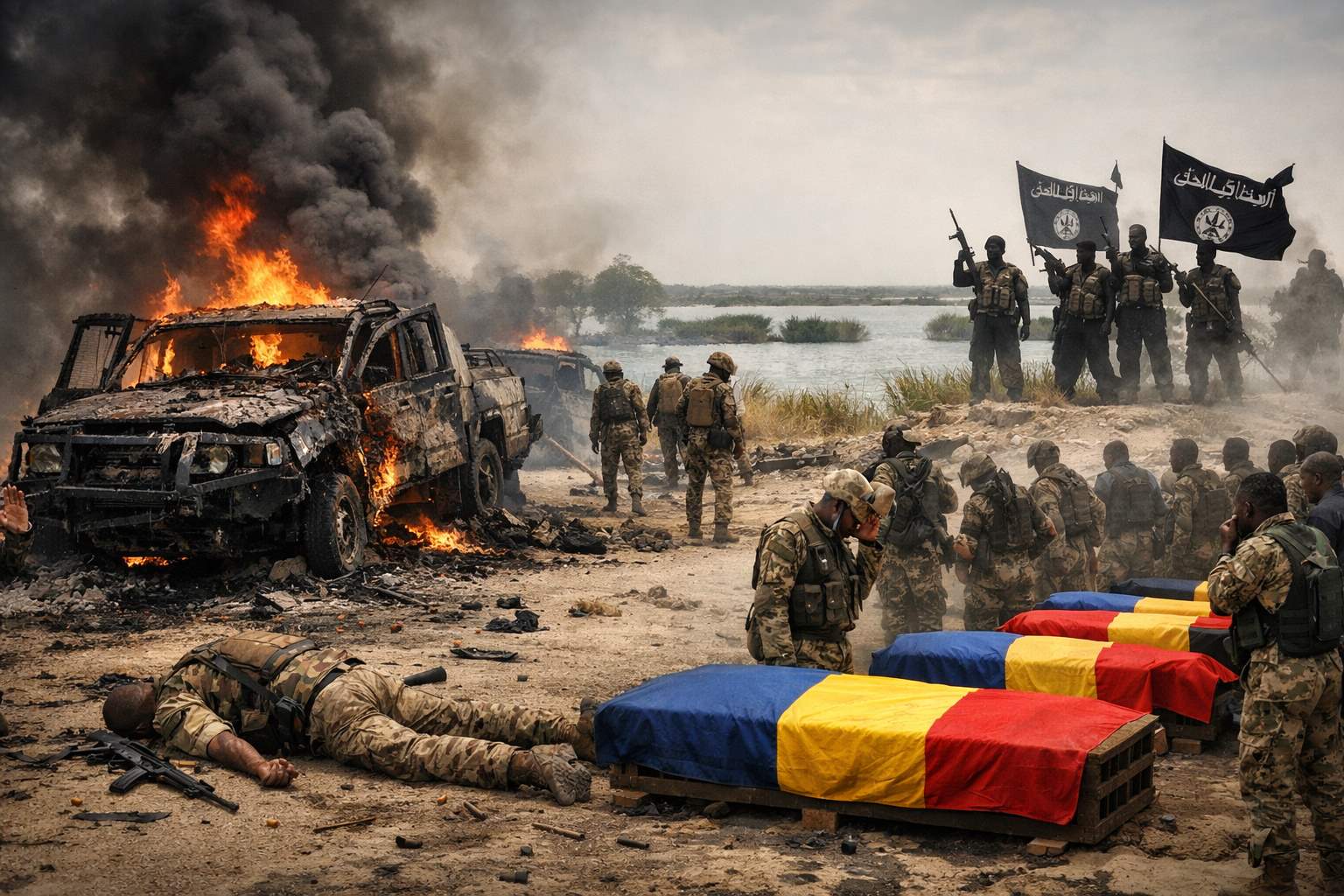
Chadian military suffers significant losses as jihadist group intensifies border incursions, leading to a three-day pause in festivities and heightened security measures.
Monday, May 11, 2026
Last updated: 12:45 PM GMT
Global War News Editorial
The Chadian government has concluded a three-day period of national mourning following a series of deadly ambushes by Boko Haram militants in the Lake Chad region. According to official statements from the Chadian presidency, the mourning period began on May 6 and continued through midnight on May 9, 2026, as a tribute to at least 23 soldiers killed during a violent assault on a military post.
The primary engagement occurred on Monday night, May 4, on the island of Barka Tolorom. Chadian armed forces reported that militants launched a coordinated strike on the base, resulting in the deaths of 23 service members and wounding at least 26 others. Chadian President Mahamat Idriss Déby Itno condemned the act as a “cowardly” attack and vowed that the sacrifice of the fallen soldiers would be met with renewed military determination.
While the initial attack was repelled, local media and international agencies, including AFP and Xinhua, reported a second ambush on Wednesday afternoon. During this subsequent engagement, security and defense force boats patrolling the lake fell into a militant trap. Unverified reports suggest that two generals were among those killed in the Wednesday skirmish, though the Chadian military has not yet provided an official casualty breakdown for this second encounter.
The Geography of Conflict: Lake Chad
The Lake Chad Basin sits at the strategic tripoint of Chad, Niger, Nigeria, and Cameroon. For over a decade, the region’s dense marshlands and numerous islands have provided a natural sanctuary for the Nigeria-based Boko Haram and its splinter faction, the Islamic State West Africa Province (ISWAP).
The island of Barka Tolorom, where the May 4 attack took place, is one of several remote outposts maintained by the Chadian military to monitor militant movement across the border. According to the United Nations, the insurgency has displaced millions and claimed several thousand lives across the four nations surrounding the lake. Analysts note that militants frequently use these islands as staging grounds for cross-border raids before retreating back into the difficult-to-navigate terrain.
National Mourning and Security Measures
Under the decree signed by President Déby, Chadian flags were flown at half-mast across the territory, and all festive activities were prohibited through Saturday. Media outlets and places of worship were instructed to limit programming to religious music and prayers. This symbolic gesture reflects the gravity of the recent losses, which echo a similar incident in October 2024 that claimed roughly 40 Chadian lives.
In addition to the mourning period, the government has reportedly declared a state of emergency in the Lake Province. This measure grants the military broader powers for search and seizure operations and allows for the establishment of restricted zones to curb the mobility of armed groups.
Economic and Humanitarian Strain
The persistent insecurity in the Lake Chad region has severely disrupted local economies dependent on fishing and cross-border trade. According to World Bank data, the “conflict zone” status of these waters has led to a significant decline in the livelihoods of local communities, forcing many into internal displacement camps.
Humanitarian organizations, including the International Committee of the Red Cross (ICRC), have noted that the closure of trade routes and the ongoing military operations make it increasingly difficult to deliver food and medical supplies to the islands. The UN Refugee Agency (UNHCR) estimates that thousands of civilians have fled the immediate vicinity of Barka Tolorom since the May 4 ambush, fearing further retaliatory strikes.
Analysis: A Strategic Stalemate?
Observers note that despite numerous regional military offensives—including those conducted by the Multinational Joint Task Force (MNJTF)—Boko Haram retains the capability to strike high-value military targets. This suggests a persistent intelligence gap in the remote regions of the lake.
Analysts have suggested that the Wednesday ambush on patrolling boats indicates that militants have adapted to the Chadian military’s tactical patterns. It remains unclear whether N’Djamena will seek a larger deployment of regional allies or if it will rely on its newly declared state of emergency to conduct localized counter-insurgency sweeps. What is certain, however, is that the security of the Lake Chad Basin remains a critical vulnerability for the stability of Central Africa.
Source Disclosure: This report is based on official statements from the Chadian Presidency and the Chadian Armed Forces. Factual reporting was sourced from the Associated Press (AP), Agence France-Presse (AFP), Reuters, Anadolu Agency, and Xinhua. Economic and humanitarian context was provided by the World Bank and UN agencies.
This article is based on publicly available reporting from named international news agencies and attributed official statements. All claims about ongoing events are attributed to their original sources. Analysis sections represent the editorial interpretation of reported facts and do not constitute advocacy for any party to the described conflict. AI tools may be utilized for image generation to assist in explaining complex concepts, as well as for refining grammar, spelling, and other linguistic enhancements. However, all original content is produced, fact-checked, and revised by the editorial team. This publication does not take political positions on active military conflicts.