
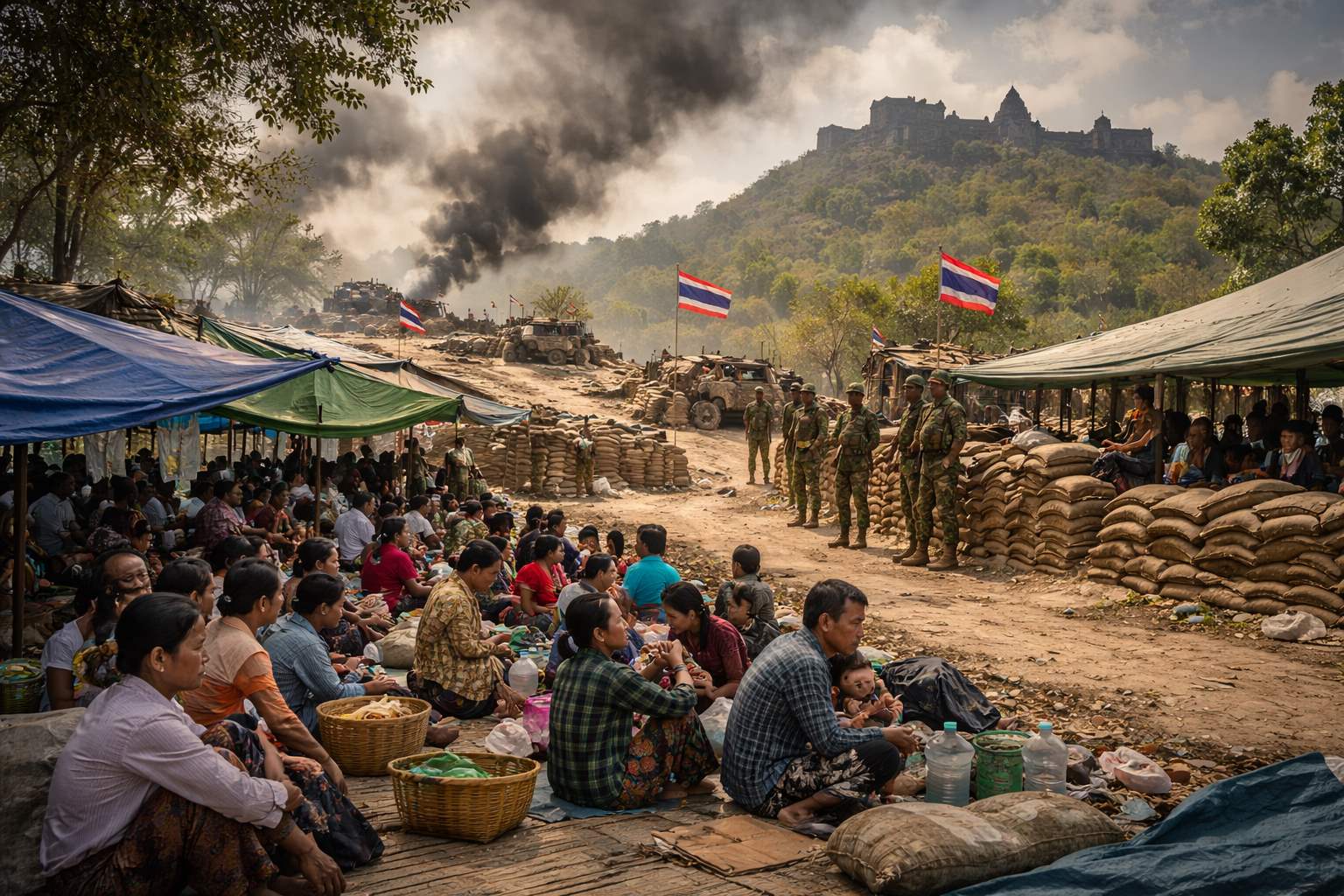
Localized skirmishes and military build-ups near contested temple sites threaten to undermine regional stability as hundreds of civilians remain in makeshift shelters.
Monday, May 11, 2026
Last updated: 01:15 PM GMT
Global War News Editorial
Tensions remain high along the forested border between Cambodia and Thailand following a series of localized skirmishes that have displaced hundreds of villagers. While a tentative ceasefire agreement was reached between local commanders late last week, residents on both sides of the frontier report a continued military presence near the 11th-century Preah Vihear temple and surrounding contested territories.
According to reports from the Associated Press and regional news agencies, the most recent exchange of fire occurred on Thursday, involving small arms and light mortar rounds. While no fatalities were officially confirmed by either government, the Cambodian Ministry of Defense alleged that Thai troops encroached on sovereign territory, a claim the Thai Royal Army has firmly denied.
The displacement of civilians highlights the human cost of the long-standing maritime and land boundary disputes that have periodically flared into violence since the mid-20th century. Local administrative officials in Cambodia’s Preah Vihear province stated that approximately 400 families have sought refuge in bunkers and temporary camps, fearing a return to the heavy artillery exchanges seen in previous decades.
Historical Context: The Preah Vihear Dispute
The root of the current tension lies in the 1962 International Court of Justice (ICJ) ruling, which awarded the Preah Vihear temple to Cambodia. However, the 4.6-square-kilometer scrubland surrounding the UNESCO World Heritage site remains a subject of intense disagreement. Thailand maintains that the area was not covered by the 1962 ruling and relies on a different set of colonial-era maps to define the border.
Since 2008, when the temple was granted World Heritage status, the border has seen several fatal clashes. While the Association of Southeast Asian Nations (ASEAN) has previously attempted to mediate, the current 2026 escalation occurs at a time when regional diplomatic resources are heavily diverted toward the broader US-Iran conflict and its impact on Southeast Asian energy security.
Current Military Posture and Civilian Impact
According to Al Jazeera, satellite imagery and local witness accounts suggest that both nations have reinforced their border outposts with additional personnel and hardware over the weekend. A spokesperson for the Thai government stated that the military is “maintaining a defensive posture” and has no intention of escalating the situation.
For the displaced civilians, the uncertainty is the primary concern. In the Thai border village of Phalan, residents reported that schools remain closed as a precaution. “We have lived through this before, but every time the soldiers arrive, we lose our livelihoods in the fields,” one resident told reporters. Human rights monitors in the region note that the “state of flux” along the border prevents essential infrastructure development and keeps local populations in a cycle of poverty.
Economic and Diplomatic Implications
While the Cambodia-Thailand border conflict is localized, it carries implications for the ASEAN Economic Community. The border crossings near the contested sites are vital for small-scale trade and tourism. According to data from the World Bank, prolonged instability in border regions can reduce local economic output by as much as 15% due to the disruption of agricultural cycles and trade routes.
Diplomatically, the flare-up presents a challenge for ASEAN’s principle of non-interference. Observers note that if the ceasefire fails to hold, it may require a more robust intervention from regional neighbors to prevent a tactical skirmish from evolving into a broader diplomatic crisis. Currently, both Phnom Penh and Bangkok have expressed a preference for bilateral talks, though no high-level meeting has been scheduled.
Analysis: Tactical Skirmishes or Strategic Signaling?
Analysts suggest that these periodic border flare-ups often serve as domestic political tools, allowing leaders to emphasize nationalist credentials during times of internal economic pressure. However, the risk of miscalculation remains high. Without a clearly demarcated border and a joint monitoring mechanism, a single uncoordinated patrol can trigger a chain reaction of “retaliatory” fire.
What remains to be seen is whether the current “window of silence” provided by the ceasefire will be used for meaningful demarcation talks or simply for military regrouping. As global attention remains fixed on larger theaters of war, the persistence of these “frozen” border conflicts serves as a reminder that localized instability can easily ignite when international oversight is stretched thin.
Source Disclosure: This report is based on official statements from the Cambodian Ministry of Defense, the Thai Royal Army, and the Thai Government Spokesperson’s Office. Factual details regarding displacements and skirmishes were sourced from the Associated Press (AP), Reuters, and Al Jazeera. Economic context was provided via World Bank data and regional reports from the ASEAN Secretariat.
This article is based on publicly available reporting from named international news agencies and attributed official statements. All claims about ongoing events are attributed to their original sources. Analysis sections represent the editorial interpretation of reported facts and do not constitute advocacy for any party to the described conflict. AI tools may be utilized for image generation to assist in explaining complex concepts, as well as for refining grammar, spelling, and other linguistic enhancements. However, all original content is produced, fact-checked, and revised by the editorial team. This publication does not take political positions on active military conflicts.