
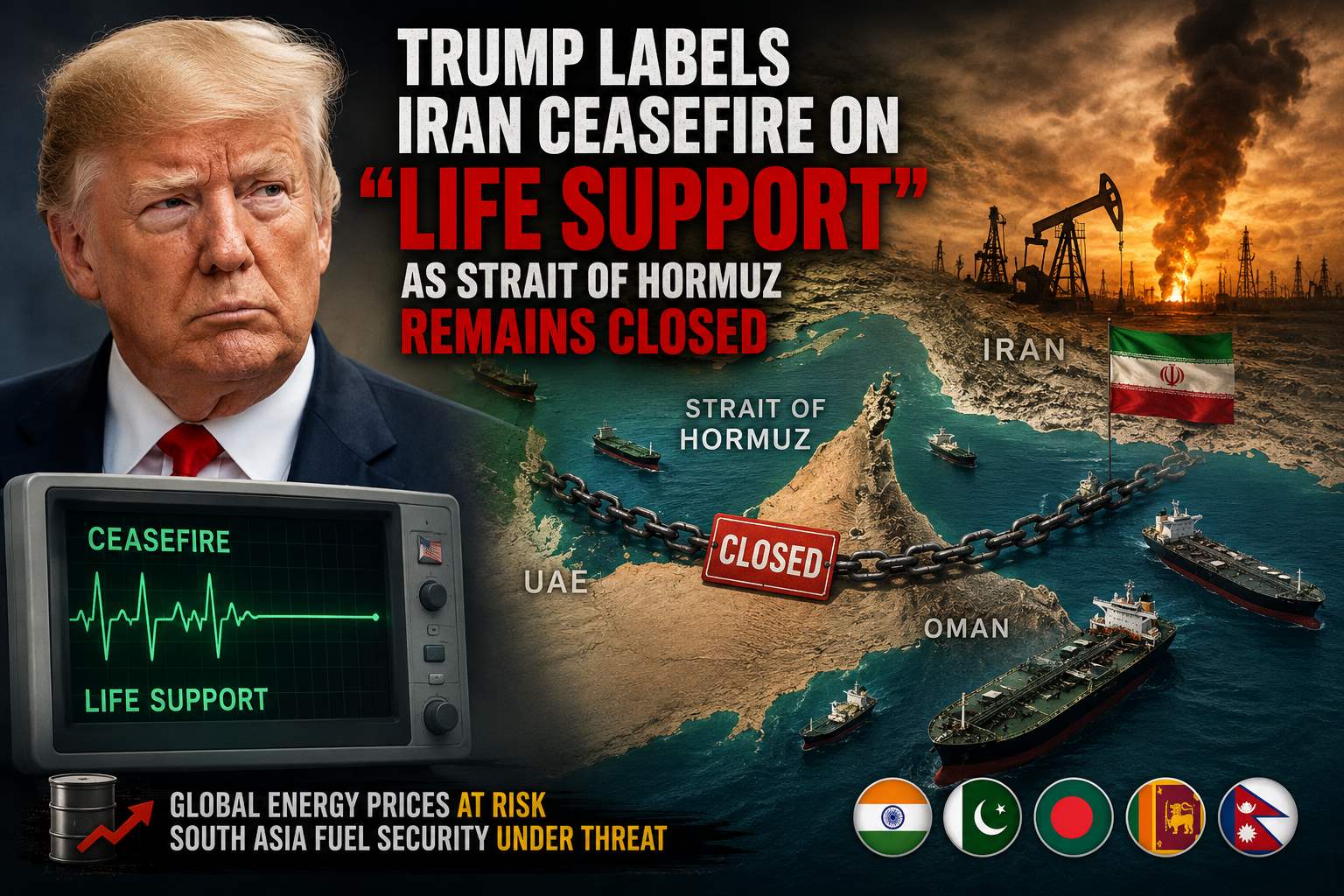
Persistent blockade of the world’s most vital oil chokepoint threatens global energy price stability and South Asian fuel security.
May 12, 2026
Global War News Editorial
The prospect of a diplomatic resolution to the ongoing maritime crisis in the Persian Gulf has dimmed significantly. Former President Donald Trump, in a public statement on Monday, described the current ceasefire negotiations between international mediators and Tehran as being on “life support.” His remarks come as the Strait of Hormuz enters its third week of a total blockade, an event that has effectively halted the passage of approximately 20% of the world’s liquid petroleum gas and oil consumption.
According to reporting from Reuters, the blockade was initiated following a series of naval skirmishes and remains in place despite intensive back-channel diplomacy led by regional intermediaries. The closure of this narrow waterway, which separates the Persian Gulf from the Gulf of Oman, has forced global shipping firms to reroute tankers around the Cape of Good Hope, adding significant transit time and insurance costs to global energy deliveries.
The Economic Stranglehold
The impact on global markets has been immediate. Data from the International Monetary Fund (IMF) suggests that prolonged disruption at the Strait could lead to a sustained increase in global crude prices, with some analysts projecting a spike toward $120 per barrel if the impasse continues through the next fiscal quarter.
In South Asia, the consequences are particularly acute. AP News reported that several nations in the region, which rely heavily on Middle Eastern crude, have already begun implementing energy conservation measures. Sri Lankan energy officials have noted that the increased cost of freight and the scarcity of available shipments are putting “unprecedented pressure” on national foreign exchange reserves.
Analysis: A Fragile Diplomatic Path
The description of the ceasefire as being on “life support” reflects a deepening pessimism among Western political figures regarding Iran’s willingness to de-escalate without significant concessions. Observers note that while the UN has called for an immediate reopening of the waterway, the leverage held by Tehran over global energy prices remains a formidable barrier to a quick resolution.
This situation raises questions about the long-term viability of current maritime security frameworks. If the Strait remains closed, the shift in global trade routes may become more than a temporary fix, potentially leading to a permanent restructuring of how energy is priced and transported to Asian markets.
What to Watch
Moving forward, the focus remains on the upcoming emergency session of the UN Security Council. Market participants are also closely monitoring official statements from the International Energy Agency (IEA) regarding the potential release of strategic petroleum reserves to stabilize prices. Whether the “life support” status of the ceasefire transitions into a total collapse of talks will likely depend on the next 48 hours of regional diplomatic activity.
Source Disclosure: This report relies on official public remarks from Donald Trump, reporting from Reuters and AP News, and economic data and projections provided by the IMF and regional energy ministries.
This article is based on publicly available reporting from named international news agencies and attributed official statements. All claims about ongoing events are attributed to their original sources. Analysis sections represent the editorial interpretation of reported facts and do not constitute advocacy for any party to the described conflict. AI tools may be utilized for image generation to assist in explaining complex concepts, as well as for refining grammar, spelling, and other linguistic enhancements. However, all original content is produced, fact-checked, and revised by the editorial team. This publication does not take political positions on active military conflicts.