
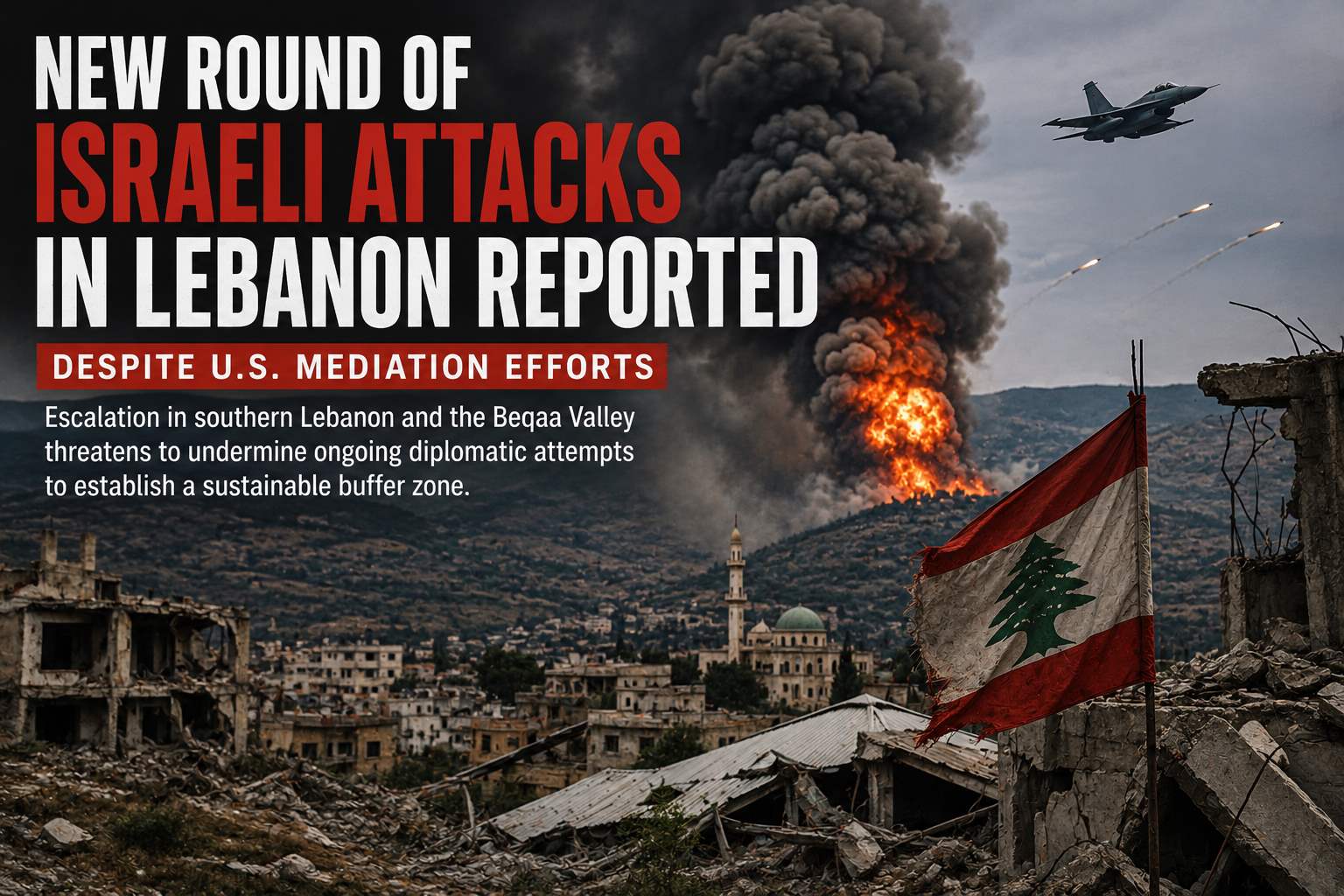
Escalation in southern Lebanon and the Beqaa Valley threatens to undermine ongoing diplomatic attempts to establish a sustainable buffer zone.
May 12, 2026
Global War News Editorial
Renewed military activity has been reported across southern and eastern Lebanon as Israeli forces launched a series of coordinated airstrikes Tuesday. According to reporting from Al Jazeera, the strikes targeted multiple locations, including several sites in the Beqaa Valley, a region that has seen increasing volatility over the past several months.
The escalation occurs during a sensitive window for international diplomacy. U.S. mediators have been actively engaging with regional leaders in an attempt to negotiate a de-escalation framework aimed at moving armed groups away from the border. However, the latest round of kinetic activity suggests a significant gap remains between diplomatic objectives and the situation on the ground.
Geographic Scope of the Strikes
Local sources and international monitors reported that the strikes were not limited to the immediate border area. Al Jazeera’s coverage indicated that at least three separate strikes hit the outskirts of Baalbek, a major urban center in eastern Lebanon.
In a public statement, the Israeli military reported that its aircraft targeted “infrastructure belonging to armed groups” in response to recent projectile launches toward northern Israel. While the military claimed to have hit command centers and weapons storage facilities, Lebanese state media reported that the strikes also impacted residential areas and agricultural land. The full extent of the damage and any potential casualties have not yet been independently verified.
The Diplomatic Impasse
The timing of the attacks has raised questions among observers regarding the efficacy of current U.S. mediation efforts. A senior U.S. envoy recently concluded a round of meetings in Beirut and Jerusalem, proposing a multi-stage plan that would involve an increased presence of the Lebanese Armed Forces (LAF) in the south to act as a buffer.
Analysts note that while the diplomatic track remains active, the continued use of high-intensity airstrikes creates a cycle of retaliation that makes political concessions difficult for all parties involved. In a recent press briefing, Lebanese officials stated that any agreement would be impossible as long as “sovereignty is being violated by daily incursions.”
Analysis: Strategic Objectives vs. Buffer Zone Stability
The primary challenge for mediators is the disconnect between tactical military goals and long-term regional stability. From the Israeli perspective, the objective appears to be the systematic degradation of the opposition’s logistics before any formal truce is signed. Conversely, the continued strikes provide armed groups with a pretext to maintain their presence along the border, citing the need for “defensive posture.”
This raises a critical question: Can a buffer zone be established while both sides continue to expand the geographic limits of their engagements? If the strikes continue to push further north into the Beqaa Valley, the conflict risks transitioning from a localized border dispute into a broader national crisis for Lebanon, which is already struggling with a prolonged economic collapse.
What to Watch
Moving forward, the international community is looking for a formal response from the U.S. State Department regarding the impact of these latest strikes on the mediation timeline. Additionally, the role of the United Nations Interim Force in Lebanon (UNIFIL) remains under scrutiny, as their ability to monitor and report on the Blue Line is increasingly hampered by the intensity of the aerial campaign.
The next 72 hours will be crucial in determining whether the U.S. proposal gains traction or if the region enters a new, more intensive phase of combat that could sideline diplomatic efforts for the remainder of the quarter.
Source Disclosure: This report is based on reporting from Al Jazeera, official statements from the Israeli military, and updates from Lebanese state media and regional diplomatic correspondents.
This article is based on publicly available reporting from named international news agencies and attributed official statements. All claims about ongoing events are attributed to their original sources. Analysis sections represent the editorial interpretation of reported facts and do not constitute advocacy for any party to the described conflict. AI tools may be utilized for image generation to assist in explaining complex concepts, as well as for refining grammar, spelling, and other linguistic enhancements. However, all original content is produced, fact-checked, and revised by the editorial team. This publication does not take political positions on active military conflicts.