
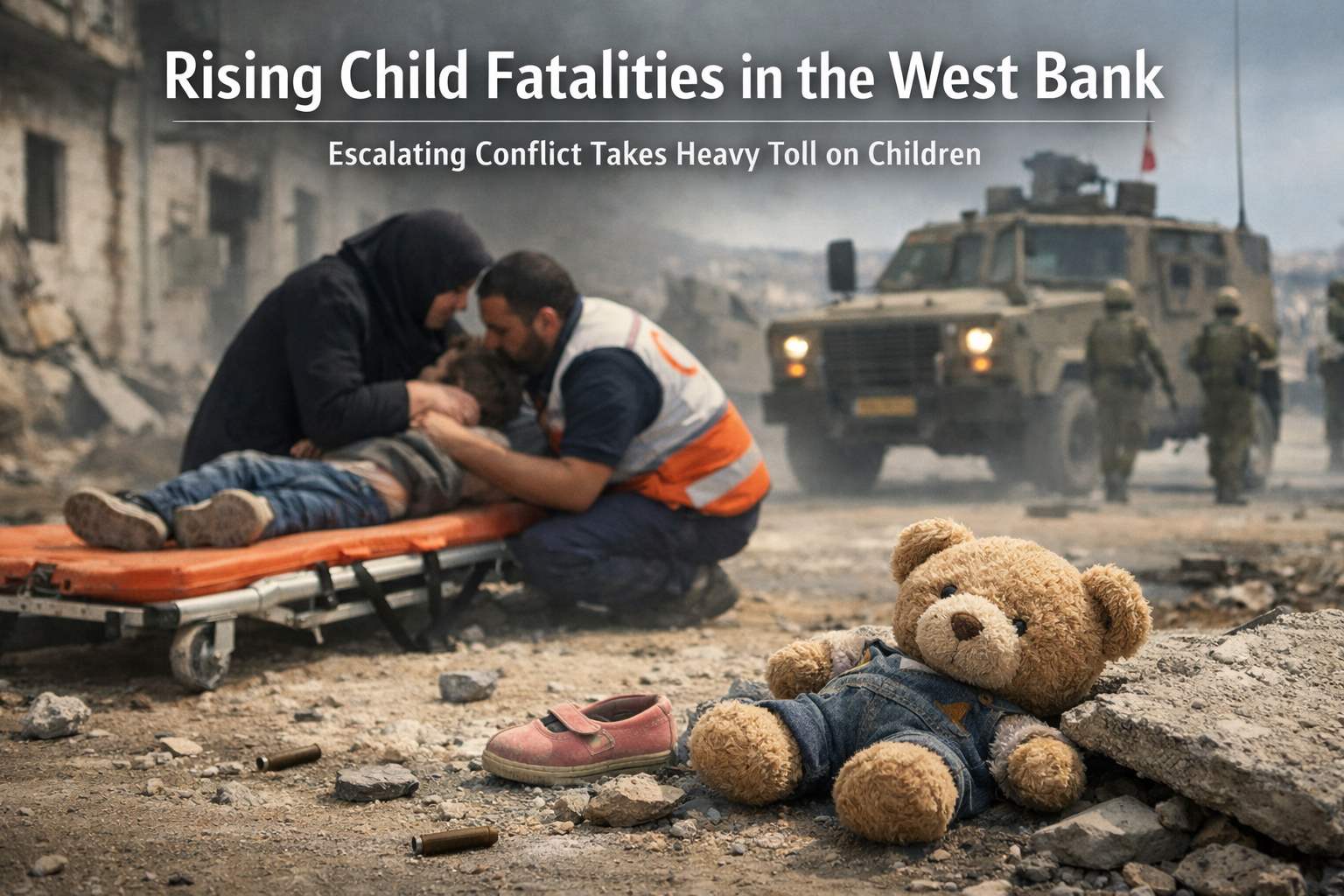
Escalating military activity in northern territories leads to sharp rise in minor casualties according to humanitarian monitors
May 13, 2026
Last updated: 21:15 GMT
By Global War News Editorial
The United Nations has issued a briefing reporting a marked increase in the fatality rate among children in the West Bank following a sustained period of intensified security operations. According to the latest data released by the UN Office for the Coordination of Humanitarian Affairs (OCHA), the number of minors killed in the territory since the beginning of 2026 has already surpassed the figures recorded for the entirety of the previous year.
The report states that the majority of these casualties occurred during large-scale incursions by Israeli forces into the northern governorates of Jenin, Tulkarm, and Nablus. While the Israeli Defense Forces (IDF) maintain that their operations are necessary to dismantle militant infrastructure and prevent planned attacks against Israeli civilians, international observers have raised concerns regarding the high toll on non-combatants.
OCHA’s briefing indicates that the fatalities often occur during prolonged firefights in densely populated refugee camps. The UN has called for an independent investigation into specific incidents where minors were reportedly caught in the crossfire or targeted during military maneuvers.
Patterns of Escalation and Casualties
According to unverified local reports corroborated in part by the Palestinian Ministry of Health, at least 14 children were killed in the first two weeks of May alone. UNRWA, the agency for Palestinian refugees, reported that its schools and health centers in the northern West Bank have frequently been forced to suspend operations due to the proximity of kinetic military activity.
The IDF has stated that it takes “all feasible precautions” to mitigate civilian harm. In several official communications, the military has alleged that armed groups in the West Bank frequently operate from within civilian areas and utilize minors in logistical roles, such as lookouts or transporters of materials. However, human rights organizations, including B’Tselem and Defense for Children International (DCI-P), have argued that the use of high-velocity ammunition and drone strikes in urban centers makes civilian casualties, particularly among children, an inevitable outcome.
Economic and Psychological Impact
Beyond the immediate loss of life, the escalating violence has severely degraded the economic stability of affected Palestinian communities. The UN report notes that frequent roadblocks and the destruction of local infrastructure during raids have prevented parents from reaching workplaces and hindered the distribution of essential goods.
“The psychological toll on the surviving youth is immeasurable,” a spokesperson for UNICEF stated in a public remark on the record. “A generation is being raised in a state of constant high-intensity conflict, with significant disruptions to education and basic safety.”
Analysis suggests that the deterioration of the security environment is leading to a total collapse of the local economy in towns like Jenin. Small businesses have reportedly seen a 60% drop in revenue compared to the same period in 2025, largely due to the physical destruction of storefronts and the fear of localized clashes.
Analysis: Legal and Political Implications
This spike in minor fatalities raises significant questions about the future of security coordination in the region. Analysts have suggested that the high casualty rate among the youth is serving as a primary driver for further radicalization, creating a self-perpetuating cycle of violence that current military strategies have failed to break.
From an international legal perspective, the UN briefing adds weight to ongoing inquiries by the International Criminal Court (ICC) regarding the conduct of all parties in the occupied territories. Observers note that while Israel is not a member of the ICC, the court’s prosecutor has previously asserted jurisdiction over the West Bank.
It remains unclear whether the mounting international pressure and the specific data provided by OCHA will lead to a change in tactical approach by the IDF or a shift in the political strategy of the Palestinian Authority, which has struggled to maintain order as its influence in the northern governorates wanes.
Source Disclosure Note: This report is based on official data from the UN Office for the Coordination of Humanitarian Affairs (OCHA), statements from UNRWA and UNICEF, and official communications from the Israeli Defense Forces (IDF) and the Palestinian Ministry of Health. Supplemental context was sourced from reporting by Reuters and the Associated Press.
This article is based on publicly available reporting from named international news agencies and attributed official statements. All claims about ongoing events are attributed to their original sources. Analysis sections represent the editorial interpretation of reported facts and do not constitute advocacy for any party to the described conflict. AI tools may be utilized for image generation to assist in explaining complex concepts, as well as for refining grammar, spelling, and other linguistic enhancements. However, all original content is produced, fact-checked, and revised by the editorial team. This publication does not take political positions on active military conflicts.