
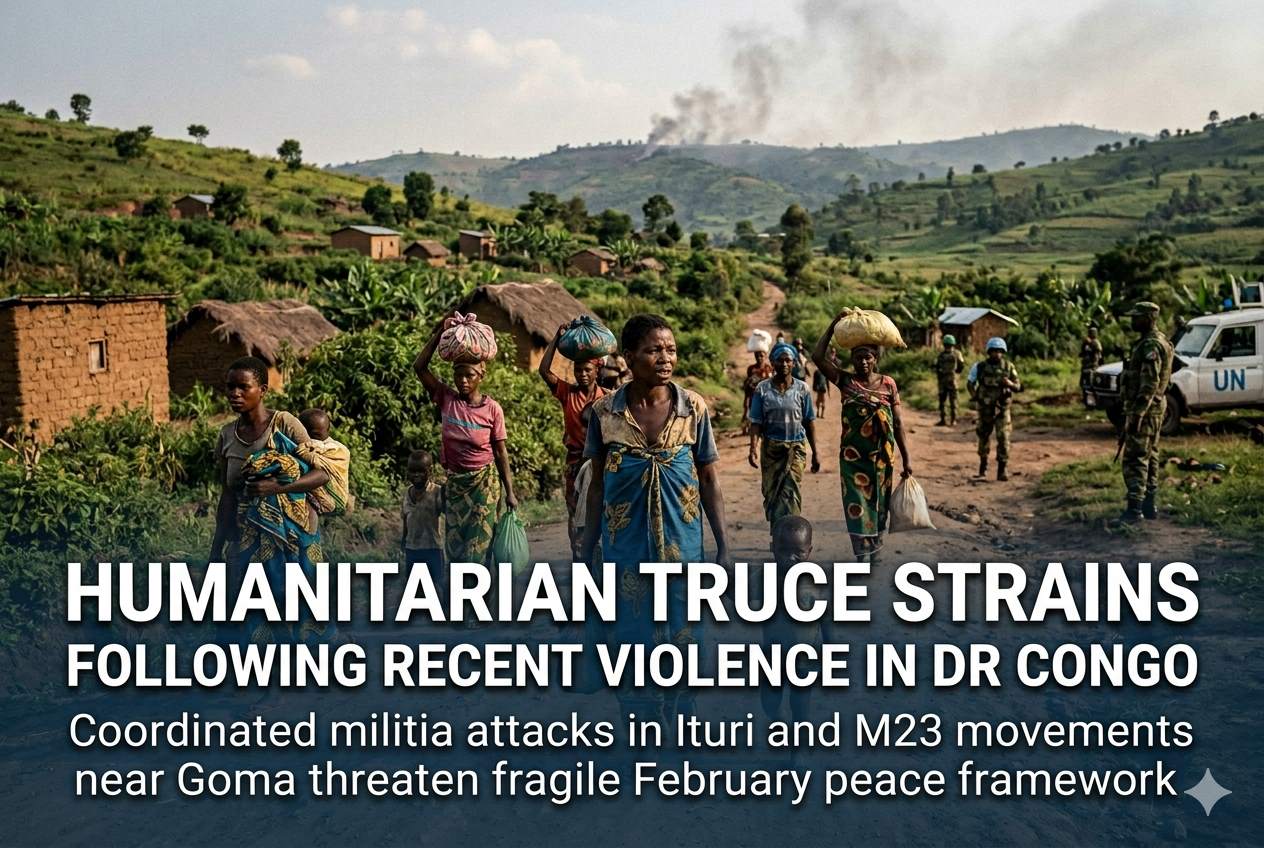
Coordinated militia attacks in Ituri and M23 movements near Goma threaten fragile February peace framework
May 13, 2026
Last updated: 22:30 GMT
By Global War News Editorial
Humanitarian monitors and local authorities in the Democratic Republic of the Congo (DRC) have reported a series of violent escalations that threaten to dismantle the fragile ceasefire established in early February 2026. According to reports from the United Nations and the Global Centre for the Responsibility to Protect, coordinated attacks by non-state armed groups in the northeastern Ituri province have killed dozens of civilians in recent days, raising questions about the viability of current de-escalation efforts.
The surge in violence comes as the Alliance Fleuve Congo/M23 (AFC/M23) reportedly began a partial withdrawal from several towns in North Kivu under mounting international pressure. However, the vacuum left by shifting frontline positions has coincided with a rise in activity from other groups, including the Cooperative for the Development of the Congo (CODECO) and the Allied Democratic Forces (ADF), both of which have been accused of committing mass atrocities against civilian populations.
While the Congolese government in Kinshasa and various rebel factions signed a Terms of Reference for a ceasefire mechanism in Doha on February 3, 2026, the reality on the ground remains volatile. Analysts suggest that without a more robust enforcement mechanism, the “humanitarian truce” intended to facilitate aid delivery is nearing a point of total collapse.
Escalation in Ituri and North Kivu
The most severe of the recent reports originates from Ituri province. According to the UN Joint Human Rights Office in the DRC, armed men affiliated with CODECO attacked several villages near Pimbo in Djugu territory on April 28, resulting in at least 69 confirmed fatalities. Local sources have suggested the final death toll may exceed 70 as insecurity initially prevented recovery teams from reaching the site.
Simultaneously, in North Kivu, the withdrawal of M23 fighters from certain strategic areas has not yet translated into stability. While the African Union (AU) welcomed the signing of ceasefire terms earlier this year, the Armed Forces of the Democratic Republic of the Congo (FARDC) continue to clash with the Convention for the Popular Revolution (CRP), a newer armed group that emerged in 2025.
“The situation is deteriorating sharply,” stated a spokesperson for Médecins Sans Frontières (MSF) in a report released earlier this month. The organization noted that its teams in Fataki and Bule have treated thousands of patients for gunshot wounds and violence-related injuries since February, indicating that the ceasefire has failed to protect civilians in several key humanitarian corridors.
Humanitarian and Economic Impact
The renewed fighting has triggered a massive wave of internal displacement. According to the UN Office for the Coordination of Humanitarian Affairs (OCHA), more than 920,000 people are currently displaced across Ituri province alone, with over 100,000 newly displaced in the first quarter of 2026.
The economic consequences of this displacement are acute. As farming communities flee their land, local food production has stalled, leading to severe food insecurity. The European Union, which allocated €70 million in humanitarian aid to the DRC for 2026, warned that 26.6 million people are currently facing acute hunger.
Logistical disruptions are also mounting. Aid organizations report that the closure of major transit routes and the volatility of local airstrips have made the delivery of medical supplies and food nearly impossible in high-conflict “red zones.” The EU recently launched a new “Humanitarian Air Bridge” to bypass ground-level insecurity, but officials admit it cannot meet the total scale of the need.
Analysis: A Peace Process Under Pressure
The current violence highlights a fundamental flaw in the regional peace architecture. While high-level negotiations in Doha and Luanda produced formal agreements, the lack of a “joint verification mechanism” with enough physical presence on the ground has allowed smaller militias to operate outside the scope of the truce.
Observers note that the M23 withdrawal—long a central demand of the Kinshasa government—may be more tactical than permanent. “It remains unclear whether these pullbacks represent a genuine commitment to peace or a temporary repositioning to avoid international sanctions,” suggested a regional analyst for a Nairobi-based think tank.
Furthermore, the rise of groups like the CRP and the continued resilience of the ADF suggest that even if a permanent agreement with M23 is reached, the eastern DRC remains a patchwork of competing interests over land and mineral resources that a single ceasefire cannot address.
What to Watch For
In the coming weeks, the focus will remain on the African Union’s Expanded Joint Verification Mechanism (EJVM+). If this body cannot successfully operationalize its monitoring teams to document violations, the February truce may officially be declared void. Additionally, the international community is watching for any signs of direct involvement by neighboring states, as allegations of external support for rebel groups continue to strain diplomatic relations in the Great Lakes region.
Source Disclosure Note: This report is based on official data and statements from the United Nations (OCHA and UNJHRO), the African Union Commission, Médecins Sans Frontières (MSF), the Global Centre for the Responsibility to Protect, and international news coverage from Agence France-Presse (AFP) and Africanews.
This article is based on publicly available reporting from named international news agencies and attributed official statements. All claims about ongoing events are attributed to their original sources. Analysis sections represent the editorial interpretation of reported facts and do not constitute advocacy for any party to the described conflict. AI tools may be utilized for image generation to assist in explaining complex concepts, as well as for refining grammar, spelling, and other linguistic enhancements. However, all original content is produced, fact-checked, and revised by the editorial team. This publication does not take political positions on active military conflicts.