
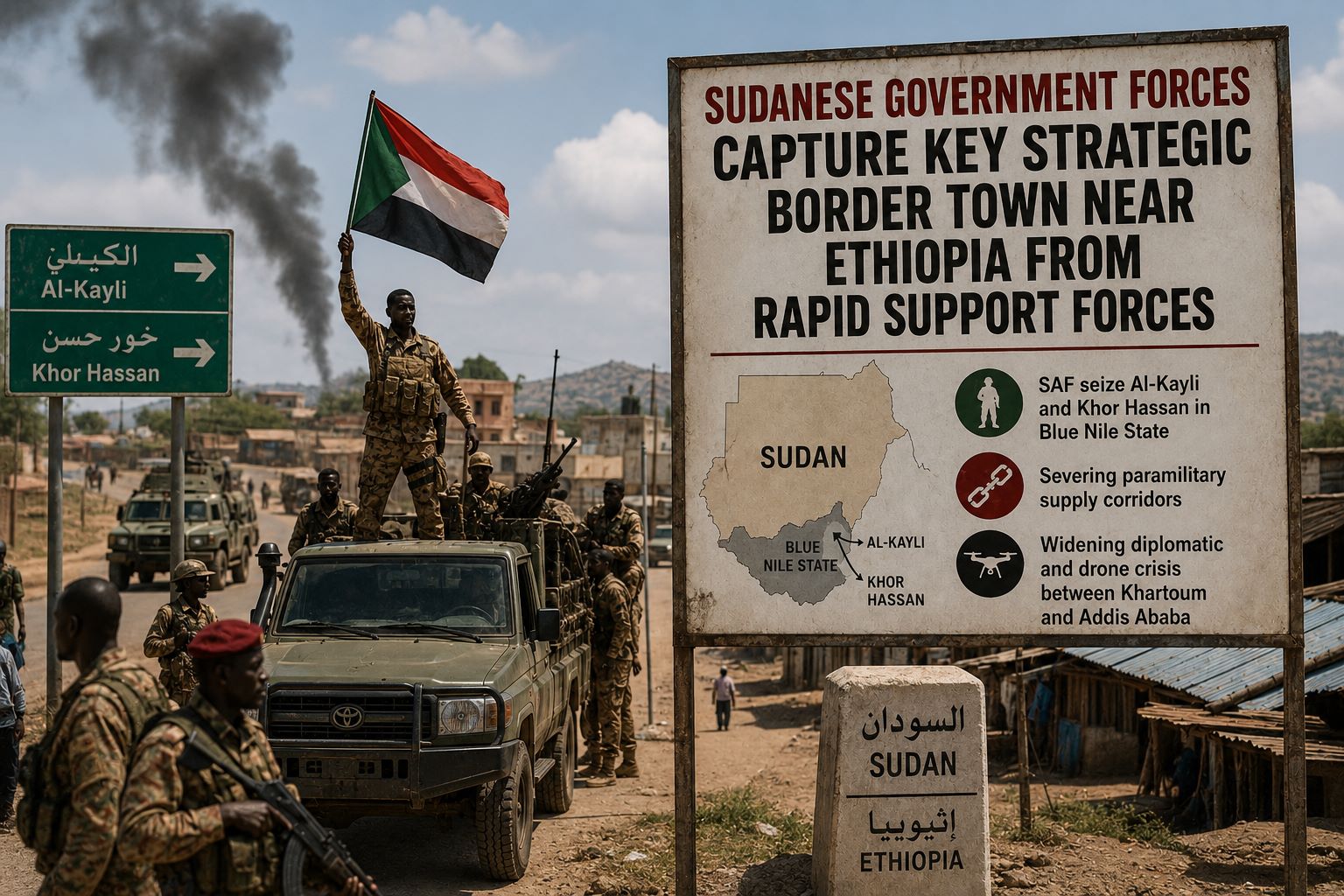
The Sudanese Armed Forces seize Al-Kayli and Khor Hassan in Blue Nile State, severing paramilitary supply corridors amid a widening diplomatic and drone crisis between Khartoum and Addis Ababa.
Publication Date: May 18, 2026
Last Updated: May 18, 2026
Byline: Global War News Editorial
The Sudanese Armed Forces have captured critical territorial hubs in the southeastern Blue Nile region near the Ethiopian border, marking a significant operational shift in the country’s multi-year civil conflict. The military maneuvers effectively disrupt key supply corridors utilized by the paramilitary Rapid Support Forces and their regional insurgent allies.
According to a series of official military press briefings issued between May 10 and May 16, 2026, troops from the army’s 4th Infantry Division successfully secured the areas of Al-Kayli and Khor Hassan. The locations sit on the immediate outskirts of Kurmuk, a prominent border city that has been under paramilitary administration since March 24. The operational push represents the most significant government counter-offensive along the southeastern frontier since an active southern front re-opened earlier this year.
The escalation on the ground coincides with a severe rupture in diplomatic relations between Sudan and Ethiopia. The central government in Khartoum has formally recalled its ambassador from Addis Ababa, accusing the Ethiopian state of providing direct logistical sanctuary to the RSF and facilitating hostile drone operations inside Sudanese territory. Ethiopian authorities have rejected the allegations, warning that the militarization of the shared frontier threatens to reignite historical border disputes.
The Push for Al-Kayli and Khor Hassan
The physical reclamation of the border zone followed days of heavy artillery duels and localized infantry engagements. In an official communique broadcast via state networks, the Sudanese Armed Forces stated that the 4th Infantry Division, supported by domestic reserve elements, overran fortified positions held by the RSF and the affiliated Sudan People’s Liberation Movement-North, led by rebel commander Joseph Touka.
According to the military’s statement, government troops advanced into Al-Kayli on May 9, before extending their perimeter to clear the neighboring Khor Hassan garrison on May 15. The army claimed to have inflicted substantial losses in personnel and hardware, forcing rebel remnants to retreat south toward the Ethiopian line.
The RSF-aligned political network, the Sudan Founding Alliance, offered a different account of the regional fighting. While acknowledging a repositioning of its forces around the outskirts of Kurmuk, the alliance accused the Sudanese military of relying on indiscriminate combat operations. The group asserted that a government drone strike targeted a civilian transport vehicle in the neighboring South Kordofan sector, resulting in the deaths of 15 civilians. The Sudanese military has not provided an official comment regarding the alleged drone casualty figures.
Context and Background: The Geopolitics of the Blue Nile Front
The civil war between the Sudanese Armed Forces, led by General Abdel Fattah al-Burhan, and the RSF, commanded by Mohamed Hamdan “Hemedti” Dagalo, has devastated the nation since April 2023. While much of the early warfare concentrated on Khartoum and the western Darfur region, the southeastern Blue Nile state transformed into a critical active theater in February 2026.
The strategic significance of the Blue Nile region lies in its proximity to Ethiopia’s Benishangul-Gumuz region. Independent investigative assessments published earlier this year by Reuters and Yale University indicated that the RSF had established operational hubs inside western Ethiopia to funnel fuel, weapons, and medical supplies into southeastern Sudan. By seizing Al-Kayli and Khor Hassan, the SAF is attempting to build a physical containment wall to isolate the RSF from its cross-border supply lines.
The localized cross-border friction escalated dramatically following an April 29 SAF drone strike that targeted an RSF logistics pathway inside the Ethiopian side of Kurmuk, which reportedly killed eight individuals, including an international humanitarian worker. Tensions peaked on May 4, when Khartoum airport was targeted by a drone strike. The Sudanese government alleged the aircraft originated from an airbase in Bahir Dar, Ethiopia, leading to the immediate recall of Sudan’s ambassador.
Analysis: Supply Line Disruption and Border Risks
From an operational standpoint, the capture of Al-Kayli and Khor Hassan allows the Sudanese army to establish an observation and interdiction zone over the primary unpaved transit roads connecting western Ethiopia to the interior of Sudan. If the 4th Infantry Division can maintain its hold on these positions, the RSF units operating in the broader Blue Nile and Sennar sectors face a prolonged contraction of ammunition and fuel resources.
However, the strategy carries immense geopolitical risks. To prevent the RSF from utilizing cross-border depth, the SAF has reinforced its troop presence further north in the contested Al-Fashaga agricultural border region of Gedaref State. Major General Youssef Mohamed Ahmed Abu Sharb, commander of the Second Infantry Division, recently placed the eastern frontier on a high state of security alert.
Observers note that by deploying heavy armor and regular units to Al-Fashaga, Khartoum is signaling a willingness to confront external logistical support directly. This aggressive posturing increases the probability of accidental kinetic contact between the Sudanese military and regular Ethiopian border security detachments, potentially transforming an internal civil war into a wider interstate conflict.
What to Watch
The immediate development to track is the impending battle for Kurmuk city itself. Having secured the high ground and minor garrisons surrounding the urban center, the Sudanese army is expected to launch a direct assault to retake the border gate.
Additionally, international monitors will watch for any shifts in regional air activity. Should further drone strikes occur near Sudanese airports or within Ethiopian frontier provinces, it would signal that the localized escalation cycle remains open, threatening the fragile security balance of the entire Horn of Africa.
Source Disclosure Note: This report is compiled from official military communiques released by the Sudanese Armed Forces 4th Infantry Division and field inspection briefings from the Second Infantry Division in Gedaref. Paramilitary and allied counter-claims are drawn from statements published by the RSF-aligned Sudan Founding Alliance and the SPLM-North (Joseph Touka faction). Diplomatic developments are sourced via the Sudanese Ministry of Foreign Affairs and the Ethiopian Ministry of Foreign Affairs, with supplementary field data provided by the independent regional outlets Radio Tamazuj and Sudan Tribune.
This article is based on publicly available reporting from named international news agencies and attributed official statements. All claims about ongoing events are attributed to their original sources. Analysis sections represent the editorial interpretation of reported facts and do not constitute advocacy for any party to the described conflict. AI tools may be utilized for image generation to assist in explaining complex concepts, as well as for refining grammar, spelling, and other linguistic enhancements. However, all original content is produced, fact-checked, and revised by the editorial team. This publication does not take political positions on active military conflicts.