
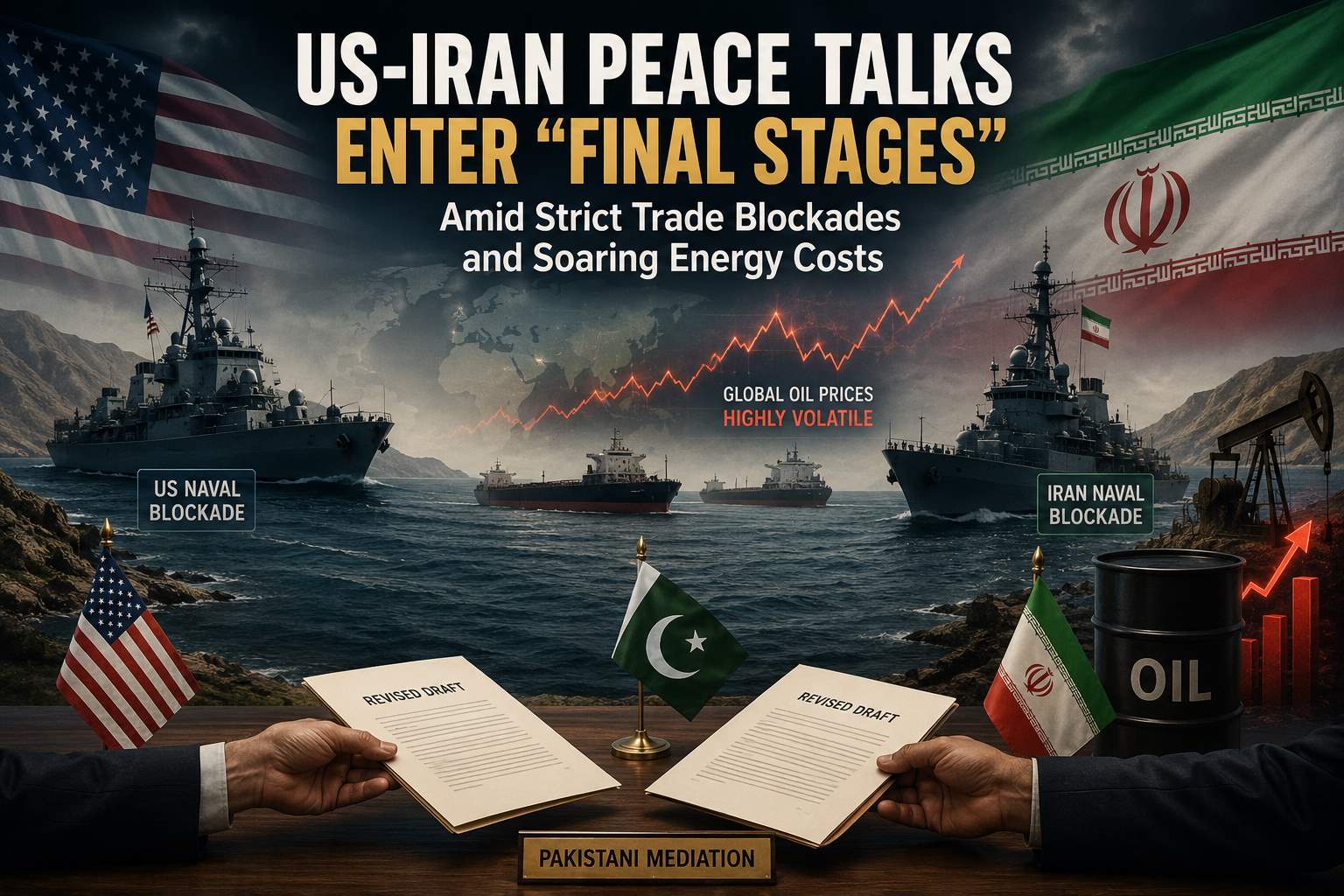
Negotiators exchange revised drafts via Pakistani mediators while dual naval blockades keep global oil prices highly volatile.
Published: May 21, 2026
By: Global War News Editorial
Indirect diplomatic negotiations between the United States and Iran have reached a critical inflection point, with both nations actively reviewing newly exchanged frameworks to end the ongoing 2026 Iran war. The diplomatic updates come directly from public statements issued by top government leaders in Washington and Tehran over the last 24 hours.
While political leaders describe the diplomatic track as entering its final phases, regional military realities remain highly restrictive. A tense “dual blockade” continues to choke commercial shipping in West Asia. The United States Navy maintains a strict blockade of Iranian ports, while Iranian forces restrict transit through the critical Strait of Hormuz. This maritime chokehold has driven global Brent crude oil prices above $110 per barrel, triggering significant downstream economic disruptions across international supply chains and Asian energy markets.
The Diplomatic Status: “One Shot” at an Agreement
Speaking to reporters on Wednesday before boarding Air Force One, US President Donald Trump announced that his administration is in the “final stages” of peace talks with Iran. Trump indicated a willingness to wait several days for what he termed the “right answer” from Tehran, but explicitly ruled out a partial or limited compromise that would only focus on reopening the Strait of Hormuz.
“We’re going to give this one shot,” Trump stated, adding that the outcome would either be a comprehensive deal or a return to aggressive measures.
In Tehran, the semi-official Tasnim News Agency reported that Washington transmitted a new draft proposal to the Iranian government via Pakistani mediators. This document serves as a counter-proposal to a 14-point peace plan previously submitted by Iran. Pakistani officials are currently in Tehran attempting to reconcile the significant structural gaps between the two working texts.
Responding to the developments, Iranian President Masoud Pezeshkian stated on social media that his country has consistently honored its international commitments and sought to avert wider warfare. However, Pezeshkian explicitly rejected the idea of capitulation, asserting that forcing Iran to surrender through economic or military coercion is an illusion.
Core Negotiation Hurdles and Conflicting Demands
The current diplomatic friction revolves around distinct and conflicting sets of preconditions established by both capitals. According to records compiled by international observers, the primary obstacles to a finalized treaty include:
- Nuclear Constraints: The Trump administration has established strict baselines, reportedly demanding that Iran transfer 400 kilograms of enriched uranium to the United States and maintain only one operational, highly monitored nuclear facility. Conversely, the head of Iran’s Atomic Energy Organization has publicly stated that Tehran will not accept arbitrary limits on its domestic enrichment capabilities.
- Financial and Asset Disputes: Iranian Foreign Ministry Spokesperson Esmaeil Baghaei stated during a press briefing that Iran’s core demands include the immediate release of frozen Iranian assets abroad and an end to what Tehran characterizes as hostile actions against its commercial shipping. Current US negotiation guidelines, however, signal a refusal to release at least 25 percent of those frozen funds, alongside a firm rejection of Iran’s demands for war reparations.
- Regional Scope: The Iranian delegation remains focused on securing a comprehensive cessation of hostilities across all regional fronts, specifically including Lebanon. This position faces resistance from the US and Israel, who have historically treated the conflicts as separate operational theaters.
Economic and Trade Impact: The Strait of Hormuz Standoff
The direct consequence of the prolonged conflict and the current diplomatic stalemate is felt most severely in global energy markets. The dual blockade has transformed the Persian Gulf into a heavily restricted zone for commercial logistics.
The initial closure of the Strait of Hormuz by Iranian forces, followed by the deployment of the US naval blockade against Iranian ports, has caused the largest supply disruption in the modern history of the global oil market. International shipping firms continue to face extreme insurance premiums and logistical delays, forcing many tankers to reroute entirely around the African continent.
The resulting spike in crude prices has trickled down to consumer economies worldwide. In South Asia and developing island nations, central bank tracking data reveals rising domestic fuel costs, which are driving up transportation expenses and inflating the baseline cost of imported essential commodities.
Analysis: What to Watch Next
Economic and military analysts suggest that the next 48 to 72 hours will determine whether the region transitions toward an extended truce or reverts to high-intensity kinetic conflict. The temporary ceasefire brokered by Islamabad in April demonstrated that temporary pauses are possible, but the failure to transition that truce into a permanent framework underscores the deep systemic distrust between the parties.
Observers note that while both sides are publicly utilizing coercive rhetoric to maximize leverage, the severe economic toll of the shipping blockades creates an underlying pressure to find a functional compromise. Should the Pakistani-mediated drafts fail to narrow the current gaps, military commanders on both sides have indicated readiness to resume active operations.
Iran’s Islamic Revolutionary Guard Corps issued a public warning on Wednesday that any repeated military aggression against Iranian territory would result in a conflict extending beyond the West Asia region. Concurrently, the Israeli military remains on its highest alert, with leadership conducting operational situational assessments to ensure total force readiness if diplomacy collapses.
Source Disclosure Note: This report relies on official public briefings from US President Donald Trump, public statements by Iranian President Masoud Pezeshkian, official press conference transcripts from Iranian Foreign Ministry Spokesperson Esmaeil Baghaei, reporting from the semi-official Tasnim News Agency, and verified market data tracking global crude oil pricing.
This article is based on publicly available reporting from named international news agencies and attributed official statements. All claims about ongoing events are attributed to their original sources. Analysis sections represent the editorial interpretation of reported facts and do not constitute advocacy for any party to the described conflict. AI tools may be utilized for image generation to assist in explaining complex concepts, as well as for refining grammar, spelling, and other linguistic enhancements. However, all original content is produced, fact-checked, and revised by the editorial team. This publication does not take political positions on active military conflicts.