
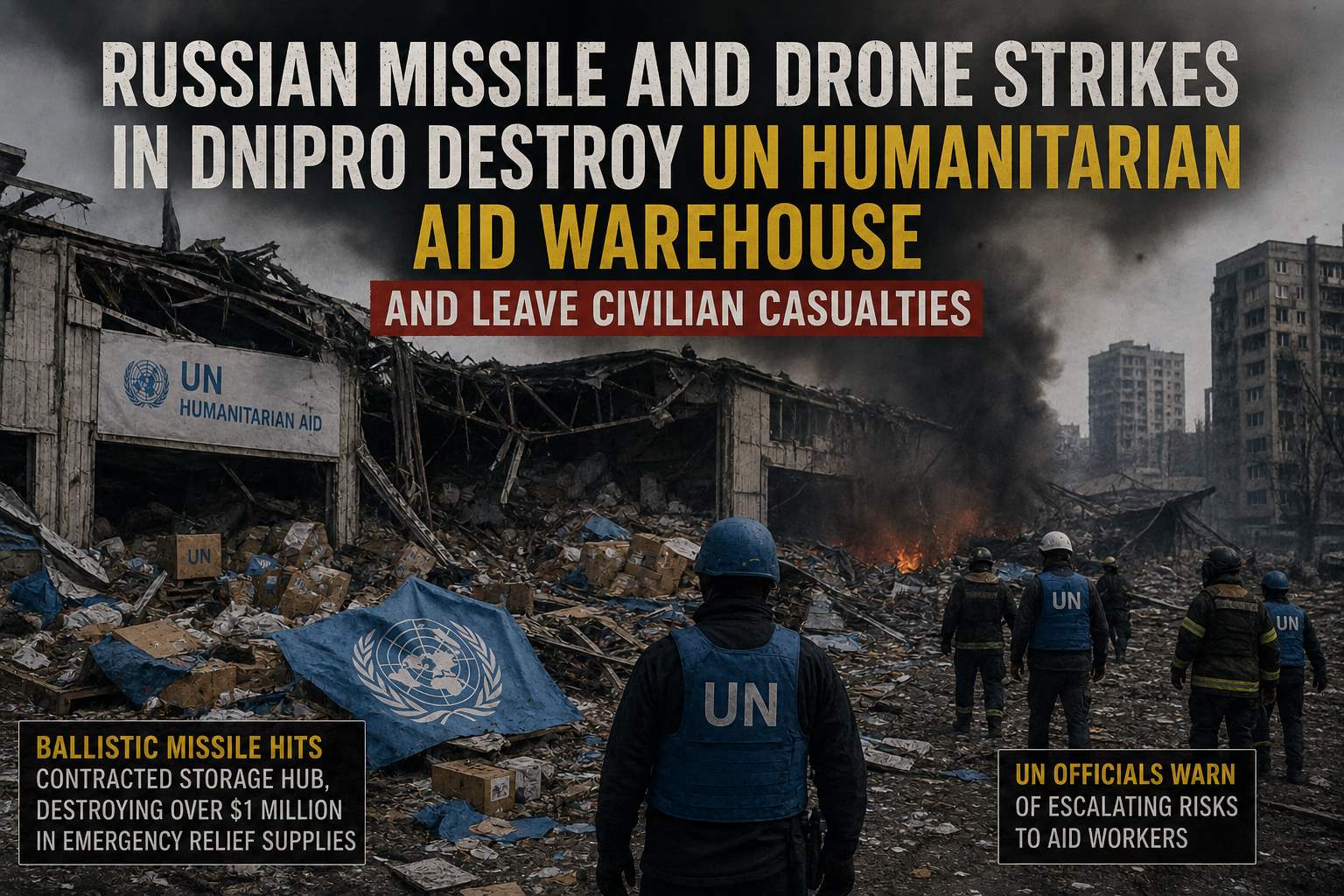
Ballistic missile hits contracted storage hub, destroying over $1 million in emergency relief supplies as UN officials warn of escalating risks to aid workers.
Published: May 21, 2026
By: Global War News Editorial
A major overnight aerial assault involving Russian ballistic missiles and attack drones has struck the central Ukrainian city of Dnipro, killing at least two people, injuring six others, and decimating a vital international humanitarian storage hub.
The United Nations High Commissioner for Refugees confirmed on Wednesday that a ballistic missile directly struck a contracted warehouse facility in the city, triggering an intense fire that completely destroyed approximately 900 pallets of humanitarian relief and emergency shelter materials. The UN agency estimated the material value of the lost inventory at more than $1 million, noting that the supplies were designated for thousands of internally displaced people and vulnerable families across the Dnipropetrovsk region and neighboring frontline communities.
Direct Hit on Humanitarian Infrastructure
According to a formal statement issued by the UNHCR Representative in Ukraine, the two individuals killed in the bombardment were local warehouse workers operating inside the facility when the missile struck. Ukraine’s State Emergency Service reported that more than 80 rescue workers and 25 specialized emergency vehicles, including remote-controlled robotic systems, were deployed to combat the massive blaze at the three-story structure.
Local administrative officials, including the Head of the Dnipropetrovsk Oblast Military Administration, Oleksandr Hanzha, reported that the overnight barrage combined multiple weapon systems. Ukrainian air defense units from the East Air Command reported intercepting and destroying 17 Russian attack drones over the region during the night. However, a ballistic missile bypassed defenses, striking the commercial and logistical district.
Aside from the UN-contracted facility, adjacent local food storage warehouses and several private residential homes sustained significant physical damage. Of the six wounded civilians, regional medical administrators confirmed that three individuals—a 42-year-old woman and two men aged 25 and 47—remain hospitalized in severe condition.
Escalating Risks to Relief Operations
The destruction of the Dnipro warehouse follows a sequence of recent incidents that have directly affected United Nations operations and assets across Ukraine. Speaking at a UN Security Council session in New York, Director Kayoko Gotoh detailed an alarming rise in hostilities impacting aid distribution networks.
According to official UN logs, the attack in Dnipro occurred just days after an incident on May 12, when a clearly marked UN vehicle belonging to a World Food Programme humanitarian convoy was struck by a remote-controlled drone in the broader Dnipropetrovsk region. In a separate incident on May 14, another marked UN vehicle was struck twice by drones during an inter-agency humanitarian mission led by the Office for the Coordination of Humanitarian Affairs in the Kherson region, despite prior notification of the mission’s route to the combatant parties.
The UNHCR noted that the destroyed items included basic relief supplies such as blankets, sleeping mats, and hygiene kits, which are routinely distributed to evacuees at transit sites, alongside specialized construction materials required for emergency repairs on war-damaged civilian homes.
Context: A Nationwide Surge in Civilian Harm
The UN Human Rights Monitoring Mission in Ukraine reported that civilian casualties have risen significantly during the first four months of 2026 compared to the same period over the past three years. The mission verified that at least 238 civilians were killed and 1,404 injured in April alone, marking the highest single-month casualty toll since July 2025.
| Time Period / Record | Verified Killed | Verified Injured | Source |
| Month of April 2026 | 238 | 1,404 | UN HRMMU |
| Total 2026 (Jan–April) | 815 | 4,174 | UN HRMMU |
| Total Since Feb 2022 | 15,850 | 44,809 | UN OHCHR |
UN officials emphasize that these figures represent exclusively verified cases, and the actual total number of casualties is likely significantly higher due to reporting delays from occupied and heavy combat zones.
The Russian Federation has consistently maintained that its military operations strictly target military objectives and supporting infrastructure, denying deliberate targeting of civilians or non-military assets. However, international humanitarian organizations note that the increasing usage of high-velocity ballistic missiles and loitering munitions in dense urban logistical centers continuously results in severe collateral damage to civilian and humanitarian networks.
What to Watch Next
The loss of the Dnipro logistics base creates an immediate operational challenge for international agencies attempting to support frontline sectors. Dnipro serves as the primary logistical springboard for humanitarian operations across eastern and southern Ukraine, meaning alternative warehouse facilities must be quickly secured and restocked to avoid gaps in emergency distributions.
Furthermore, the escalation of strikes directly following the expiration of a brief, three-day bilateral ceasefire observed earlier in May indicates a return to high-intensity aerial campaigns. Observers are monitoring whether the UN Security Council will push for formalized safety corridors for aid delivery, or if the targeting of regional distribution hubs will continue to constrict the reach of international relief efforts.
Source Disclosure Note: This report is based on official statements from the United Nations High Commissioner for Refugees, briefing transcripts from the UN Security Council session featuring Director Kayoko Gotoh, and verified field data from the UN Human Rights Monitoring Mission in Ukraine. Additional situational details were drawn from statements by the Dnipropetrovsk Oblast Military Administration Head Oleksandr Hanzha, the Ukraine State Emergency Service, and reporting by Agence France-Presse and the Kyiv Post.
This article is based on publicly available reporting from named international news agencies and attributed official statements. All claims about ongoing events are attributed to their original sources. Analysis sections represent the editorial interpretation of reported facts and do not constitute advocacy for any party to the described conflict. AI tools may be utilized for image generation to assist in explaining complex concepts, as well as for refining grammar, spelling, and other linguistic enhancements. However, all original content is produced, fact-checked, and revised by the editorial team. This publication does not take political positions on active military conflicts.