
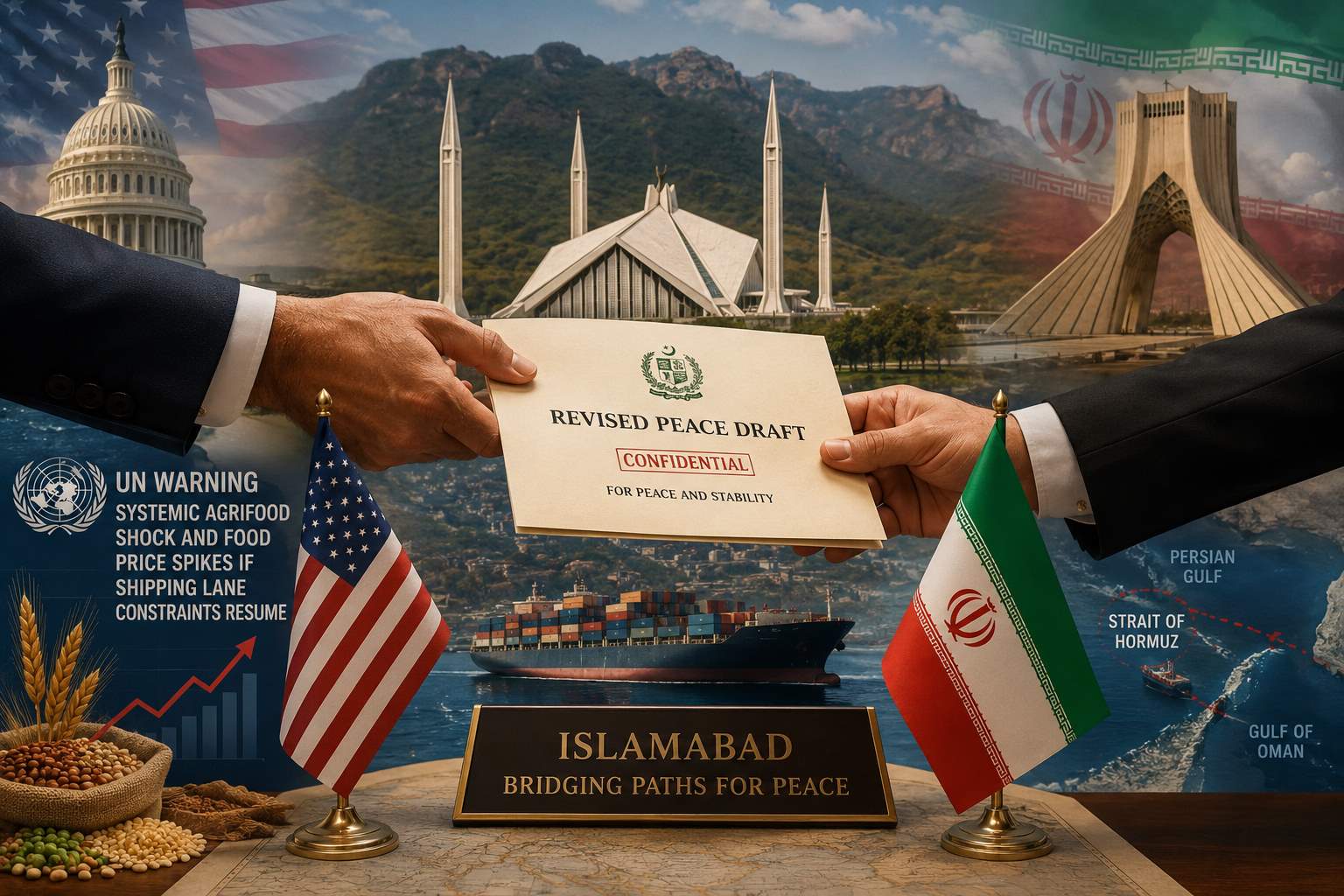
Backchannel diplomacy intensifies as UN warns of systemic agrifood shock and food price spikes if shipping lane constraints resume.
Publication Date: May 21, 2026
Last Updated: May 21, 2026
By Global War News Editorial
Backchannel diplomatic lines between Washington and Tehran have intensified. Pakistani intermediaries are currently conveying a revised framework aimed at solidifying the fragile April 8 ceasefire. The renewed diplomatic push comes amid a sharp rise in rhetoric from both capitals. United States President Donald Trump announced that negotiations are in their final stages, while simultaneously warning of a return to large-scale military actions if talks collapse. In response, senior Iranian officials have indicated they are examining the latest points of view transmitted via Islamabad, though military commanders maintain that any renewed intervention will meet a devastating regional response.
The outcome of these mediated exchanges carries profound consequences for the global economy. Although the April ceasefire temporarily halted the direct US-Israeli airstrikes and Iranian retaliatory missile salvos that began on February 28, the underlying friction has left vital maritime corridors highly restricted. Global energy markets, international shipping companies, and agricultural distribution networks remain exposed to sudden disruptions, keeping operating costs elevated worldwide.
The Diplomatic Bridge: Islamabad’s Evolving Role
According to reports from Al Jazeera, Pakistan’s Interior Minister Mohsin Naqvi concluded high-level emergency meetings in Tehran with Iranian President Masoud Pezeshkian and Parliament Speaker Mohammad Bagher Ghalibaf. The diplomatic mission represents a direct effort by Islamabad to prevent the collapse of the negotiation channel. Pakistan has maintained a policy of official neutrality since the conflict erupted, positioning itself as the primary communication bridge between the two adversaries.
The revised peace framework builds upon earlier diplomatic rounds hosted in Islamabad during April. Reuters reported that the latest iterative text addresses highly contested parameters, including conditional sanctions relief, the unfreezing of Iranian assets blocked in foreign accounts, and a structured protocol for verified maritime security. Iranian Foreign Ministry spokesman Esmaeil Baqaei publicly confirmed that Tehran had received the updated points of view from the American side and is currently evaluating the details.
However, deep institutional skepticism remains a barrier to a formal signing. Ghalibaf, who also serves as Tehran’s chief negotiator, stated that military movements suggest Washington has not abandoned its broader operational objectives. Simultaneously, President Trump posted statements indicating he had postponed a planned military operation on the advice of regional Gulf leaders to give diplomacy a final window, adding that US forces remain prepared to proceed at a moment’s notice.
The Core Sticking Point: Maritime Security and Port Blockades
The primary geographic friction point remains the Strait of Hormuz. The thin shipping lane serves as the conduit for approximately one-third of the world’s liquefied natural gas and a fifth of global petroleum liquids. While the Iranian Revolutionary Guards Navy stated it permitted 26 commercial vessels to transit the channel over a recent 24-hour window, maritime security companies report that transit volumes remain significantly below pre-war levels due to stringent inspection regimes and prohibitive war-risk insurance premiums.
Concurrently, the United States continues to enforce a strict naval blockade on Iranian ports. US Central Command confirmed that maritime forces recently boarded an Iranian-flagged tanker in the Gulf of Oman under suspicion of attempting to evade these economic restrictions. Analysts observe that until a formal, bilateral protocol removes both the threat of Iranian disruption in the strait and the US blockade on coastal terminals, international commercial shipping cannot resume normal operations.
ANALYSIS: The Global Economic Toll of a Prolonged Stalemate
Observers note that while the April 8 ceasefire lowered immediate battlefield casualties, the economic side effects of the war continue to compound. The protracted closure and militarization of the Gulf waterways have forced global supply chains to adapt to systemic changes, driving structural inflation in two critical sectors: energy and agriculture.
Energy Market Vulnerability
While oil prices initially experienced a sharp downward correction on early reports of a potential memorandum breakthrough on May 6, they have since stabilized at a high baseline. Energy analysts suggest that pre-war global crude stockpiles are steadily depleting. If the Islamabad channel fails and military strikes resume, energy markets are projected to face immediate supply deficits, impacting industrial output across Europe and Asia.
The Looming Agrifood Shock
The secondary impact on global agriculture is emerging as an equally severe threat. The Strait of Hormuz is a vital global artery for chemical fertilizers and raw agricultural inputs. The United Nations Food and Agriculture Organization issued an explicit warning, stating that prolonged logistics restrictions in the region risk triggering a severe global food price crisis and a systemic agrifood shock. Countries in South and East Asia, which rely heavily on these specific fertilizer shipments for seasonal crop cycles, face direct threats to domestic agricultural yields.
What to Watch Next
The immediate future of the regional conflict hinges on the technical feedback Pakistan receives from Tehran’s security council over the coming days. Observers suggest three immediate variables will dictate whether the region transitions toward a durable truce or returns to open warfare:
- The Nuclear and Sanctions Trade-Off: Whether Washington accepts a phased, incremental lifting of trade restrictions in exchange for verifiable pauses in Iran’s nuclear enrichment.
- Hormuz Transit Protocols: The establishment of an independent or third-party monitoring mechanism to guarantee unhindered commercial navigation through the strait without triggering interdictions by regional navies.
- Domestic Political Pressures: How the US administration balances its public deadlines with the explicit requests from allied Gulf states to sustain diplomatic channels.
Source Disclosure Note: This report relies on official public statements from the Iranian Foreign Ministry, US Central Command, and the United Nations Food and Agriculture Organization. Supplemental operational and diplomatic data were drawn from verified coverage by Reuters, Agence France-Presse, Al Jazeera, and The Guardian.
This article is based on publicly available reporting from named international news agencies and attributed official statements. All claims about ongoing events are attributed to their original sources. Analysis sections represent the editorial interpretation of reported facts and do not constitute advocacy for any party to the described conflict. AI tools may be utilized for image generation to assist in explaining complex concepts, as well as for refining grammar, spelling, and other linguistic enhancements. However, all original content is produced, fact-checked, and revised by the editorial team. This publication does not take political positions on active military conflicts.