
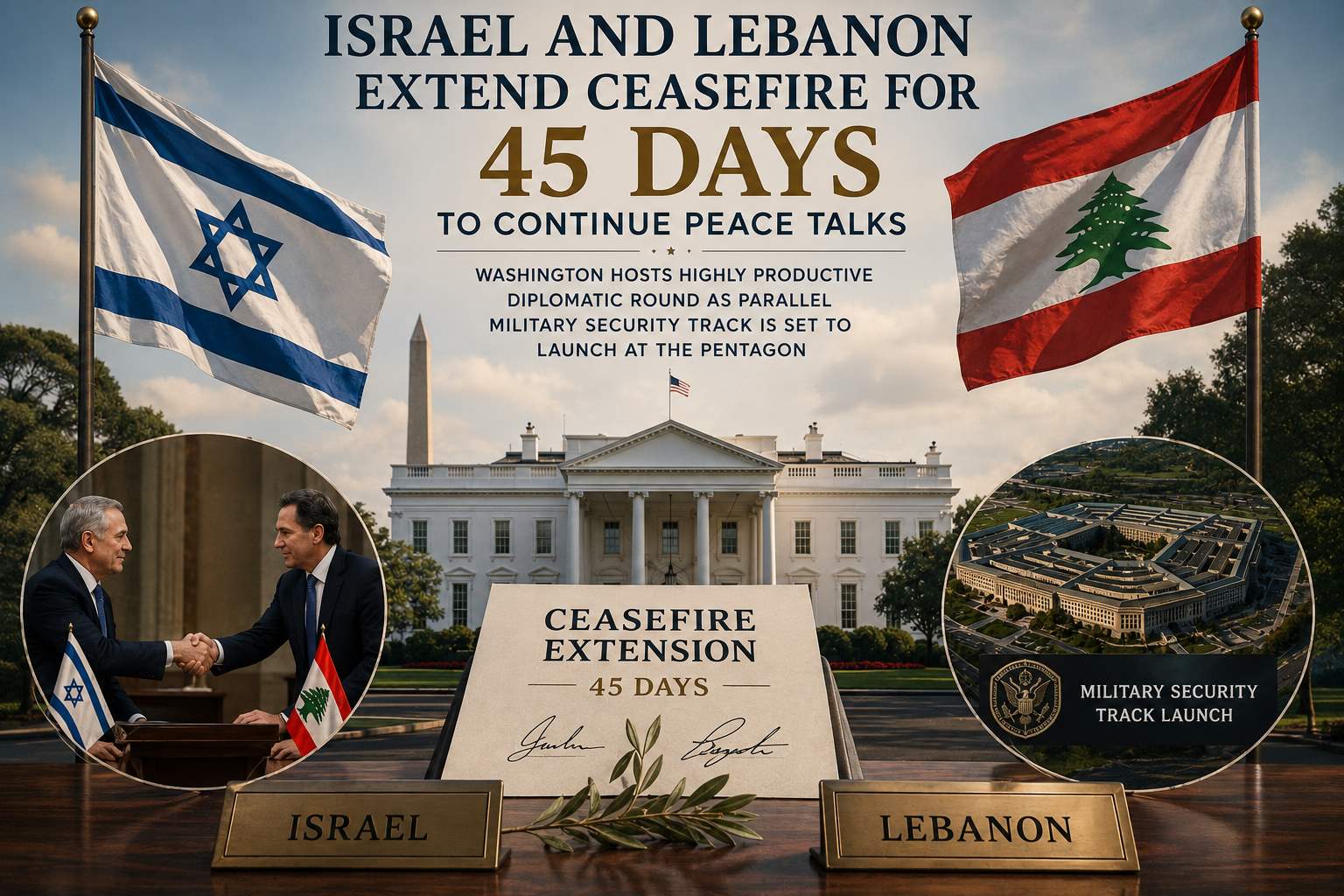
Washington hosts highly productive diplomatic round as parallel military security track is set to launch at the Pentagon
Publication Date: May 21, 2026
Last Updated: May 21, 2026
Byline: Global War News Editorial
Israel and Lebanon have agreed to a 45-day extension of their temporary ceasefire following two days of direct negotiations in Washington, according to statements issued by the United States Department of State. The extension prevents the expiration of a truce that was originally scheduled to conclude over the weekend, providing additional time for political and security frameworks to be negotiated.
The agreement marks a continuation of the diplomatic channel established on April 16, 2026. According to United States officials, the latest round of discussions involved both civilian diplomats and military representatives from both nations, representing the most significant bilateral diplomatic engagement between Israel and Lebanon in decades.
While the diplomatic track has been extended, observers note that active hostilities between the Israel Defense Forces and the Hezbollah militant group have persisted in southern Lebanon. Because Hezbollah is not an official signatory to the state-to-state truce, cross-border strikes and casualties continue to complicate the implementation of the agreement on the ground.
Background and Context
The current cessation of hostilities was initiated on April 16, 2026, amid the broader regional conflict connected to the ongoing United States-Iran war. Following decades of official hostility, the governments of Israel and Lebanon opened direct negotiations aimed at establishing permanent border security, resolving territorial disputes, and affirming mutual state sovereignty.
Prior to the current 45-day extension, United States President Donald Trump announced a three-week extension in late April to keep the diplomatic pathway open. The negotiations represent the first formal bilateral peace talks between the two Mediterranean nations since the collapse of the May 17 Agreement in 1983.
The structure of the truce requires the Lebanese government, with international support, to take steps to prevent non-state armed groups from launching attacks from its territory. Concurrently, the terms allow Israel to retain the right to act in self-defense against imminent threats, while committing to a pause in offensive operations against Lebanese state infrastructure.
Current Situation and Ongoing Hostilities
According to United States State Department spokesperson Tommy Pigott, the meetings held in Washington were highly productive. The political track of the negotiations is scheduled to resume at the State Department on June 2 and June 3, 2026. Additionally, the Pentagon will host a parallel security track involving military delegations from both countries starting May 29, 2026, focusing on border demarcation and security arrangements.
The Lebanese delegation welcomed the outcome. In a statement shared by the Lebanese presidency, officials noted that the extension provides critical breathing space for citizens and reinforces state institutions. The Israeli ambassador to the United States, Yechiel Leiter, described the talks as frank and constructive, stating that while there would be fluctuations in the process, the potential for success remains high.
Despite the diplomatic consensus in Washington, the situation on the ground remains volatile. According to reports from the Lebanese National News Agency, recent Israeli strikes in southern Lebanon, including the coastal city of Tyre and the town of Hanuf, resulted in civilian and medical personnel casualties. The Lebanese Public Health Emergency Operations Center reported that conflict-related operations between March 2 and mid-May have caused significant displacement and casualties inside Lebanon.
Concurrently, the Israel Defense Forces reported casualties among their personnel operating in southern Lebanon. On Saturday, military officials confirmed the death of Captain Maoz Israel Recanati following an explosive drone strike, marking the twentieth Israeli military fatality in Lebanon since the launch of regional operations.
Analysis: Challenges to Implementation
Analysts suggest that the primary obstacle to a permanent peace agreement remains the divergence between state-level diplomacy and non-state military activity. Because Hezbollah operates independently of the Lebanese central government, the state delegation in Beirut faces structural limitations in enforcing the disarmament clauses demanded by Israeli negotiators.
Observers note that while the diplomatic framework buys time for official state actors, the reduction of hostilities is only partial. The continuing cross-border exchanges indicate that the ceasefire operates as a diplomatic mechanism rather than an absolute halt to violence on the ground. The upcoming security talks at the Pentagon are expected to address these enforcement mechanisms, including the potential deployment of the Lebanese Armed Forces along the southern border.
Furthermore, economists point out that regional stability remains tied to the wider geopolitical landscape, particularly the maritime disruptions in the Strait of Hormuz linked to the United States-Iran conflict. A stabilization of the Israel-Lebanon border could provide a model for broader de-escalation, though the persistence of local clashes keeps the risk of sudden escalation high.
Outlook: What to Watch
Moving forward, international observers will focus on two key milestones in the negotiation process. The first is the commencement of the military talks at the Pentagon on May 29, which will test whether the two sides can agree on specific security zones and monitoring protocols. The second is the resumption of the political track in early June, which will attempt to draft the baseline text for an official border treaty.
The stability of the truce will depend heavily on whether the scale of cross-border exchanges between Israeli forces and Hezbollah remains below the threshold that would prompt a total breakdown of the Washington talks. The actions of regional backers, including Iran, will also play a critical role in determining whether the Lebanese state can successfully assert its authority during the 45-day window.
Source Disclosure Note: This report relies on official press briefings from the United States Department of State, statements from the Lebanese Presidency and the Israeli Embassy in Washington, official casualty announcements from the Israel Defense Forces and the Lebanese Ministry of Public Health, and field reporting from Reuters, the Associated Press, and the Xinhua News Agency.
This article is based on publicly available reporting from named international news agencies and attributed official statements. All claims about ongoing events are attributed to their original sources. Analysis sections represent the editorial interpretation of reported facts and do not constitute advocacy for any party to the described conflict. AI tools may be utilized for image generation to assist in explaining complex concepts, as well as for refining grammar, spelling, and other linguistic enhancements. However, all original content is produced, fact-checked, and revised by the editorial team. This publication does not take political positions on active military conflicts.