
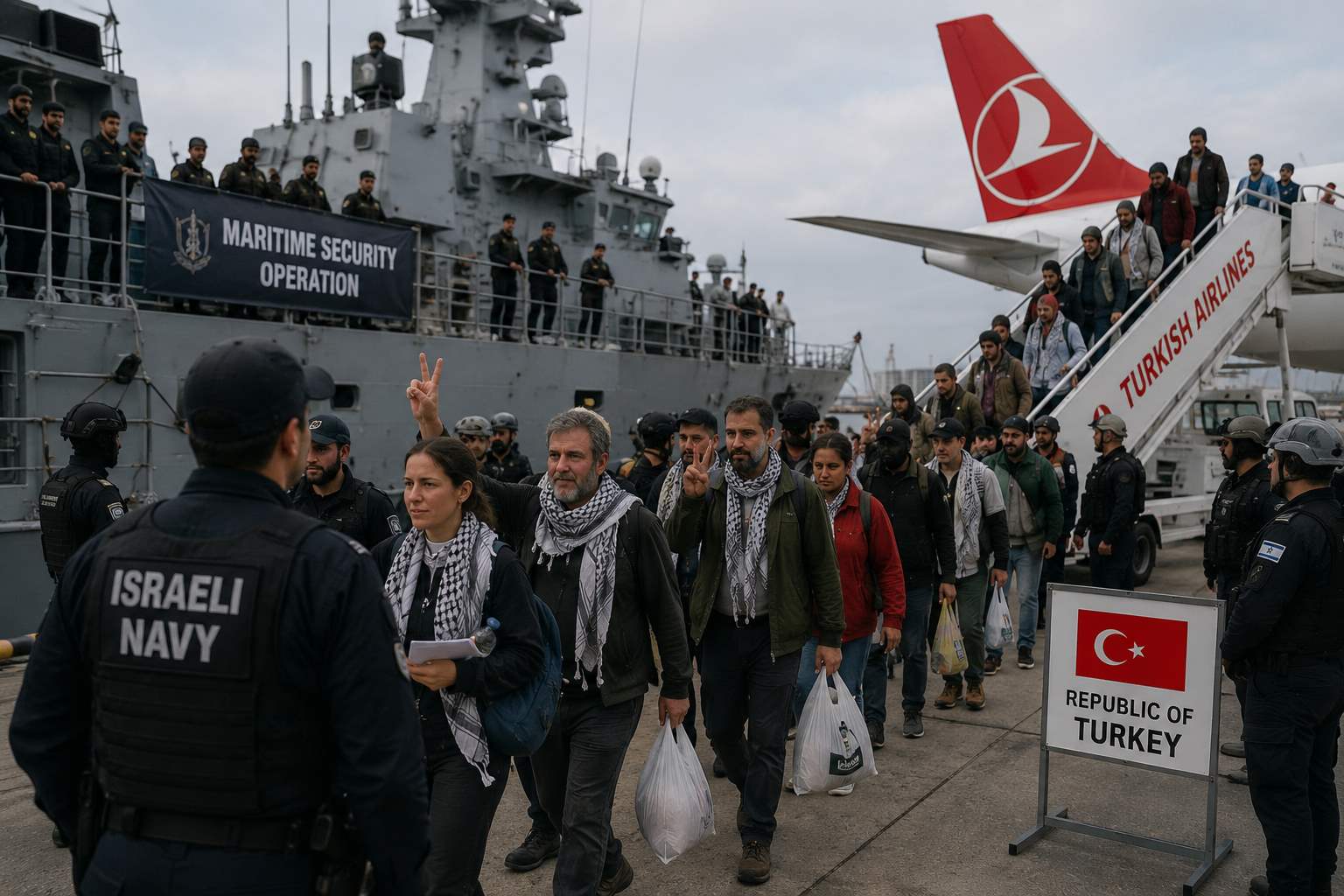
Sudden mass expulsions conclude a week of naval detentions, political fracturing inside Jerusalem, and major diplomatic reprimands from European and G20 governments.
Published: May 22, 2026
Last Updated: May 22, 2026
Byline: Staff Writer, Global War News
The Israeli government has completed the swift deportation of all foreign maritime activists seized during a high-profile interception of a Gaza-bound aid convoy. According to international news reports and official state tallies, approximately 420 individuals from dozens of nations arrived late Thursday evening at Istanbul Airport on three charter flights coordinated between Ankara and Israeli authorities.
The mass expulsion marks the rapid conclusion of a week-long stand-off that began when the Israeli Navy intercepted the “Global Sumud Flotilla” in international waters. While the maritime convoy aimed to symbolically challenge Israel’s long-standing naval blockade of the Gaza Strip, its capture sparked a fierce international diplomatic crisis.
The incident has heightened regional political friction and triggered internal rifts within Israel’s governing coalition, particularly regarding the handling and treatment of the foreign detainees while in state custody.
Interception and Transfer via Ramon Airport
The Global Sumud Flotilla, consisting of roughly 50 small vessels carrying 428 participants from 44 countries, originally set sail from the Turkish port district of Marmaris on May 14, 2026. Organisers stated that the ships carried a symbolic cache of humanitarian aid destined for civilians in Gaza. According to logbooks kept by the flotilla, Israeli naval forces intercepted and boarded the convoy approximately 268 kilometres (167 miles) off the Gaza coastline, subsequently towing the vessels to a southern Israeli port.
Following their arrest, the foreign nationals were held at the Ktziot detention facility located in the Negev Desert. On Thursday, Israeli authorities transported the detainees to Ramon Airport near the Red Sea city of Eilat to execute the deportation order.
Turkish Foreign Minister Hakan Fidan confirmed that Ankara organized the evacuation flights, noting that his ministry directly coordinated with Israeli counterparts to secure the return of 78 Turkish citizens and hundreds of third-country nationals, including citizens of Spain, South Korea, Italy, and Ireland.
Political Friction and International Condemnation
The rapid deportations follow an intense wave of international backlash generated by the public behavior of a high-ranking Israeli official. On Wednesday, Israel’s National Security Minister, Itamar Ben-Gvir, published self-shot promotional videos on social media from inside the port facility. The footage depicted dozens of handcuffed, zip-tied activists forced to kneel on the deck of a vessel with their foreheads touching the floor while the minister walked among them.
The publication of the videos prompted an immediate international outcry. A array of foreign governments, including Great Britain, France, the Netherlands, Canada, Portugal, Greece, and Indonesia, formally summoned top Israeli diplomats in their respective capitals to lodge official protests. UK Foreign Secretary Yvette Cooper publicly declared she was appalled by the footage, stating that it violated basic standards of respect and dignity. French Foreign Minister Jean-Noël Barrot similarly noted that irrespective of the legality of the flotilla itself, foreign citizens must be treated with basic decency.
The international backlash caused a visible internal rupture within the Israeli cabinet. Prime Minister Benjamin Netanyahu issued a sharp, public rebuke of his National Security Minister, stating that while Israel maintains a legal right to enforce its naval blockade against what he termed “provocative flotillas,” the behavior displayed by Ben-Gvir was not aligned with Israel’s values or state norms. Seeking to minimize further diplomatic fallout, Netanyahu ordered the immediate deportation of the activists.
Conflicting Claims of Custodial Abuse
As the deported activists began landing in Istanbul, major discrepancies emerged regarding their physical treatment while held in Israeli custody. Several returning participants appeared to be limping as they disembarked, and independent legal groups inside Israel raised concerns regarding the processing methods used by security forces.
Suhad Bishara, the legal director of Adalah—the Legal Center for Arab Minority Rights in Israel—reported that many detainees were forced into fast-tracked court hearings without receiving proper access to legal counsel. The legal group stated that at least two participants required hospitalization after being struck by rubber bullets during the initial naval boarding, while others reported sustaining broken ribs.
Specific allegations of physical abuse were detailed by returning European citizens. Italian journalist Alessandro Mantovani, who was detained alongside the activists, stated upon his arrival in Europe that he and others were punched, kicked, and subjected to verbal taunts by guards. Furthermore, the governments of Brazil and Spain issued formal statements condemning what they described as the unlawful detention and interrogation of their citizens during preliminary phases of the naval interception.
The Israeli government has forcefully rejected all allegations of mistreatment. Zivan Freidin, an official spokesperson for the Israeli Prison Service, issued a statement declaring that the allegations of physical abuse and torture brought forward by the activists are entirely false and lack any factual basis.
Perspective: The Gaza Naval Blockade
The interception of the Global Sumud Flotilla reflects a recurring point of geopolitical friction in the eastern Mediterranean. Israel has enforced a strict naval blockade on the Gaza Strip since 2007, a measure it maintains is vital to prevent the maritime smuggling of weapons and raw military components to Hamas.
Critics and international humanitarian observers argue that the blockade imposes severe limitations on the entry of essential commercial goods and civilian infrastructure materials. Activists regularly orchestrate maritime convoys to pressure the international community, though Israel has routinely intercepted these groups in international waters, maintaining that no unauthorized maritime entry into the coastal zone will be permitted.
Outlook and What to Watch
In the wake of the deportations, diplomatic observers are monitoring whether the fallout will lead to broader international policy shifts toward Israel. In Italy and Spain, progressive opposition parties are already citing the alleged abuse of their nationals to demand a formal suspension of the European Union-Israel Association Agreement, which governs bilateral trade and political cooperation.
Additionally, the incident may carry notable domestic political ramifications within Israel. The public clash between Prime Minister Netanyahu and far-right elements within his coalition, such as Minister Ben-Gvir, highlights deepening structural fractures ahead of potential early elections, showing how foreign policy and internal security tactics remain highly contested inside the Israeli cabinet.
Source Disclosure Note: This report is compiled from verified field updates and dispatches published by the Associated Press (AP), Reuters, Agence France-Presse (AFP), and state-run outlets including Turkey’s Anadolu Agency. Factual descriptions of the deportations and diplomatic responses are drawn from the official public statements of Turkish Foreign Minister Hakan Fidan, UK Foreign Secretary Yvette Cooper, French Foreign Minister Jean-Noël Barrot, and the Israeli Foreign Ministry. Legal and processing details were gathered from public filings by Adalah.
This article is based on publicly available reporting from named international news agencies and attributed official statements. All claims about ongoing events are attributed to their original sources. Analysis sections represent the editorial interpretation of reported facts and do not constitute advocacy for any party to the described conflict. AI tools may be utilized for image generation to assist in explaining complex concepts, as well as for refining grammar, spelling, and other linguistic enhancements. However, all original content is produced, fact-checked, and revised by the editorial team. This publication does not take political positions on active military conflicts.