
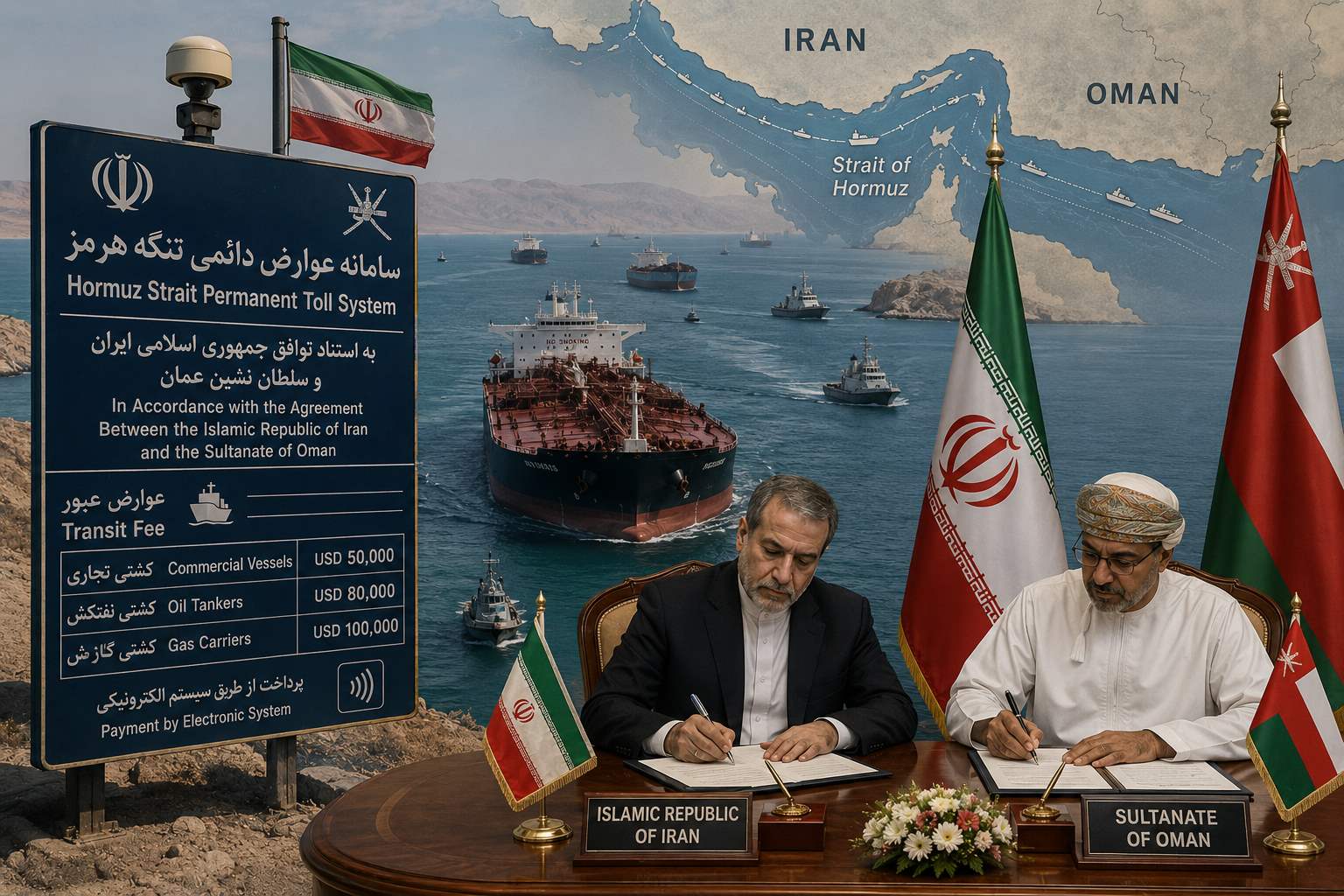
Tehran moves to formalise administrative control over the strategic chokepoint through a joint regulatory framework with Muscat, challenging Western maritime doctrines and risking secondary U.S. sanctions for global shippers.
Published: May 22, 2026
Last Updated: May 22, 2026
Byline: Staff Writer, Global War News
The Iranian government has initiated bilateral consultations with the Sultanate of Oman aimed at establishing a permanent transit toll system to regulate and tax commercial maritime traffic navigating the Strait of Hormuz. The diplomatic push marks an attempt by Tehran to transition its recent wartime control of the waterway into a permanent, internationally recognized administrative and economic regime.
The proposed framework, which would be jointly managed by the coastal states, seeks to formalize passage requirements through a chokepoint that historically carried approximately 20% of global seaborne petroleum. By layering a statutory tariff system over the strait, Tehran aims to secure a consistent stream of foreign currency revenue while cementing its veto power over commercial shipping access to the Persian Gulf.
The development has drawn swift condemnation from Washington and international shipping consortia. Legal experts warn that the imposition of transit fees inside an international strait directly challenges established maritime law, threatening to entrench high war-risk insurance premiums and alter global energy distribution costs for the foreseeable future.
The Proposed PGSA Toll Framework
According to official briefings from the Iranian Foreign Ministry, detailed technical discussions between Iranian and Omani maritime experts were held in Muscat to outline the parameters of the new navigation system. The mechanism is designed to operate under the auspices of the Persian Gulf Strait Authority (PGSA), a regulatory body recently established by Tehran to vet, approve, and monitor all vessels seeking entry into the gulf.
Esmaeil Baghaei, the spokesman for Iran’s Foreign Ministry, confirmed during a press conference that continuous consultations are underway to design the transit mechanism. The spokesman stated that because the Strait of Hormuz lies within the territorial waters of Iran and Oman, both coastal nations consider themselves duty-bound to institute safety and administrative measures.
Supporting this position, Iran’s Ambassador to France, Mohammad Amin-Nejad, stated that both countries must mobilize resources to provide maritime security services and manage navigation, adding that such operations will inevitably incur structural costs, though the tariff system would remain transparent.
Under the protocols publicized by the PGSA, all commercial vessels intending to transit the strait must submit comprehensive pre-arrival data to the authority, including detailed disclosures regarding vessel ownership, hull insurance, crew manifests, and specific cargo manifests. A transit permit is issued only after the administrative vetting is finalized and a fee is settled.
While the PGSA has not published an official, uniform tariff schedule, maritime intelligence data indicates that some commercial operators have already paid up to 2 million USD per individual transit to secure safe passage, with transactions reportedly settled in Chinese yuan.
Geopolitical Friction and Legal Discrepancies
The joint initiative is being advanced against a backdrop of severe friction regarding international maritime law and freedom of navigation. The United States and its European allies have forcefully rejected the legality of any toll or restrictive permitting system inside the waterway.
US Secretary of State Marco Rubio argued that the Strait of Hormuz is categorized as an international waterway under the provisions of the United Nations Convention on the Law of the Sea (UNCLOS). Under the transit passage doctrine enshrined in international law, vessels of all nations enjoy the right of unimpeded, continuous navigation for the purpose of international transit, a right that cannot be legally blocked, conditioned, or taxed by coastal states.
Furthermore, US President Donald Trump responded to the bilateral talks by stating that the United States expects the Strait of Hormuz to remain entirely unobstructed to allow free passage, adding that his administration does not support or recognize the imposition of maritime tolls.
The situation is further complicated by the domestic legislative stance of Iran’s parliament. Ebrahim Azizi, the chairman of the parliament’s National Security and Foreign Policy Committee, confirmed that Tehran intends to provide preferential transit access exclusively to commercial vessels and nation-states that actively cooperate with Iran.
The Iranian official noted that the route would remain entirely closed to operators linked to Western military coalitions or hostile entities, creating a highly segregated transit corridor.
Comparative Economic Impacts on Shipping Options
The institutionalization of the PGSA toll mechanism leaves international shipping companies and energy buyers caught between severe physical risks at sea and aggressive regulatory penalties on land. This operational divide has split Persian Gulf transit into two distinct, high-cost options, as outlined below:
| Operational Metric | Option A: Compliance with PGSA | Option B: High-Risk Unauthorized Transit |
| Financial Cost | High explicit transit fees (reported up to $2 million per voyage paid in non-Western currency). | Elevated war-risk insurance premiums and potential cargo seizure risks. |
| Regulatory Risk | Exposure to U.S. Department of the Treasury (OFAC) secondary sanctions for funding Iranian entities. | Compliance with standard international maritime routing and G7 compliance frameworks. |
| Operational Impact | Mandatory data disclosure to Iranian authorities; potential delays during administrative vetting. | Widespread use of “dark transit” methods, including disabling transponders (AIS) to avoid local detection. |
Analysis: Sanctions Risk and Supply Chain Re-alignment
From a global macro-economic perspective, the implementation of a formalized toll system introduces an intricate layer of compliance risk for international corporations. On May 1, 2026, the US Office of Foreign Assets Control (OFAC) issued a strict regulatory guidance warning that any payments made to Iranian-linked entities, including transit fees paid through maritime brokers or port agents for passage through Hormuz, constitute prohibited transactions under existing counter-terrorism and state sanctions frameworks.
Consequently, non-US firms that comply with the PGSA tariff to protect their vessels from physical attack run the immediate risk of triggering secondary American sanctions. This could cut off their access to the US dollar financial system and bar their fleets from Western ports.
This regulatory pressure is driving a sharp bifurcation in global shipping behaviors. While some Middle Eastern energy exporters, including the Abu Dhabi National Oil Company, continue to navigate the strait by instructing tankers to temporarily deactivate their automatic identification system (AIS) transponders while passing through Iranian-designated control zones, others are seeking systemic alternatives.
The long-term economic fallout is forcing global energy markets to adapt to a permanently altered supply chain. To mitigate dependency on the vulnerable chokepoint, regional producers are accelerating the activation of alternative export infrastructure.
This includes shifting crude volumes via land pipelines to terminals on the Red Sea or utilizing newly activated loading nodes situated on Iran’s Gulf of Oman coast, entirely outside the geographic boundaries of the Strait of Hormuz. For global consumers, the combined burden of administrative toll costs, compliance overhead, and extended alternative routing guarantees that a structural premium will remain embedded in global energy and logistics pricing models.
Outlook and What to Watch
In the coming weeks, international observers will closely watch the diplomatic responses from Muscat. While Oman has traditionally maintained a neutral, mediatory role in Persian Gulf diplomacy, its formal participation in a joint toll mechanism would alter its relations with Western trading partners and neighboring Gulf states.
The key indicator of the system’s viability will be whether major Asian energy importers, particularly state-owned enterprises in China and India, formally integrate PGSA permit applications into their standard maritime procurement processes.
Additionally, maritime tracking data will serve as a critical gauge to monitor whether the volume of commercial vessels crossing Hormuz recovers from its current depressed levels, or if the dual pressure of Iranian enforcement at sea and American financial sanctions on land permanently suppresses traffic through the world’s most critical energy artery.
Source Disclosure Note
This report is compiled from verified maritime updates and diplomatic dispatches, including official press briefings by Iranian Foreign Ministry spokesman Esmaeil Baghaei and public commentary from Ebrahim Azizi of the Iranian Parliament’s National Security Committee. International policy data and regulatory tracking were drawn from formal press releases by the US Office of Foreign Assets Control (OFAC) and corporate operational briefings published by maritime intelligence firm Windward. Supplemental shipping data was cross-referenced via Bloomberg and Reuters maritime tracking feeds.
This article is based on publicly available reporting from named international news agencies and attributed official statements. All claims about ongoing events are attributed to their original sources. Analysis sections represent the editorial interpretation of reported facts and do not constitute advocacy for any party to the described conflict. AI tools may be utilized for image generation to assist in explaining complex concepts, as well as for refining grammar, spelling, and other linguistic enhancements. However, all original content is produced, fact-checked, and revised by the editorial team. This publication does not take political positions on active military conflicts.