
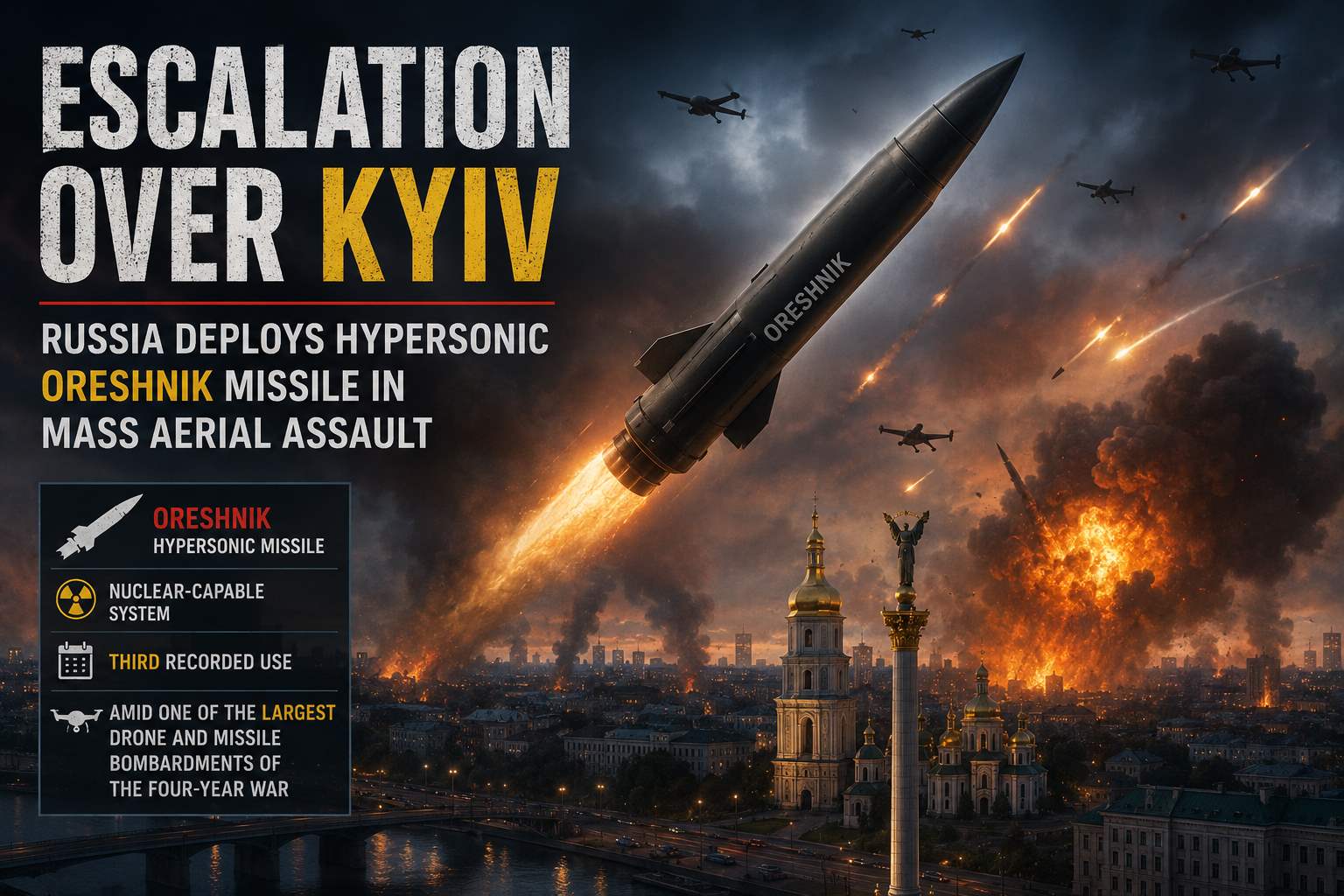
Ballistic strike marks the third use of the nuclear-capable system amid one of the largest combined drone and missile bombardments of the four-year war.
Publication Date: May 25, 2026
Last Updated: May 25, 2026
Byline: Global War News Editorial
The Core Event
Russia carried out a massive combined aerial assault against Ukraine on Sunday, May 24, 2026, deploying its newly developed hypersonic “Oreshnik” intermediate-range ballistic missile alongside hundreds of strike drones and cruise missiles. According to statements by Ukrainian President Volodymyr Zelenskyy on Telegram, the bombardment focused heavily on the capital city of Kyiv and the surrounding region, resulting in at least four confirmed fatalities and nearly 100 injuries across the country.
The overnight operation stood out due to its sheer scale and the utilization of specialized ordnance. The Ukrainian Air Force reported tracking a total of 600 strike drones and 90 air, sea, and ground-launched missiles during the hours-long barrage. Ukrainian air defense systems reportedly intercepted or jammed 549 of the drones and 55 of the missiles, leaving dozens of projectiles to impact locations across the capital and broader regional infrastructure.
The Russian Ministry of Defence confirmed the deployment of the Oreshnik system in an official statement on Sunday, noting that it was used in conjunction with Iskander, Kinzhal, and Zircon missile variants. Russian authorities stated that the operation successfully targeted Ukrainian military command and control facilities, airbases, and defense-industrial enterprises. However, Ukrainian regional administrators and emergency service personnel documented extensive damage across 50 separate locations in Kyiv, including apartment blocks, schools, shopping centers, a central market, and a local water supply facility.
Technical Context and Tactical Background
The deployment marks the third time the Russian Federation has used the Oreshnik missile in active combat, following its initial launch against Dnipro in November 2024 and a subsequent strike in the Lviv region in January.
According to public descriptions previously delivered by Russian President Vladimir Putin, the Oreshnik—which translates to “hazelnut tree” in Russian, is a ballistic system capable of carrying either conventional or nuclear warheads. Russian state media has stated that the missile travels at speeds approaching Mach 10 (approximately ten times the speed of sound) and utilizes multiple re-entry vehicles. Independent open-source investigators reviewing footage of Sunday’s strike noted that the warhead appeared to split into 36 distinct submunitions prior to impact.
Military analysts point out that the deployment highlights a critical challenge for Ukraine’s defense network: a structural deficit in ballistic missile interception. While Ukraine relies heavily on Western-supplied air defense systems, such as the U.S.-manufactured Patriot system, to counter high-velocity ballistic threats, Ukrainian defense officials have repeatedly stated that interceptor stockpiles remain strictly limited. President Zelenskyy acknowledged that several ballistic targets bypassed defensive measures during Sunday’s raid, reinforcing Kyiv’s ongoing appeals to international partners for specialized ammunition and modern anti-ballistic platforms.
The Retaliatory Dynamic
The Russian government characterized the operation as a direct retaliatory response to a prior Ukrainian attack. On Friday, May 22, 2026, Russian officials reported that a Ukrainian drone strike hit a student dormitory in the Russian-controlled city of Starobilsk, located in the Luhansk region. According to Russian emergency services, that strike resulted in 21 deaths and 42 injuries. President Putin publicly condemned the incident, stating that no military installations were located near the site, and directed the military command to prepare retaliatory options.
Following Sunday’s bombardment, Dmitry Medvedev, Deputy Chairman of Russia’s Security Council, stated on social media that the Ukrainian operations in Luhansk directly triggered the massive strikes against symbols and institutions in Kyiv.
In response, Ukrainian authorities rejected the characterization of their operations as attacks on civilians. At an emergency meeting of the United Nations Security Council convened on Sunday at Moscow’s request, Ukrainian Ambassador Andrii Melnyk stated that Ukraine’s May 22 operations exclusively targeted the Russian military apparatus. Ambassador Melnyk described the Kremlin’s public accusations as a propaganda effort intended to obscure regular Russian bombardments of civilian infrastructure.
International Diplomatic Reactions
The scale of the attack and the re-emergence of the Oreshnik missile triggered immediate condemnation from European leaders and international officials.
Kaja Kallas, the European Union’s foreign policy chief, characterized the use of the nuclear-capable hypersonic missile as an act of political intimidation and reckless nuclear brinkmanship. Kallas stated that EU foreign ministers would convene within days to discuss measures to increase international pressure on Moscow. Representatives from France and Germany also issued statements condemning the strike, labeling the targeting of population centers an unacceptable escalation.
Additionally, Albania’s Foreign Ministry reported that the official residence of the Albanian ambassador to Ukraine suffered damage during the strikes in central Kyiv, calling the incident a grave violation of diplomatic norms.
Economic and Humanitarian Implications
The long-term effects of the strike extend into urban infrastructure and logistical stability. Local authorities in Kyiv confirmed that part of the barrage intentionally targeted water supply infrastructure, a move President Zelenskyy suggested was timed to disrupt regional utility access ahead of peak summer demand.
In the city center, commercial disruptions were severe. The historic Lukyanivka district faced widespread structural damage, with a prominent shopping center and an open-air market completely destroyed by fire. Local traders and business owners reported substantial losses of inventory and capital, further straining a municipal economy heavily adapted to wartime conditions. Small businesses operating within the capital’s center face prolonged closures due to structural instability and ongoing rescue operations.
What to Watch
Moving forward, international observers are focusing on three primary developments:
- Western Supply Decisions: Whether the use of the Oreshnik prompts the United States and European allies to accelerate the delivery of specific ballistic missile interceptors to Ukraine.
- Domestic Defense Production: The progress of Ukraine’s internal defense programs, which are currently attempting to develop domestic alternatives to Western anti-ballistic defense networks.
- Diplomatic Deadlocks: The impact of this escalation on U.S.-brokered peace talks, which diplomatic sources report have remained stalled.
Source Disclosure Note: This report relies on official statements from the Ukrainian Ministry of Defence and the Ministry of Defence of the Russian Federation. Factual details regarding casualties and infrastructure damage are compiled from reports issued by the Associated Press, Reuters, Agence France-Presse, the BBC, and local emergency services in Kyiv. Diplomatic positions are drawn from public statements issued by the European Union External Action Service and official social media communications from state representatives.
This article is based on publicly available reporting from named international news agencies and attributed official statements. All claims about ongoing events are attributed to their original sources. Analysis sections represent the editorial interpretation of reported facts and do not constitute advocacy for any party to the described conflict. AI tools may be utilized for image generation to assist in explaining complex concepts, as well as for refining grammar, spelling, and other linguistic enhancements. However, all original content is produced, fact-checked, and revised by the editorial team. This publication does not take political positions on active military conflicts.