
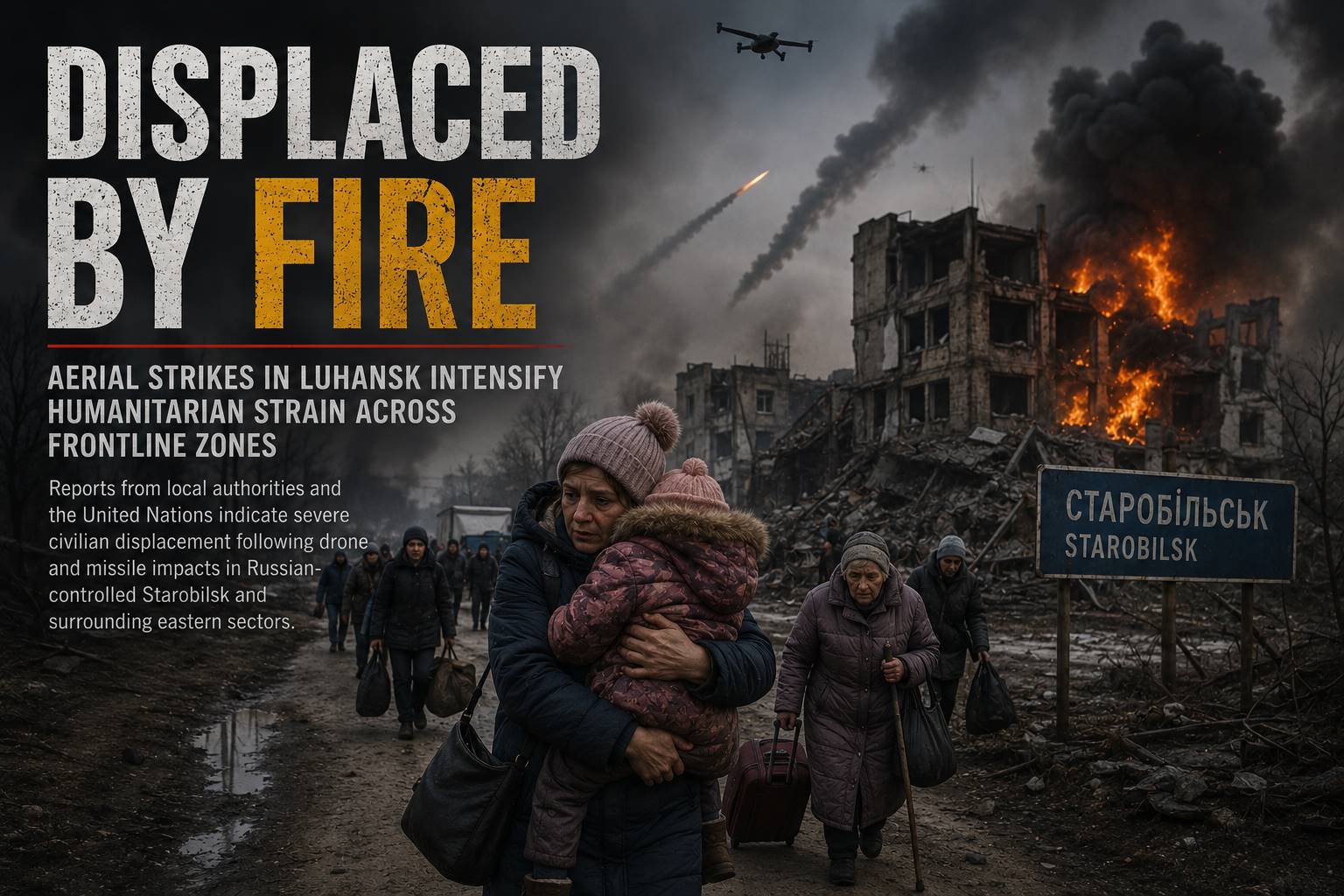
Reports from local authorities and the United Nations indicate severe civilian displacement following drone and missile impacts in Russian-controlled Starobilsk and surrounding eastern sectors.
Publication Date: May 25, 2026
Last Updated: May 25, 2026
Byline: Global War News Editorial
The Core Event
A significant surge in aerial hostilities in eastern Ukraine’s Luhansk region has triggered a wave of civilian displacement and a mounting humanitarian crisis, according to statements from regional administrators and international monitoring bodies. The escalation follows a devastating drone strike during the late hours of May 21, 2026, which struck a vocational school and dormitory facility in the Russian-occupied town of Starobilsk.
The Russian Emergency Situations Ministry reported via social media that the death toll from the Starobilsk facility collapse reached 18 individuals, with another 60 sustaining injuries. Emergency personnel continued clearing rubble through the weekend as local Kremlin-installed authorities declared two days of official mourning across the region.
In the immediate aftermath of the strike and subsequent localized artillery exchanges along the frontline, hundreds of families have reportedly fled their homes. Ukrainian local administrative sources tracking populations near the contested regional borders reported intense displacement from adjacent villages, as non-combatants seek safety from an expanding zone of drone and missile operations. The United Nations Refugee Agency (UNHCR) and UNICEF both expressed immediate alarm over the safety of adolescents and families remaining in the path of the intensifying hostilities.
Technical Context and Tactical Background
The strike in Starobilsk highlights the changing tactical nature of the air war along the eastern front, where long-range and short-range strike drones have increasingly complemented traditional artillery. According to data released by the United Nations Human Rights Monitoring Mission in Ukraine, long-range weapons and short-range loitering munitions have become the primary drivers of civilian casualties and displacement far from the immediate trench lines, with short-range drones alone causing historic levels of casualties in recent months.
The specific targeting and capabilities demonstrated in the Luhansk region reveal a deep divergence in tactical reporting between the combatants:
- The Russian Assertion: The Kremlin-installed head of the Luhansk region, Leonid Pasechnik, characterized the strike on the pedagogical university’s college building as a deliberate act of terrorism aimed at academic infrastructure. Russian officials asserted that no military or law enforcement personnel were stationed near the dormitory, which reportedly housed dozens of adolescents aged 14 to 18.
- The Ukrainian Counterclaim: The Armed Forces of Ukraine rejected accusations of targeting civilians. In an official military briefing, Kyiv stated that its operations strictly adhere to international humanitarian law and that the strike in Starobilsk successfully neutralized an elite Russian drone command and intelligence unit operating out of the facility.
Independent open-source intelligence analysts note that educational and civic structures near frontline supply lines are frequently repurposed by occupying forces for logistical and command operations, turning them into high-value tactical targets while inadvertently exposing the surrounding civilian population to catastrophic structural failures and displacement.
The Humanitarian and Displacement Dynamic
The immediate consequence of the strikes has been an abrupt dislocation of the local population. UNICEF Deputy Executive Director Ted Chaiban, during a formal briefing to the United Nations Security Council, emphasized that the escalation is worsening an already severe displacement crisis. According to verified UN data, more than a third of Ukraine’s children—amounting to approximately 2.6 million youth—remain displaced either internally or across international borders.
A recent UNICEF survey highlighted the compounding psychological and logistical toll on the population, revealing that one in three adolescents in these conflict-heavy sectors has been forced to relocate at least twice due to direct safety threats. The destruction of local housing and academic infrastructure in Starobilsk has eliminated primary shelter points, forcing remaining families to choose between navigating active frontline corridors or retreating further into Russian-controlled territory where access to international aid organizations remains severely restricted.
The crisis is further compounded by a broader pattern of attacks affecting humanitarian logistics. Earlier in the week, a UNHCR leased warehouse in the nearby city of Dnipro was struck by a missile during a separate Russian raid, destroying critical emergency shelter materials and emergency aid packages intended precisely for those fleeing the frontline zones in Luhansk and Donetsk.
International Diplomatic Reactions
The humanitarian fallout from the Luhansk strikes quickly reached the diplomatic arena, triggering a contentious session at the United Nations Security Council in New York. The emergency meeting, convened at the request of the Russian Federation, served as a forum for sharp exchanges regarding the laws of armed conflict.
Russian representatives accused Ukraine of committing war crimes against student populations. In response, Ukrainian Ambassador Andrii Melnyk dismissed the allegations as a propaganda effort designed to distract from Russia’s massive retaliatory missile strikes on Kyiv, which occurred less than 48 hours later.
Meanwhile, UN officials took a neutral but firm stance. Stéphane Dujarric, spokesperson for UN Secretary-General António Guterres, issued a statement strongly condemning all attacks against civilian infrastructure, regardless of where they occur or who initiates them. Edem Wosornu, Director of Operations for the UN relief coordination office (OCHA), reminded the Council that the human cost of the conflict reveals a persistent pattern that defies international humanitarian law, demanding that both parties guarantee safe passage and protection for fleeing non-combatants.
Economic and Structural Implications
The ongoing displacements and infrastructure damage are profoundly altering the localized economy of the Luhansk region. Starobilsk, historically operating as a regional agricultural and educational hub, has seen its local economy grind to a halt. The closure of academic institutions and the mass flight of residents have disrupted agricultural supply chains and small-scale trading enterprises that the local population relies on for basic survival.
Furthermore, the destruction of energy, housing, and water facilities during the recent drone waves has created a structural vacuum. Local municipal services under Russian control lack the capital and equipment to perform rapid rehabilitation of residential quarters, signaling a long-term displacement trend where those who flee are unlikely to return before the winter months. The financial strain of supporting these internally displaced populations is increasingly falling on overextended regional budgets and international relief agencies whose operations face direct kinetic threats.
What to Watch
As the humanitarian situation in the eastern sectors continues to unfold, international observers are monitoring several critical variables:
- Access for International Monitors: Whether independent international bodies, such as the UN or the International Committee of the Red Cross, will be granted physical access to Starobilsk to verify casualty data and distribute aid to the displaced.
- Frontline Retaliation Cycles: The extent to which subsequent drone and missile operations continue to target logistics and energy centers, which would trigger secondary waves of municipal displacement.
- Aid Pipeline Disruptions: How the destruction of regional warehouses, such as the UNHCR facility in Dnipro, will impact the speed and volume of emergency shelter deployment to the eastern borders.
Source Disclosure Note: This report is compiled from official data released by the United Nations Human Rights Monitoring Mission in Ukraine, official briefings delivered to the UN Security Council by UNICEF and OCHA, and statement logs from the Russian Emergency Situations Ministry. Regional developments and casualty figures are sourced from verified coverage by Reuters, the Associated Press, Anadolu Agency, and official administrative updates from local regional governors.
This article is based on publicly available reporting from named international news agencies and attributed official statements. All claims about ongoing events are attributed to their original sources. Analysis sections represent the editorial interpretation of reported facts and do not constitute advocacy for any party to the described conflict. AI tools may be utilized for image generation to assist in explaining complex concepts, as well as for refining grammar, spelling, and other linguistic enhancements. However, all original content is produced, fact-checked, and revised by the editorial team. This publication does not take political positions on active military conflicts.