
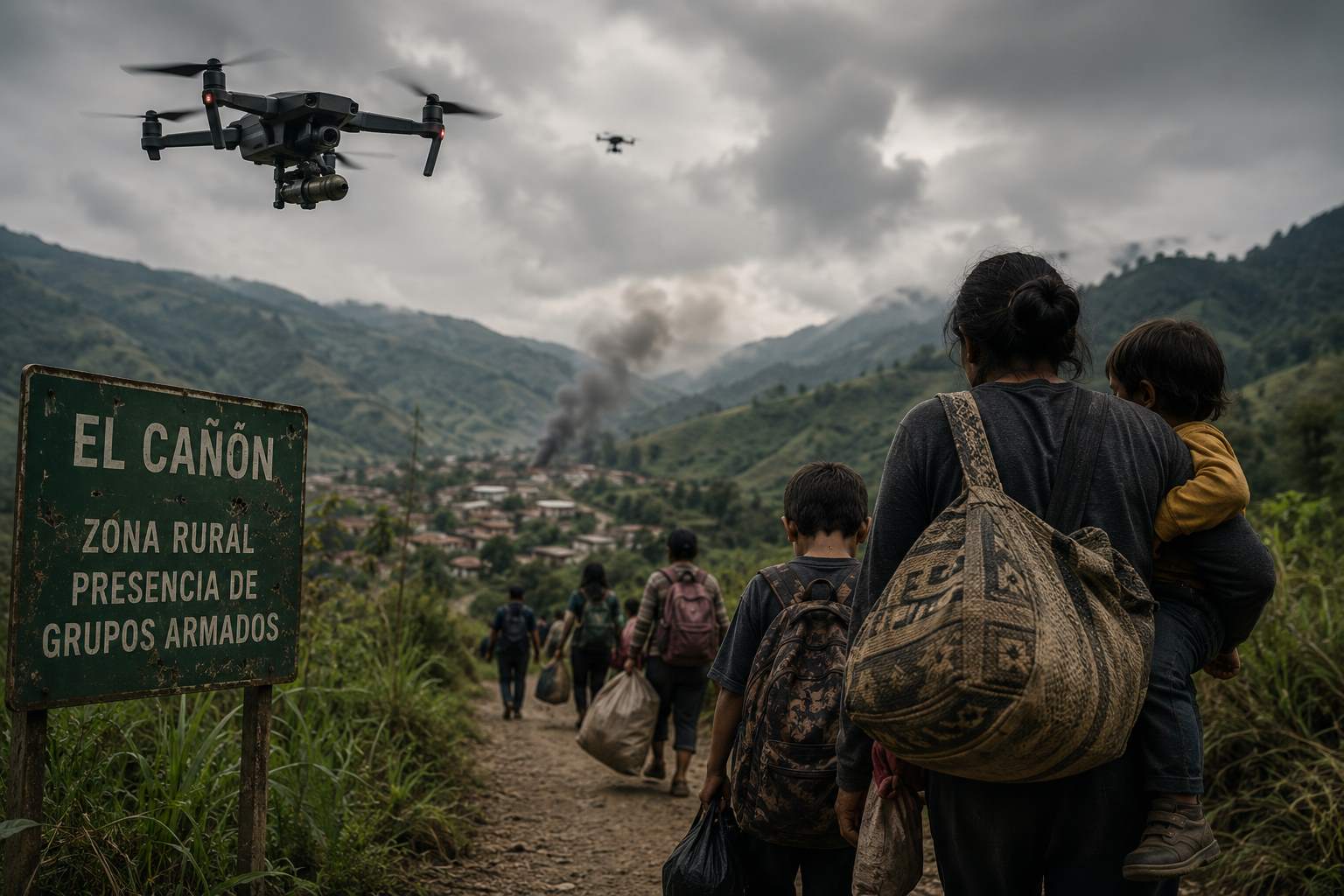
As non-state armed groups rapidly deploy modified commercial drones across fragmented frontlines, rising casualties and localized combat are straining rural municipal infrastructure and forcing internal displacement.
Publication Date: May 25, 2026
Last Updated: May 25, 2026
Byline: Global War News Editorial
The Core Event
A sharp increase in the use of commercial drones modified with improvised explosive payloads by non-state armed groups has triggered a fresh wave of civilian displacement across rural Colombia. Local administrative personnel and humanitarian agencies in the southwestern departments of Cauca and Nariño, alongside the northeastern Catatumbo region, report that hundreds of families are fleeing isolated villages to seek refuge in municipal hubs following intense frontline clashes characterized by sustained remote aerial bombardments.
According to verified data released by the United Nations Mine Action Service (UNMAS) in Colombia, the internal security landscape has been substantially altered by these uncrewed aircraft systems. Official registries maintained by the Colombian Ministry of Defense indicate that armed groups carried out approximately 8,395 weaponised drone launches throughout 2025, with 333 resulting in effective detonations. This marks an escalation of over 445 percent compared to the 61 effective incidents documented in 2024, with the trend extending aggressively into the first half of 2026.
The expanding use of these low-cost systems has severely compromised civilian safety. Human rights monitors noted that recent direct confrontations between rival groups, including the National Liberation Army (ELN), factions of the Clan del Golfo, and dissident groups of the former Revolutionary Armed Forces of Colombia (FARC) that rejected the 2016 peace accord, have involved the regular deployment of consumer drones rigged to drop mortar shells and hand grenades. The physical damage to residential structures and the indiscriminate nature of the air drops have prompted acute displacement crises in municipalities such as Tibú and Segovia.
Technical Context and Tactical Background
The tactical transformation observed along Colombia’s internal frontlines is driven by the accessibility of consumer technology. Rather than relying on military-grade hardware, non-state armed actors are purchasing off-the-shelf recreational quadcopters and agricultural drones, then modifying them using local mechanical workarounds. Analysts tracking the supply chains report that these devices are frequently equipped with simple release mechanisms designed to drop low-weight, high-yield explosives, such as modified industrial cylinder bombs or standard 60mm mortar rounds.
The shift toward commercial remote technology provides armed groups with notable tactical advantages:
- Asymmetrical Power: The adaptation allows small insurgent columns to project force over long distances and bypass established government ground defenses without risking frontline personnel.
- Low Cost and High Accessibility: While conventional military assets require extensive logistical footprints, consumer drones are acquired easily via online marketplaces, international couriers, or transnational criminal networks linking local groups with global syndicates.
- Jamming Resistance: Open-source intelligence monitors recently identified the deployment of fiber-optic guided drones in rural sectors, a technical variation that remains highly resistant to commercial electronic jamming equipment.
In an effort to close these logistical loopholes, the Colombian government enacted severe regulatory restrictions on drone imports. The Ministry of Defense and the national customs authority barred the entry of uncrewed aircraft via international mail, postal express delivery, or courier services. Legal commercial procurement has been strictly funneled through just two authorized high-security ports of entry, forcing all travelers arriving in the country to declare personal electronic equipment to establish complete supply-chain traceability.
The Humanitarian and Displacement Dynamic
The primary consequence of this remote aerial warfare has been the psychological and physical dislocation of rural populations. In deep valley communities, the distinct acoustic profile of low-flying drone propellers has become a catalyst for widespread panic. Human Rights Watch documented instances where armed groups intentionally hovered weaponised platforms over villages to enforce local curfews, extort small businesses, and intimidate indigenous community councils, effectively establishing psychological dominance over contested territory.
When localized combat erupts, the lack of precision in improvised aerial drops frequently results in structural damage to strictly civilian spaces. According to a technical paper published by UNMAS, weaponised drones are increasingly impacting civic zones, including rural schools, open-air athletic fields, and local healthcare clinics. A notable strike in the municipality of Segovia saw an improvised mortar payload strike a private residence, causing multiple civilian casualties and prompting an immediate mass exit of neighboring households.
The sudden arrival of displaced families is overwhelming the administrative capacity of rural municipal capitals. Displaced persons arriving in urban centers face significant shortages of temporary shelter, clean drinking water, and basic medical access. Local ombudsmen have warned that state-backed relief pipelines are struggling to match the geographic spread of the crisis, as drone operations expand far beyond traditional conflict zones into dozens of newly affected municipalities.
International Diplomatic and Institutional Reactions
The rapid proliferation of uncrewed weapon systems has drawn intense scrutiny from international organizations and human rights groups. Humanitarian bodies operating under the United Nations framework have consistently reminded all active combatants of their legal obligations under international humanitarian law, emphasizing the core principles of distinction and proportionality.
Carlos Ruiz Massieu, Special Representative and Head of the UN Verification Mission in Colombia, has repeatedly highlighted the deteriorating security situation in formal briefings, noting that the introduction of explosive drone technology presents a serious threat to the ongoing implementation of long-term peace frameworks.
Concurrently, international mine-action personnel and non-governmental organizations are attempting to adjust their localized field training. UNMAS Colombia announced initiatives to revise community emergency messaging, incorporating distinct guidelines on how rural populations should react to aerial threats alongside historical training regarding landmines and unexploded ordnance. However, international personnel acknowledge that standard protective measures remain structurally limited when dealing with mobile, air-dropped explosives.
Economic and Supply Chain Implications
Beyond the immediate human toll, the drone conflict is systematically damaging the regional rural economy. Contested zones such as the Catatumbo region serve as critical transport corridors for agricultural goods, livestock, and small-scale mining operations. The regular presence of hostile surveillance and strike drones along major rural transit routes has caused transport operators to suspend services, restricting the flow of goods to broader national markets and causing local food prices to fluctuate.
The financial cost of managing the crisis is also expanding. The Colombian government announced a multi-billion dollar domestic project focused on developing an integrated anti-drone “shield” to protect critical state infrastructure, police outposts, and vulnerable municipalities. This capital allocation represents a major reallocation of national defense funds away from traditional rural development and crop substitution programs, potentially deepening the economic isolation of the very regions currently experiencing the highest rates of displacement.
What to Watch
As the internal security situation evolves, observers are focusing on three main developments:
- Counter-Technology Effectiveness: The operational success of the state’s newly planned anti-drone shield and specialized military units in intercepting low-altitude commercial platforms.
- Import Restriction Loopholes: Whether the recent absolute ban on postal drone imports successfully starves armed factions of replacement components or simply drives the market deeper into informal border contraband routes.
- Humantarian Funding Strains: The ability of international aid networks to sustain assistance for internally displaced populations as local municipal relief budgets face severe depletion.
Source Disclosure Note: The findings in this report are compiled from official data released in the UNMAS Colombia technical paper on uncrewed aircraft systems, security advisories from the United Nations Office for the Coordination of Humanitarian Affairs (OCHA), and formal statistical briefings from the Colombian Ministry of Defense. Ground descriptions and displacement tracking are derived from international wire coverage by Reuters, the Associated Press, Al Jazeera, and The Guardian.
This article is based on publicly available reporting from named international news agencies and attributed official statements. All claims about ongoing events are attributed to their original sources. Analysis sections represent the editorial interpretation of reported facts and do not constitute advocacy for any party to the described conflict. AI tools may be utilized for image generation to assist in explaining complex concepts, as well as for refining grammar, spelling, and other linguistic enhancements. However, all original content is produced, fact-checked, and revised by the editorial team. This publication does not take political positions on active military conflicts.