
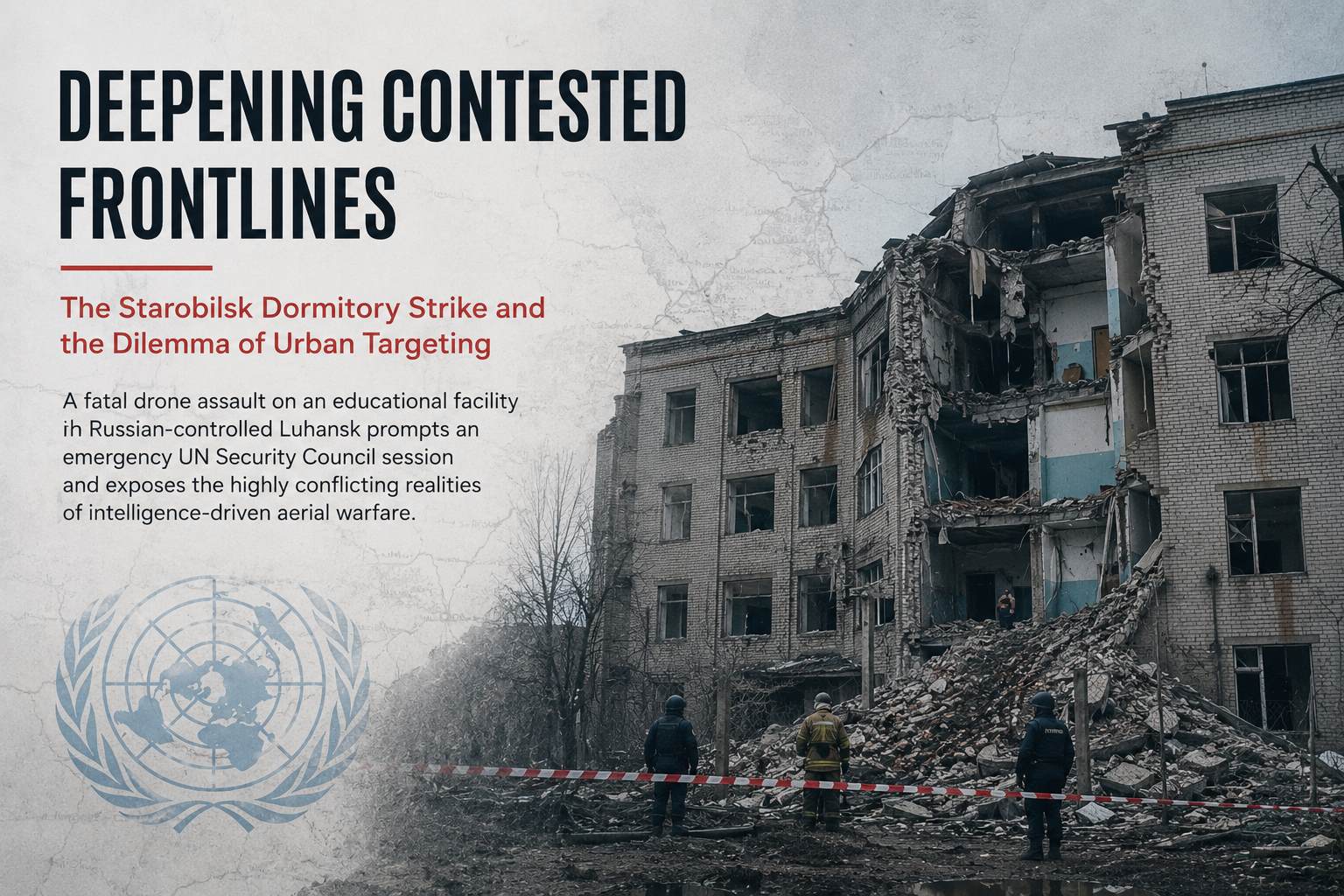
A fatal drone assault on an educational facility in Russian-controlled Luhansk prompts an emergency UN Security Council session and exposes the highly conflicting realities of intelligence-driven aerial warfare.
Publication Date: May 25, 2026
Last Updated: May 25, 2026
Byline: Global War News Editorial
The Core Event
A multi-wave drone bombardment targeting a student dormitory and associated educational buildings in the Russian-occupied city of Starobilsk, located within the eastern Luhansk region, has caused significant casualties and intensified the diplomatic standoff regarding urban targeting rules. The strike, which occurred during the late night and early morning hours of May 21 and 22, 2026, hit the residential quarters belonging to the Starobilsk College of Luhansk Pedagogical University.
According to final updates issued by the Russian Emergency Situations Ministry (EMERCOM) on Sunday, May 24, search and rescue operations at the site have concluded, with a total of 21 fatalities identified and 42 individuals documented as injured. Russian state media and regional Moscow-installed administrators reported that the structural impact completely destroyed the upper three stories of the five-story vocational housing complex, trapping dozens of residents beneath layers of concrete.
The Armed Forces of Ukraine acknowledged carrying out extensive long-range aerial operations over the weekend but strongly denied intentionally targeting non-combatants or purely civic structures. The General Staff of Ukraine issued a formal statement clarifying that its military assets exclusively target facilities utilized by the Russian military apparatus. This baseline rejection of the civilian designation has fueled a major dispute between Kyiv and Moscow regarding the precise nature and operational use of the building at the time of the impact.
Technical Context and Tactical Background
The strike on Starobilsk, a city captured by Russian forces during the opening months of the 2022 offensive and situated approximately 65 kilometers behind the current active frontline, represents one of the most concentrated uncrewed aerial attacks in the eastern theater this season. Russian military investigators claimed that the operation was carried out in three distinct successive waves using a total of 16 “Fire Point” FP-1/2 one-way attack drones.
Russian investigators publicised images from the debris showing what they asserted were the components of a commercial Starlink Mini satellite terminal, alleging that the attacking platforms utilized specialized telemetry for precision guidance deep into controlled territory. Regional officials, including Russian Commissioner for Human Rights Yana Lantratova, stated that 86 teenagers between the ages of 14 and 18 were inside the building sleeping when the first wave impacted.
The tactical justifications and technical assessments delivered by both parties highlight the structural ambiguities of modern intelligence-led conflict:
- The Ukrainian Position: The Ukrainian General Staff maintained that its intelligence networks had identified the facility as an active operational base for an elite Russian military drone command and electronic surveillance unit. Ukrainian authorities stated that the building had been repurposed to house personnel directly overseeing frontline loitering munition operations, making it a legitimate tactical objective under the rules of war.
- The Russian Position: The Russian Foreign Ministry and the regional administrative head, Leonid Pasechnik, insisted that the site functioned purely as a vocational training college with no adjacent or integrated military installations. They characterized the deployment of repeated drone waves against a known student residence as a calculated act of terror designed to inflict maximum psychological panic among the local populace.
Historical Context of Repurposed Infrastructure
The debate surrounding the Starobilsk college strike highlights a recurring structural dilemma observed throughout the four years of active warfare in Ukraine. The repurposing of educational institutions, dormitories, and civic centers for military quartering or tactical storage has been a documented characteristic of both defensive and offensive operations on both sides of the frontline.
For occupying forces holding territory far from active artillery lines, vocational schools and large public hostels provide ready-made logistical hubs equipped with independent heating, large dining facilities, and solid concrete construction capable of shielding personnel from baseline surveillance. However, under the Geneva Conventions, the militarization of a civilian asset effectively strips that structure of its protected legal status, rendering it vulnerable to long-range missile and drone interception.
When intelligence sources identify such locations as operational military assets, the attacking force faces the strict legal requirement of proportionality. International legal frameworks dictate that the anticipated concrete military advantage gained from neutralizing an enemy unit must clearly outweigh the projected risk of collateral damage to any remaining non-combatants in the vicinity. Because independent international verification agencies lack physical access to Russian-controlled zones within Luhansk, establishing whether appropriate precautions were taken before launching the Fire Point drones remains a persistent challenge for global monitors.
International Diplomatic Reactions
The humanitarian severity of the casualties prompted immediate diplomatic escalation. At the direct request of the Russian Federation, the United Nations Security Council convened an emergency session in New York on Friday, May 22, 2026, to formally debate the legality of the operation.
During the session, Russian Permanent Representative Vassily Nebenzia labeled the drone strikes a clear war crime and accused Western nations of complicity by providing technological infrastructure that enables precision tracking behind Russian lines. In response, Ukrainian diplomat Andrii Melnyk rejected the accusations, framing Moscow’s public outrage as an organized propaganda maneuver intended to shield its own ongoing aerial campaigns against Ukrainian population centers.
Simultaneously, international humanitarian officials expressed deep concern over the overall trajectory of the air war. Ted Chaiban, Deputy Executive Director of UNICEF, noted that the incident serves as another example of children and young adults bearing the direct physical cost of a conflict they did not create. The United Nations relief coordination office (OCHA), represented by Director of Operations Edem Wosornu, reminded the Council that the unfolding situation emphasizes a systemic pattern of infrastructure destruction that challenges international humanitarian standards, calling for absolute transparency and civilian protection from all combatants.
Economic and Strategic Implications
The strategic fallout from the Starobilsk strike was felt almost immediately across the wider conflict zone. Within 48 hours of the dormitory collapse, Russian President Vladimir Putin publicly directed the Ministry of Defence to prepare explicit retaliatory options, stating that the attack would not go unanswered. This directive culminated on Sunday, May 24, in one of the largest combined Russian missile and drone bombardments of the war, targeting the capital city of Kyiv and adjacent regional hubs with approximately 600 drones and 90 missiles, including the deployment of the new hypersonic “Oreshnik” intermediate-range ballistic system.
The continuous cycle of long-range strikes is severely impacting the local economic stability of deep-rear logistics hubs like Starobilsk. Once operating as a local center for agricultural trade and regional education, the city’s remaining civilian commercial operations face acute labor flight and heightened security restrictions. The physical destruction of educational infrastructure further cuts access to specialized technical training for local youth, entrenching long-term demographic and economic stagnation across the occupied eastern oblasts.
What to Watch
As the tactical environment responds to this latest flashpoint, observers are focused on three core indicators:
- Target Verification Protocols: Whether Western intelligence providers implement tighter software restrictions or geo-fencing controls on commercial communication terminals to prevent their integration into long-range strike platforms.
- Rear-Echelon Relocation Patterns: The extent to which Russian military commanders alter their quartering practices by moving command units out of civic structures in occupied towns to minimize vulnerabilities to localized intelligence leaks.
- The Scope of Retaliatory Cycles: Whether the introduction of advanced weapon systems like the Oreshnik missile marks a permanent escalation in the targeting of civilian utility and administrative infrastructure across western Ukraine.
Source Disclosure Note: The documentation within this report relies on official data from the Russian Emergency Situations Ministry (EMERCOM), statements by the General Staff of the Armed Forces of Ukraine, and transcripts from the United Nations Security Council emergency session. Ground descriptions, visual records, and regional casualty tracking are derived from verified coverage by Reuters, the Associated Press, Agence France-Presse, Sky News, and the independent research agency Meduza.
This article is based on publicly available reporting from named international news agencies and attributed official statements. All claims about ongoing events are attributed to their original sources. Analysis sections represent the editorial interpretation of reported facts and do not constitute advocacy for any party to the described conflict. AI tools may be utilized for image generation to assist in explaining complex concepts, as well as for refining grammar, spelling, and other linguistic enhancements. However, all original content is produced, fact-checked, and revised by the editorial team. This publication does not take political positions on active military conflicts.