
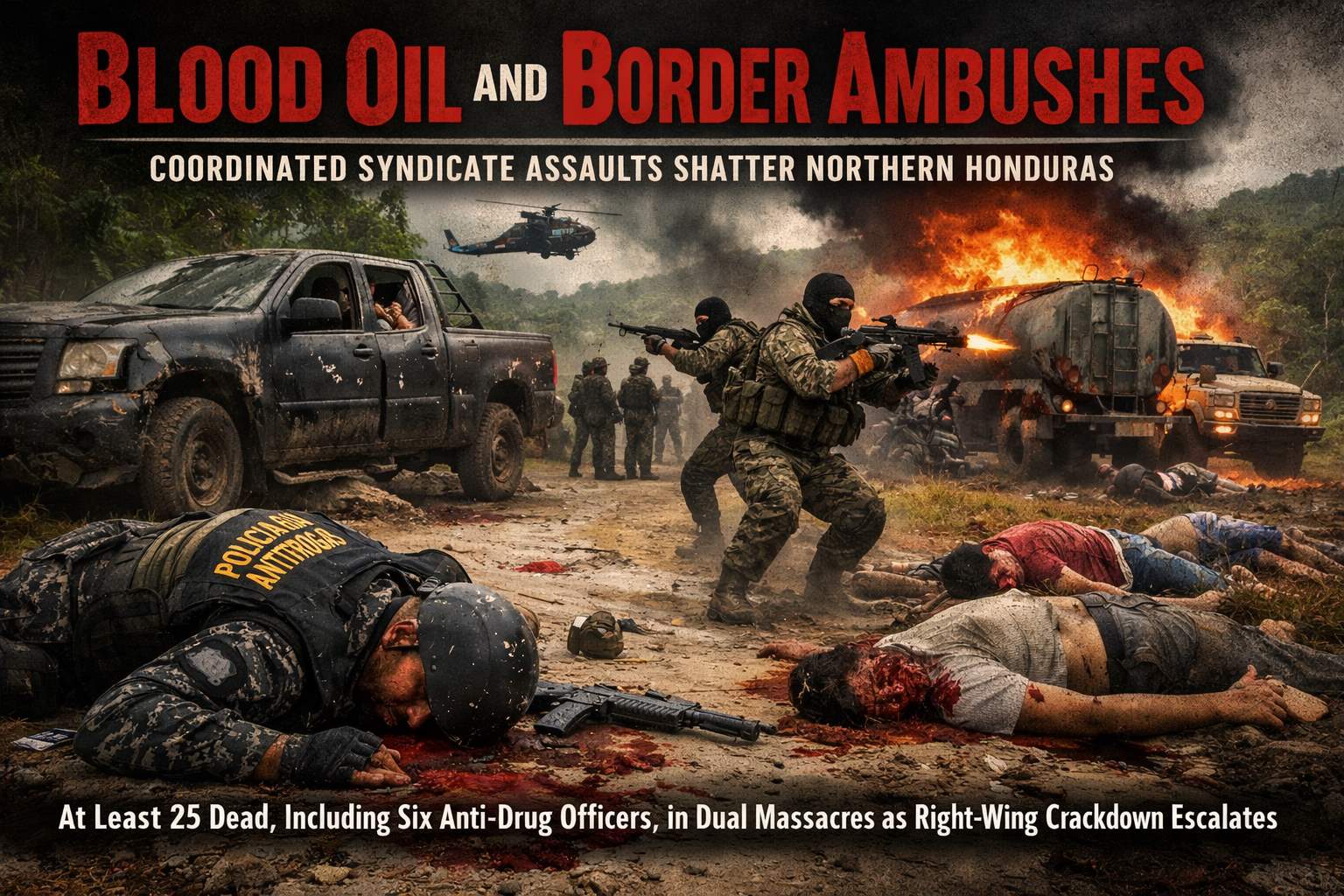
At least 25 fatalities, including six anti-drug officers, recorded in dual massacres as right-wing administration pushes aggressive military-led security reforms.
Publication Date: May 25, 2026
Last Updated: May 25, 2026
Byline: Global War News Editorial
The Core Event
Coordinated armed operations across northern Honduras on Thursday, May 21, 2026, resulted in the deaths of at least 25 people, demonstrating a stark escalation in violence as the national government moves to implement a sweeping military-backed anti-gang crackdown. According to statements released by the Honduran National Police and the Public Prosecutor’s Office, the casualties occurred across two distinct geographic sectors, targeting both private plantation workers and state security personnel.
The deadliest encounter took place at dawn in the northern municipality of Trujillo, situated within the Colon department. Yuri Mora, a spokesperson for the Public Prosecutor’s Office, confirmed to regional media that gunmen armed with high-caliber rifles raided an active African palm plantation, executing 19 individuals. Hours later, a secondary assault occurred in the western municipality of Omoa, located in the Cortes department near the Guatemalan border. National Police spokesperson Edgardo Barahona reported that an anti-drug squad traveling from the capital city of Tegucigalpa was ambushed by alleged traffickers, resulting in the deaths of six police officers, including a senior commander.
Honduran Security Minister Gerzon Velasquez described the aftermath at the Trujillo plantation as a chaotic scene, with victims executed indiscriminately in open fields. In response to the dual massacres, the Ministry of Security issued an official directive deploying joint military and police units to enforce immediate, direct territorial interventions in the affected northern and western departments.
Technical Context and Tactical Background
The structural nature of the violence highlights a deep convergence between localized agrarian disputes and transnational narcotics distribution corridors. The Trujillo massacre developed near the Aguan River Valley, an area long identified by international monitors as a highly volatile sector where rival factions contend for control of resource-rich lands. Trujillo police chief Carlos Rojas stated to local media that organized criminal networks have systematically occupied and illegally exploited large-scale African palm plantations, utilizing profits generated from palm oil extraction to purchase advanced weaponry and fund territorial operations.
The tactical execution of the attacks suggests an advanced level of planning and operational capacity among the non-state armed groups:
- High-Caliber Weapons Systems: Investigators recovered ballistic evidence indicating the extensive use of military-grade automatic rifles and shotguns, platforms that easily overmatched the baseline security protocols of the rural agricultural installations.
- Ambush Coordination: The secondary assault in Omoa targeted an elite anti-gang mission. The ability of the attackers to anticipate the transit routes of state forces near the Guatemalan border indicates an active intelligence network capable of tracking law enforcement movements in real time.
- Logistical Ambiguity: Determining the precise casualty breakdown in Trujillo was initially complicated by the fast-moving security environment, as local families removed the bodies of their relatives from the fields before forensic teams could establish proper cordons.
The escalations coincide with an aggressive political shift in the Central American nation. Following the inauguration of conservative President Nasry “Tito” Asfura, who formally ended a long-standing state of emergency to implement a more centralized approach, the Honduran national legislature approved extensive security reforms. These new measures formally authorize the armed forces to assume public security duties, establish a specialized anti-organized crime command, and introduce legal provisions to categorize drug cartels and street gangs as terrorist organizations.
The Socio-Economic and Agricultural Dynamic
The immediate humanitarian consequence of the palm oil conflict has been the destabilization of rural communities. Local agricultural union leaders, speaking to Agence France-Presse on condition of anonymity, reported that constant threats from armed syndicates have trapped local populations in a cycle of fear, forcing families to abandon rural dwellings adjacent to major plantation sectors.
The economic implications of the Trujillo attack directly threaten Honduras’s agricultural supply chain. Palm oil ranks as one of the country’s primary agricultural export commodities, generating vital foreign exchange reserves. The Aguan River Valley land conflict has pitted rural cooperative movements against transnational agribusiness corporations. Local smallholder collectives frequently accuse large-scale corporate entities of maintaining informal ties with private armed groups to enforce illegal land occupations and suppress labor movements.
According to documentation compiled by Reuters, the long-standing agrarian dispute has resulted in the death or disappearance of more than 150 individuals over the past decade, turning the northern coast into an exceptionally hazardous environment for environmental campaigners and agrarian reform advocates. The destruction of plantation safety frameworks threatens to stall harvest schedules, decrease national processing volumes, and disrupt regional transport routes into neighbouring Central American markets.
Diplomatic and Geopolitical Implications
The violence has quickly drawn international focus to the security policies of the newly installed Asfura administration, which has aligned its security goals with regional hardline strategies. President Asfura has publicly pledged to coordinate closely with United States President Donald Trump to implement rigorous border security and anti-narcotics campaigns across Latin America.
However, human rights organizations have voiced caution regarding the administration’s reliance on military deployment for domestic policing. Analysts note that while a militarized response can offer temporary territorial control, it often correlates with an increase in civil liberties violations. In a formal statement, regional monitors emphasized that classifying criminal syndicates as terrorist entities may broaden state surveillance and detention powers without addressing the root issues of rural land inequality and judicial impunity.
Concurrently, the ambush near Omoa underscores the cross-border challenges facing Central American security forces. The proximity of the attack to the Guatemalan border highlights the fluid movement of contraband and arms through blind points along the frontier, necessitating closer bilateral intelligence cooperation between Tegucigalpa and Guatemala City to disrupt transnational supply chains.
Financial Countermeasures and Infrastructure Cost
Managing the expanding security crisis imposes a notable fiscal burden on the Honduran state. The current administration’s legislative reforms require substantial budget reallocations to fund the newly established anti-organized crime units and sustain prolonged military deployments along the northern coast.
These expenditures come at a time when Honduras faces a baseline homicide rate of 24 killings per 100,000 inhabitants. Diversion of public funds toward kinetic security operations leaves fewer resources for rural development, judicial reform, and witness protection programs. Furthermore, international logistics firms operating in the Cortes department have reported rising security premiums for freight transit, an added operational cost that risks undermining the competitiveness of Honduran exports amid broader global inflationary pressures.
What to Watch
As state forces deploy into the northern departments, observers are monitoring three critical indicators:
- Military Intervention Outcomes: The operational effectiveness of the joint military-police task forces in dismantling the armed networks occupying the African palm plantations in Colon.
- Terrorist Designation Impacts: How the legal reclassification of gangs and drug cartels as terrorist organizations alters detention protocols and judicial proceedings for arrested suspects.
- Bilateral Security Cooperations: The extent to which Washington provides material or intelligence assistance to the Asfura administration’s newly formed anti-organized crime command.
Source Disclosure Note: The information contained in this report is synthesized from official press releases issued by the Honduran Ministry of Security and the National Police. Field details, geographic data, and casualty counts are compiled from verified coverage by the Associated Press, Agence France-Presse, Reuters, and Al Jazeera. Contextual data on regional homicide rates originates from statistics published by the Honduran Public Prosecutor’s Office.
This article is based on publicly available reporting from named international news agencies and attributed official statements. All claims about ongoing events are attributed to their original sources. Analysis sections represent the editorial interpretation of reported facts and do not constitute advocacy for any party to the described conflict. AI tools may be utilized for image generation to assist in explaining complex concepts, as well as for refining grammar, spelling, and other linguistic enhancements. However, all original content is produced, fact-checked, and revised by the editorial team. This publication does not take political positions on active military conflicts.