
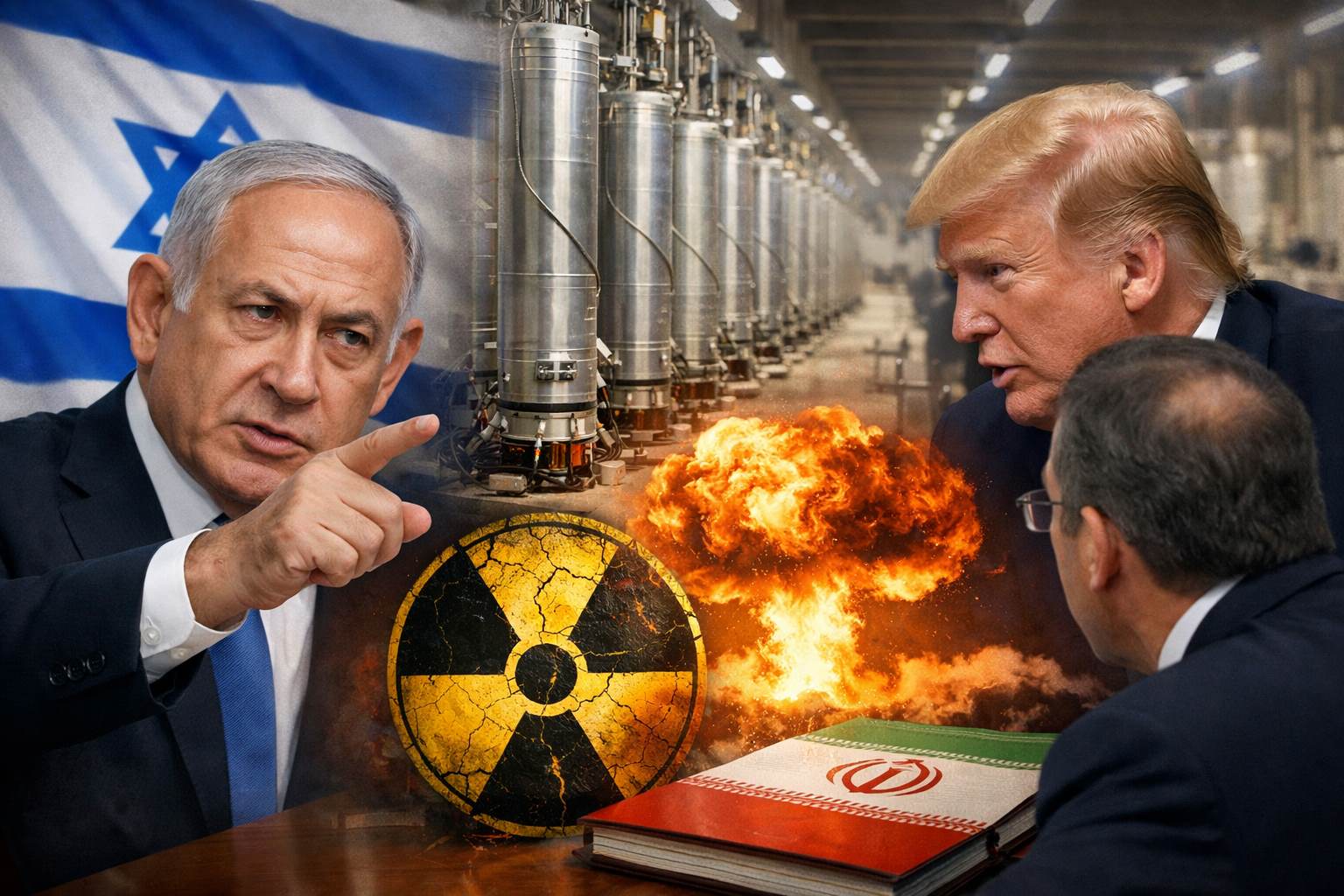
Israeli leadership insists on dismantling enrichment facilities, while the US administration signals a temporary memorandum of understanding is close to completion.
Publication Date: May 25, 2026
Byline: Global War News Editorial
Israeli Prime Minister Benjamin Netanyahu and US President Donald Trump held a high-stakes telephone call regarding an emerging multilateral agreement aimed at permanently ending the direct conflict with Iran and reopening the Strait of Hormuz. Following the discussion, the Israeli government publicly declared that any final pact must completely dismantle Tehran’s nuclear infrastructure.
According to statements published on the Israeli Prime Minister’s official Telegram channel, Netanyahu emphasized that a final agreement requires the complete removal of all enriched nuclear material from Iranian territory alongside the total decommissioning of its enrichment facilities. The diplomatic friction highlights growing strategic differences between Washington’s immediate economic goals and Jerusalem’s regional security red lines.
The conversation follows an announcement by President Trump on his Truth Social account stating that an agreement to halt hostilities and lift the naval blockade of the Strait of Hormuz has been “largely negotiated” and could be announced shortly.
The Terms of the Emerging Memorandum
The potential framework, mediated partly by regional partners and Pakistan, seeks to resolve the military crisis that escalated following the outbreak of direct hostilities earlier this year. According to regional officials speaking to the Associated Press on the condition of anonymity, the emerging memorandum of understanding operates on a dual-timeline structure:
- 30-Day Maritime Phase: The Strait of Hormuz would be demined and gradually reopened to commercial traffic, returning shipping volumes to pre-war levels. Concurrently, the US would ease its naval blockade, offering sanctions waivers for Iranian oil and petrochemical products.
- 60-Day Nuclear Negotiation Window: Over a two-month period, bilateral talks would focus on the long-term status of Iran’s nuclear capabilities. Regional sources report that Iran would initially agree to hand over or dilute its current stockpile of highly enriched uranium, with Russia offering to receive the transferred material.
However, US officials have urged caution regarding the timing of a final signature. A senior US administration official briefed reporters that negotiations remain fluid, noting that President Trump has instructed American representatives “not to rush” the process.
Divergent Demands: Washington and Jerusalem
The public communications issued by Washington and Jerusalem indicate distinct priorities in their respective approaches to Tehran. While the US administration focuses heavily on restoring maritime security and stabilizing global energy markets, the Israeli political establishment views the current framework with visible skepticism.
An Israeli official, speaking on the condition of anonymity, stated that President Trump reassured Netanyahu he would stand firm on preventing a nuclear-armed Iran. However, the exact mechanisms of enforcement remain a primary point of contention.
Furthermore, prominent Israeli political figures, including former war cabinet member Benny Gantz, have publicly warned that accepting a broad ceasefire could constitute a strategic mistake for Israel, particularly concerning its northern front.
Beyond the nuclear file, Israel has insisted on maintaining complete “freedom of action” to strike targets in Lebanon against Hezbollah, irrespective of any broader Washington-Tehran accord. While Israeli sources claim Trump backed this defensive caveat, Iranian state-affiliated media channels, including the Tasnim news agency, maintain that a comprehensive truce must halt hostilities on all fronts, including Lebanon.
Analysis: The Diplomatic Abyss Facing Netanyahu
Observers note that the current diplomatic trajectory places Prime Minister Netanyahu in a complex political position at home and abroad ahead of the Israeli legislative elections scheduled for late October. For over a year, the Israeli government has messaged its public on the necessity of achieving a decisive victory over regional proxies and neutralizing Iran’s long-range strategic threats.
The emerging reality of a negotiated settlement that leaves the political structure in Tehran intact presents what some regional analysts describe as a widening gap between official promises and diplomatic constraints. If the United States proceeds with conditional sanctions relief and unfreezes portions of Iranian assets held overseas in exchange for a temporary enrichment pause, Israel may find itself increasingly isolated in its pursuit of a broader military solution.
Furthermore, domestic pressures within the United States are heavily influencing the administration’s push for a resolution. The effective closure of the Strait of Hormuz since February has disrupted global logistics and driven up energy prices, directly impacting American consumer sentiment. Observers suggest the White House is prioritizing the normalization of international shipping corridors over an extended, unpredictable military campaign in western Asia.
Consequently, Netanyahu’s public insistence on total disarmament serves as an explicit effort to anchor the impending 60-day nuclear talks to strict parameters, even as Washington signals a willingness to accept phased concessions.
What to Watch
The implementation of the proposed memorandum faces several immediate indicators of success or failure:
- The First Phase Implementation: Whether shipping lines receive verified security guarantees to resume transits through the Strait of Hormuz within the next 30 days.
- Financial Release Mechanisms: The reaction of the US Congress to any executive actions unfreezing Iranian assets, a move already drawing sharp criticism from hardline lawmakers in Washington.
- Northern Front Cross-Border Activity: Whether the Israel Defense Forces sustain targeted strikes inside Lebanon, and if such actions prompt Iran to pause its participation in the broader framework.
Source Disclosure Note: This report relies on official public statements from Israeli Prime Minister Benjamin Netanyahu and US President Donald Trump. Sourced factual details regarding the negotiations are drawn from reporting by the Associated Press, Reuters, the Financial Times, and the Iranian state-affiliated Tasnim news agency.
This article is based on publicly available reporting from named international news agencies and attributed official statements. All claims about ongoing events are attributed to their original sources. Analysis sections represent the editorial interpretation of reported facts and do not constitute advocacy for any party to the described conflict. AI tools may be utilized for image generation to assist in explaining complex concepts, as well as for refining grammar, spelling, and other linguistic enhancements. However, all original content is produced, fact-checked, and revised by the editorial team. This publication does not take political positions on active military conflicts.