
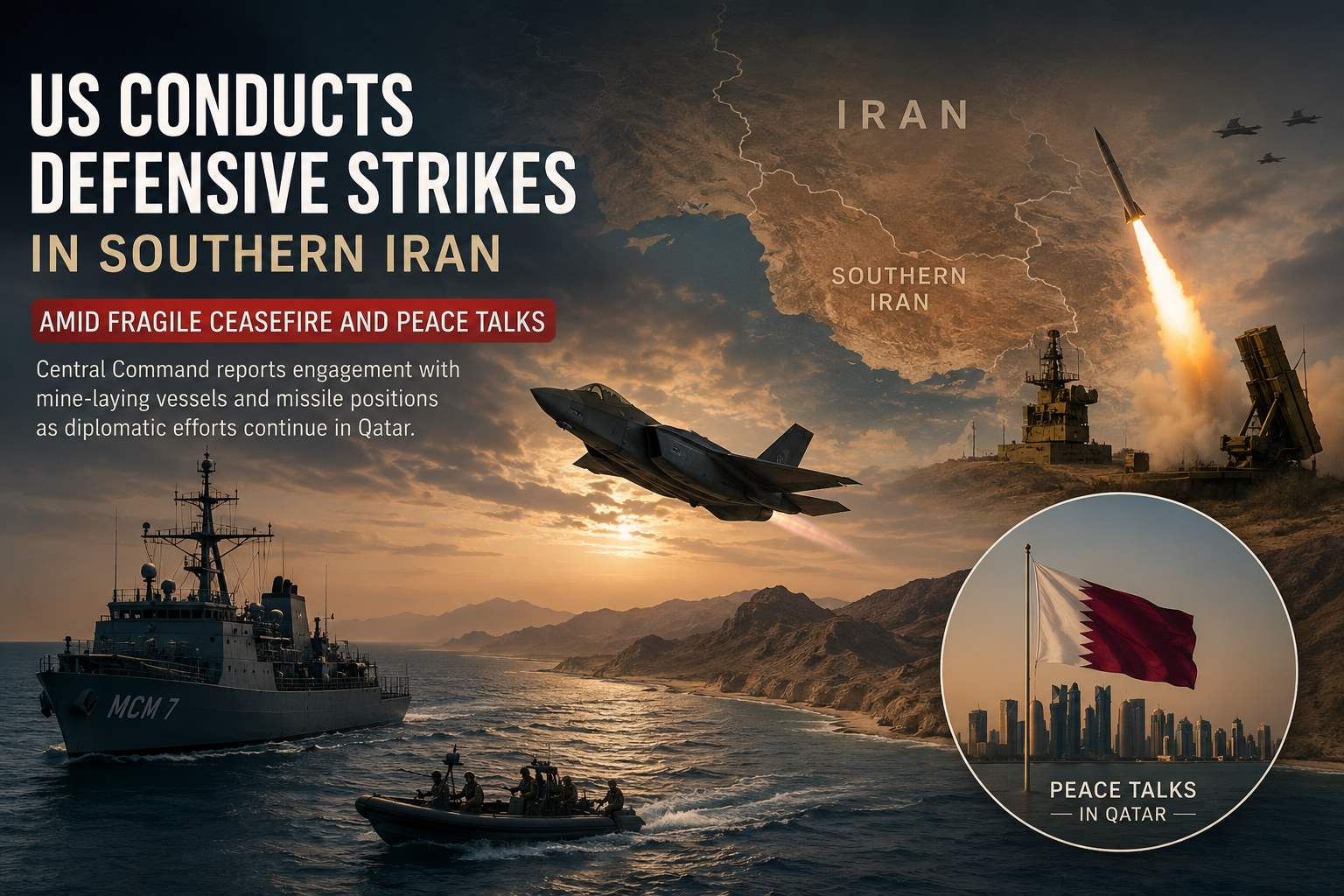
Central Command reports engagement with mine-laying vessels and missile positions as diplomatic efforts continue in Qatar.
Publication Date: May 26, 2026
Byline: Global War News Editorial
The United States military conducted a series of targeted military actions in southern Iran on Monday, focusing on what it described as imminent maritime and aerial threats. The operation occurred against the backdrop of a seven-week-old ceasefire agreement and ongoing high-level diplomatic talks in Qatar aimed at establishing a permanent framework to end the regional war.
According to an official statement issued on Monday by Navy Captain Tim Hawkins, spokesperson for US Central Command (CENTCOM), the operations were defensive maneuvers intended to protect American personnel from active threats. The strikes specifically targeted positions near the Strait of Hormuz, a critical global shipping corridor where regional tensions have repeatedly disrupted commercial traffic.
The Maritime and Aerial Engagements
According to statements provided by US defense officials, the military intervention involved two separate operational responses in the southern coastal region of Iran.
The first engagement involved surface vessels in the Strait of Hormuz. A senior US official stated that military intelligence identified two Iranian vessels belonging to the Islamic Republic Guard Corps (IRGC) attempting to deploy naval mines in the shipping lanes. US forces engaged and eliminated both watercraft.
The second action took place near Bandar Abbas, a strategic port city that hosts both a major military harbor and a dual-use airport. According to US military sources, a surface-to-air missile (SAM) site targeted US warplanes operating in the area. In response, American aircraft launched retaliatory strikes to eliminate the threat.
Local Iranian media outlets, including the state-backed news agency Mehr, reported that explosions were heard throughout Monday evening near Bandar Abbas and the coastal town of Sirik. Mehr later described the local situation as fully under control. The Iranian news website Tabnak, which is reportedly associated with former Revolutionary Guard leadership, reported that four Guard members were killed during the encounters at sea.
High-Stakes Diplomacy Continues
Despite the direct military engagement, both Washington and Tehran indicated that diplomatic negotiations remain active. US Central Command emphasized that the defensive actions do not signal an end to the existing truce, noting that the military continues to execute its defense mandates while exercising restraint under the current ceasefire guidelines.
On the diplomatic front, US President Donald Trump commented on the situation via social media on Monday morning, stating that discussions with Iranian representatives were moving forward constructively. However, the President added a warning that any final agreement must be mutually advantageous, noting that a failure in talks could result in a resumption of larger-scale military operations.
Concurrently, a high-level Iranian delegation arrived in Qatar to pursue a negotiated framework. The delegation includes Mohammad Bagher Ghalibaf, the speaker of Iran’s parliament, alongside Foreign Minister Abbas Araghchi and Central Bank Governor Abdolnaser Hemmati. Regional observers suggest the presence of Iran’s top central banker indicates that the unfreezing of sanctioned financial assets remains a central talking point for Tehran.
Regional Friction Points and the Abraham Accords
Significant policy differences continue to complicate the path toward a comprehensive peace agreement. President Trump publicly indicated on Monday that Washington seeks a broader diplomatic restructuring, suggesting that a final agreement should require additional regional nations, such as Saudi Arabia and Pakistan, to join the Abraham Accords. These accords are security and normalization agreements established during Trump’s first presidential term.
Tehran has expressed resistance to these parameters. On Tuesday, Iranian state television carried a written statement from Iran’s Supreme Leader, Ayatollah Mojtaba Khamenei, asserting that regional powers would no longer serve as a buffer for Western military installations. Furthermore, Iranian parliament spokesperson Ebrahim Rezaei stated on social media that threats would not force concessions, noting that further instability would lead to higher commercial energy prices globally.
The negotiation track is further strained by separate, escalating actions in nearby theaters. On Monday, Israeli Prime Minister Benjamin Netanyahu announced an intensification of military operations targeting Hezbollah positions in Lebanon, ordering forces to accelerate their offensive despite parallel international stabilization efforts.
Broader Economic Repercussions
The persistence of military friction in the Strait of Hormuz continues to generate economic volatility across international markets, particularly for developing economies reliant on energy imports.
In a notable development on Tuesday, the Central Bank of Sri Lanka implemented an unexpected 100-basis-point increase to its benchmark policy rate. According to official statements from the monetary authority, the outsized rate hike was a pre-emptive measure to combat domestic inflation and stabilize currency pressures resulting directly from rising global energy costs linked to the ongoing West Asian crisis.
Source Disclosure Note: This explainer relies on official public statements issued by US Central Command and the White House. Regional updates and diplomatic developments are drawn from reporting by Reuters, the Associated Press, Agence France-Presse, NPR, and the BBC. Regional perspectives were sourced from the Tasnim, Mehr, and Tabnak news agencies in Iran, as well as the Central Bank of Sri Lanka.
This article is based on publicly available reporting from named international news agencies and attributed official statements. All claims about ongoing events are attributed to their original sources. Analysis sections represent the editorial interpretation of reported facts and do not constitute advocacy for any party to the described conflict. AI tools may be utilized for image generation to assist in explaining complex concepts, as well as for refining grammar, spelling, and other linguistic enhancements. However, all original content is produced, fact-checked, and revised by the editorial team. This publication does not take political positions on active military conflicts.