
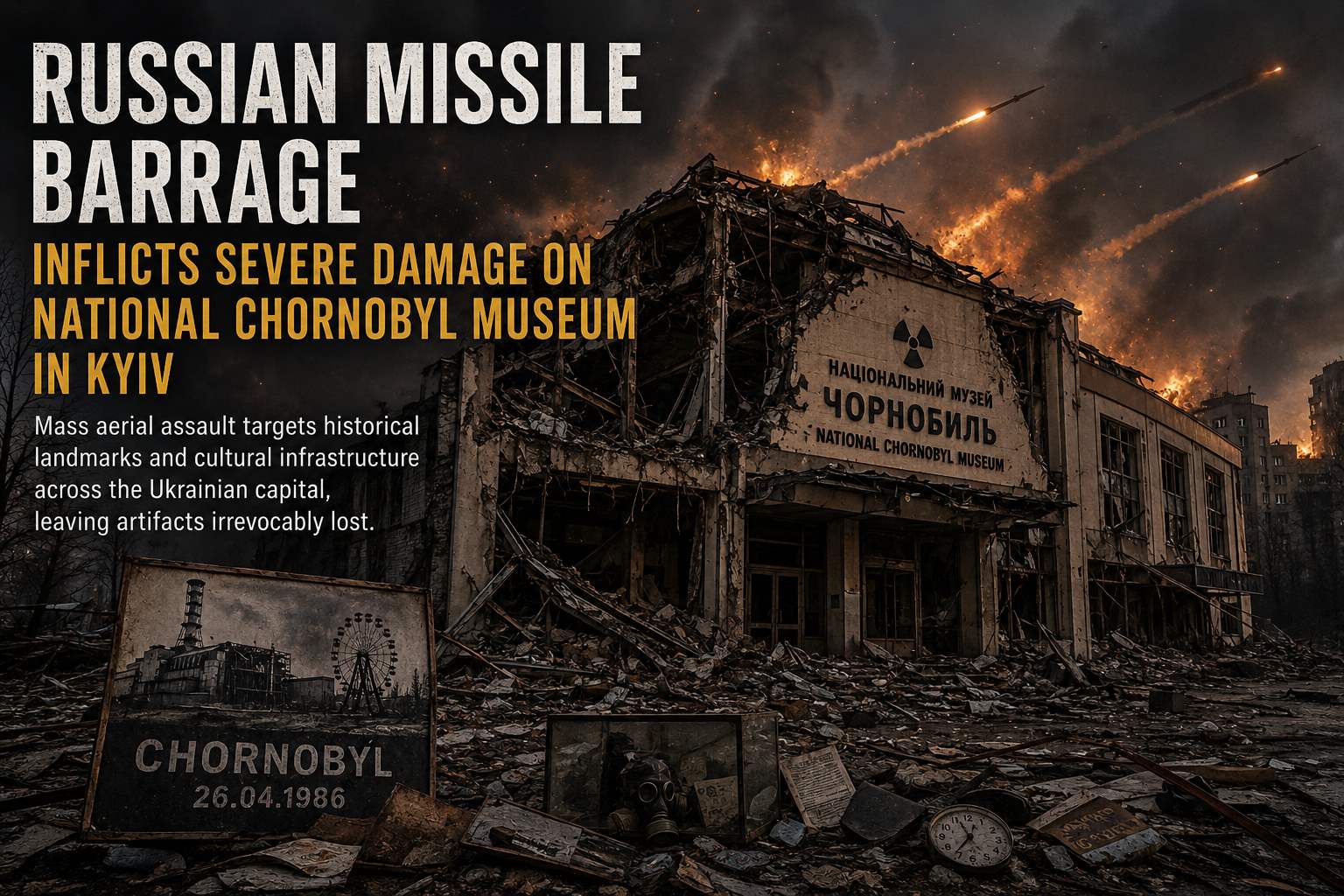
Mass aerial assault targets historical landmarks and cultural infrastructure across the Ukrainian capital, leaving artifacts irrevocably lost.
Publication Date: May 26, 2026
Byline: Global War News Editorial
A massive overnight missile and drone attack launched by Russian forces against Kyiv over the weekend has severely damaged several of Ukraine’s most prominent cultural and historical institutions. Among the hardest-hit sites is the National Chornobyl Museum, located in the historic Podil district, where local officials report that a significant portion of the permanent collection has been permanently lost.
According to statements released by the Ministry of Culture of Ukraine and local emergency services on Monday, the strikes occurred in the early hours of Sunday, May 24. The aerial bombardment affected multiple neighborhoods across the capital, resulting in civilian casualties and widespread infrastructure damage, while bringing the preservation of Ukraine’s cultural heritage back to the forefront of the conflict.
The Destruction at Podil and the Museum Inventory
The strike on the National Chornobyl Museum caused extensive structural failure to the early 20th-century building, which originally served as a fire station before being converted into a history museum in 1992.
According to a video report and statement by Yaroslav Yemelyanenko, head of the Association of Chornobyl Operators, two missiles traversed the airspace near the Saint Sophia Cathedral before one struck the Podil neighborhood. The impact triggered a large-scale fire that compromised the building’s roof and caused the upper flooring to collapse.
Museum Director Vitalina Martynovska told Reuters that no single room within the facility escaped undamaged. The third floor sustained a near-total collapse, with ceilings cave-ins impacting the second-floor exhibition spaces below.
The Ukrainian Interior Ministry reported on Monday morning that approximately 40% of the artifacts on display during the attack were irrevocably lost. The destroyed inventory included historical testimonies, documentation, and unique items belonging to the liquidators, the emergency personnel who responded to the 1986 nuclear disaster.
Despite the destruction, coordinated recovery efforts by emergency responders and museum staff managed to salvage several highly significant assets from the debris. Among the rescued items were a painting by the renowned Ukrainian folk artist Maria Prymachenko and the specific Ukrainian flag that had been raised at the Chornobyl Nuclear Power Plant following the withdrawal of Russian forces from the site in 2022.
Widespread Cultural Infrastructure Impact
The weekend bombardment represented what Ukrainian Minister of Culture Tetiana Berezhna described as the largest concentrated series of damages inflicted upon the capital’s cultural framework since the onset of the full-scale conflict.
Beyond the Podil district, blast waves and debris caused varying degrees of structural damage to multiple landmarks, including:
- The National Art Museum of Ukraine: Located near the government quarter, the building sustained shattered windows and doors blown off hinges, though officials confirmed its 40,000-piece collection remained unharmed.
- The Kyiv Mala Opera and Taras Shevchenko Institute of Literature: Wrecked book depositories, administrative departments, and internal library facilities were recorded.
- Government Headquarters: Minor structural and window damage affected the Cabinet of Ministers building and the Foreign Ministry, marking the first time the historic 1939 Foreign Ministry building sustained damage since World War II.
Ukrainian President Volodymyr Zelensky and Interior Minister Ihor Klymenko toured the ruined Chornobyl Museum site on Sunday morning. Klymenko publicly characterized the strike as a deliberate assault on historical truth and memory. Conversely, the Russian Ministry of Defense maintained its standard operational position, stating that its long-range precision strikes exclusively target military objectives, command nodes, and supporting energy infrastructure.
Context: The Chornobyl Legacy and Recent Renovation
The timing of the destruction carries a distinct symbolic weight for the institution. The National Chornobyl Museum had officially reopened its doors to the public on April 27, 2026, following a comprehensive multi-year renovation process. These upgrades were intentionally finalized to mark the 40th anniversary of the 1986 Chornobyl nuclear disaster.
The museum’s primary mission has been to educate global visitors on the technical failures of the Reactor No. 4 accident, the subsequent environmental evacuation, and the long-term biological and societal ramifications of the fallout. It stands alongside institutions like the Hiroshima Peace Memorial Museum in Japan as one of the few globally recognized repositories entirely dedicated to the human cost of nuclear catastrophes.
Following the strike, administrators announced an indefinite closure of the facility while engineering teams assess whether the remaining walls of the architectural landmark can be safely shored up and preserved.
Human Toll and Broader Capital Assessment
While the damage to historical architecture has drawn widespread condemnation from international heritage organizations, the human toll of the weekend barrage remains the primary concern for local emergency services.
According to updated figures provided on Monday by Ukraine’s State Emergency Service (DSNS), the combined missile and drone operation resulted in at least four civilian deaths and left 87 individuals injured across Kyiv, including three minors. In the Shevchenkivskyi district, a direct hit destroyed the entrance section of a five-story residential building, where rescue workers spent hours clearing reinforced concrete debris to recover casualties.
Kyiv Mayor Vitali Klitschko reported that the shockwaves also damaged two public schools, a commercial shopping center, and approximately 30 residential buildings across the city’s districts, underscoring the broad geographical distribution of the weekend’s arrivals.
Source Disclosure Note: This explainer relies on official data and statements issued by the Ministry of Culture of Ukraine, the Ukrainian State Emergency Service (DSNS), and Kyiv municipal authorities. Regional updates and eyewitness accounts are drawn from reporting by Reuters, Agence France-Presse (AFP), Ukrinform, the Kyiv Independent, the Kyiv Post, and CBC News. Counter-statements regarding targeting policy originate from official briefings by the Ministry of Defense of the Russian Federation.
This article is based on publicly available reporting from named international news agencies and attributed official statements. All claims about ongoing events are attributed to their original sources. Analysis sections represent the editorial interpretation of reported facts and do not constitute advocacy for any party to the described conflict. AI tools may be utilized for image generation to assist in explaining complex concepts, as well as for refining grammar, spelling, and other linguistic enhancements. However, all original content is produced, fact-checked, and revised by the editorial team. This publication does not take political positions on active military conflicts.