
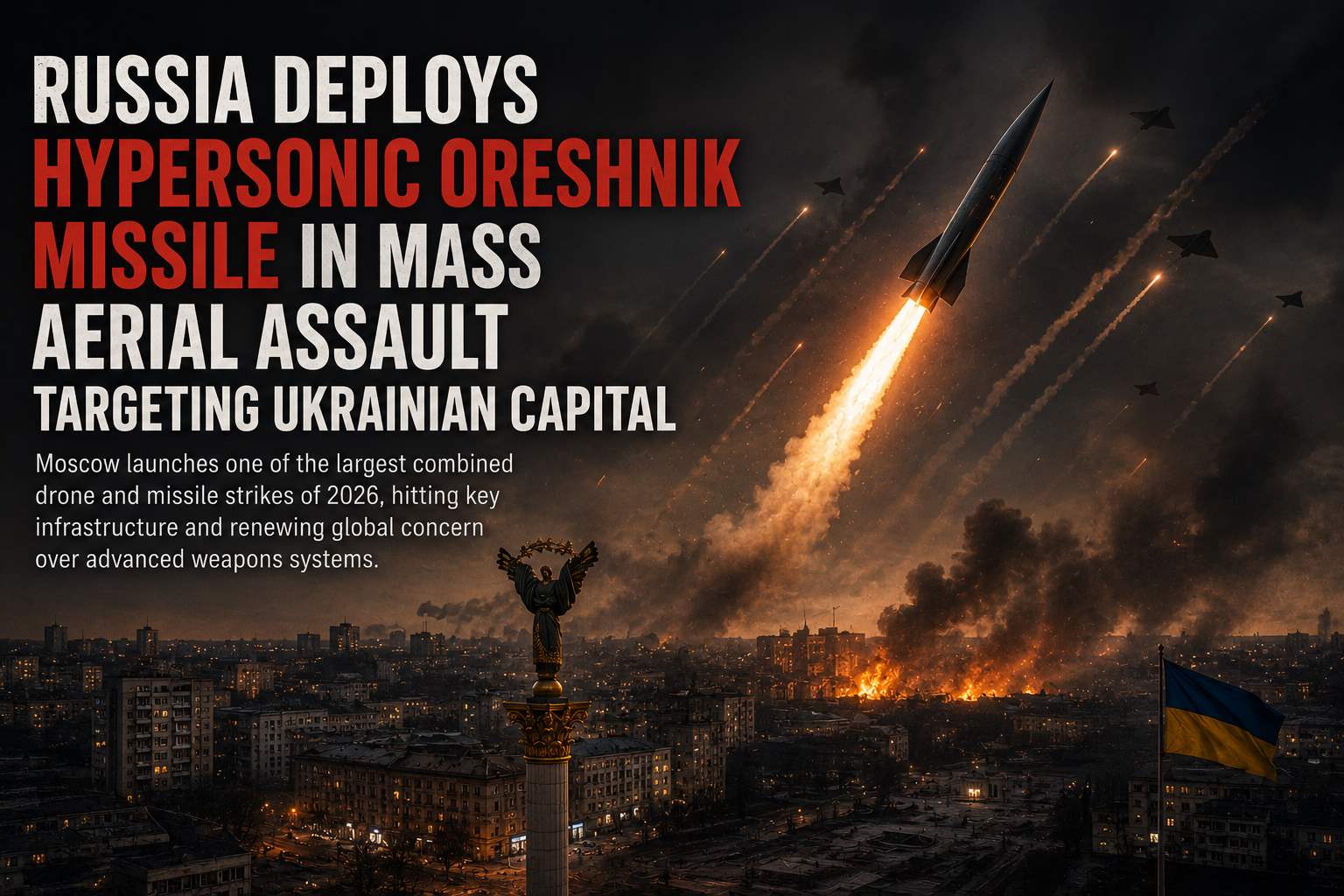
Moscow launches one of the largest combined drone and missile strikes of 2026, hitting key infrastructure and renewing global concern over advanced weapons systems.
Publication Date: May 26, 2026
Byline: Global War News Editorial
The war in Ukraine entered a technologically intense phase over the weekend as Russian forces launched a massive aerial bombardment against Kyiv, deploying the highly advanced, nuclear-capable Oreshnik hypersonic ballistic missile. The strikes resulted in widespread structural damage across every district of the capital, leaving a trail of civilian casualties and drawing sharp condemnation from international observers.
According to verified reports from international wire monitoring services and official statements from the Ukrainian Air Force on Sunday, May 24, 2026, the operation comprised approximately 600 drones and 90 missiles. The multi-wave assault targeted military infrastructure, command facilities, and energy nodes, but also caused significant damage to residential areas, public schools, and cultural landmarks, including the National Art Museum of Ukraine.
The Scale of the Barrage and the Oreshnik Deployment
The overnight operation stands as the largest single missile and drone strike recorded against the Ukrainian capital so far in 2026. According to figures published by the Ukrainian Air Force, air defense units successfully intercepted 549 drones and 55 missiles. However, at least 16 missiles and several dozen drones breached defenses, striking 54 distinct locations across the city.
The primary focus of international intelligence monitoring was the deployment of the Oreshnik, a multi-warhead, intermediate-range hypersonic ballistic missile. Ukrainian President Volodymyr Zelensky confirmed that an Oreshnik missile was directed toward Bila Tserkva, a city located roughly 64 kilometers south of Kyiv.
The Russian Ministry of Defense subsequently confirmed the operational use of the system. In a public statement, Russian officials asserted that the strikes were executed using a combination of Oreshnik, Iskander ballistic missiles, Kinzhal hypersonic air-launched missiles, and Zircon cruise missiles. Moscow maintained that the operation successfully neutralized designated military airbases, command installations, and production centers.
Technical Characteristics of the Weapon System
The engagement marks only the third reported combat deployment of the Oreshnik missile since its public unveiling by Russian President Vladimir Putin in late 2024. The system is believed by defense analysts to be derived from the previously shelved RS-26 Rubezh strategic missile program.
Military researchers from the S. Rajaratnam School of International Studies note that the Oreshnik carries unique operational advantages that present extreme difficulties for existing air defense systems:
- Terminal Velocity: The missile travels at speeds exceeding Mach 10, or roughly 12,000 kilometers per hour. This velocity drastically compresses the reaction window for tracking radars and ground-based interceptors to mere seconds.
- Payload Dispersal: The Oreshnik utilizing a Multiple Independently Targetable Re-entry Vehicle (MIRV) configuration. The platform carries six individual warheads, each equipped with six submunitions, allowing a single launch vehicle to deliver up to 36 separate kinetic strikes across a designated area footprint.
- Strategic Range: Classified as an intermediate-range ballistic missile (IRBM), the system possesses an operational envelope estimated between 3,500 and 5,000 kilometers, placing the entirety of continental Europe within its striking range.
Conflicting Rationales and Geopolitical Fallback
The timing of the strike follows weeks of heightened rhetorical and physical exchanges. The Russian government explicitly framed the mass bombardment as a severe retaliatory measure for recent Ukrainian military actions inside Russian-held territories. Specifically, Moscow pointed to a recent drone strike targeting an elite drone command center operating out of a student dormitory facility in occupied Starobilsk, located in the Luhansk region. Russian sources claimed that attack resulted in 21 fatalities, while Kyiv asserted it strictly targeted military personnel.
The deployment of the hypersonic weapon drew immediate responses from European capitals. French President Emmanuel Macron condemned the strike, characterizing the use of the Oreshnik as an index of a dangerous strategic impasse. European Union Foreign Policy Chief Kaja Kallas described the weapon’s integration into the bombing campaign as reckless nuclear brinkmanship, indicating that European foreign ministries would convene to discuss tightening international pressure on Moscow.
Humanitarian Impact and Infrastructure Damage
While defense ministries analyzed the strategic implications of the missile technology, local emergency services in Kyiv focused on the immediate human toll. According to updated figures provided by Kyiv Mayor Vitali Klitschko and regional emergency management teams, the overnight bombardment resulted in at least four civilian deaths and left approximately 100 individuals injured across the greater metropolitan area.
The kinetic impacts and falling debris caused substantial material destruction. In the capital’s Shevchenkivskyi district, a five-story residential apartment block sustained a partial structural collapse of its frontal entrance section, requiring rescue teams to work through the morning to clear concrete rubble. Additional damage was recorded at a major municipal water supply facility, a public market that caught fire and burned to the ground, and several primary schools. Shockwaves also blew out windows at the historic Ukrainian Foreign Ministry building near Independence Square.
Source Disclosure Note: This explainer relies on official briefings and data published by the Ukrainian Air Force, the State Emergency Service of Ukraine (DSNS), and the Ministry of Defense of the Russian Federation. Regional coverage, technical specifications, and international diplomatic statements were compiled from live wire monitoring and reports by Reuters, the Associated Press (AP), the BBC, The Guardian, and India Today Global.
This article is based on publicly available reporting from named international news agencies and attributed official statements. All claims about ongoing events are attributed to their original sources. Analysis sections represent the editorial interpretation of reported facts and do not constitute advocacy for any party to the described conflict. AI tools may be utilized for image generation to assist in explaining complex concepts, as well as for refining grammar, spelling, and other linguistic enhancements. However, all original content is produced, fact-checked, and revised by the editorial team. This publication does not take political positions on active military conflicts.